( 16th — 17th Century)
Question and answers for the chapter “The Mughal Empire” , Class — vii, subject — Social Science.
A. Very short answer type questions:
- Name the autobiography of Babu in which language it is written? Ans: the autobiography of Babur is called the Baburnama and it was written in chagatai turkic.
- Who defeated Humayun twice? Mention the places and years. Ans: Humayun was defeated twice by Sher ShahSuri.The first defeat was at the battle of Chausa in 1539, and the second was at the battle of Kanauj in 1540.
- Between whom and when was the battle of Haldighati caught? Ans: the Battle of Haldighati was fought between Maharana Pratap of Mewar and the forces of Akbar led by Mansingh I of Amber in 1576.
4. What is the meaning of Noor Jahan who was she
Ans: “Noor Jahan” means ” Light of the world” She was the wife of the Mughal emperor Jahangir originally named mehr-un-nisha.
5. The Mughals were descendants of Two Famous rulers
Ans: The Mughals were descendants of Genghis Khan from the maternal side and Tamerlane ( Taimur) from there paternal site.
B. Short answer type questions:
1. Write a short note on the raign of Sher Shah Suri.
Ans: Sher Shah Suri was an Afghan ruler who established the Sur Empire in North India after defeating the Mughal Emperor Humayun. Sher Shah Suri was known for administrative reforms, including a new tax system, building roads and enhancing trade. Hi policies influenced later Mughal rulers.
2. Describe the administrative changes introduced by Akbar
Ans: Akbar introduced several administrative reforms to strengthen his Empire. He implemented the mansabdari system to organise his army and bureaucracy established a centralized administration, and promoted religious tolerance called sulh-i-kul. His reforms laid the foundation a stable and prosperous Empire.
3. Write a short note on Noor Jahan.
Ans: Noor Jahan was the influential wife of Emperor Jahangir and one of the most powerful women in Mughal history, She effectively handled the administration and made important decisions on behalf of Jahangir. Known for her intelligence and political acumen, she influence the Mughal court and supported architecture poetry and art.
4. Describe the cultural contribution of Shah Jahan.
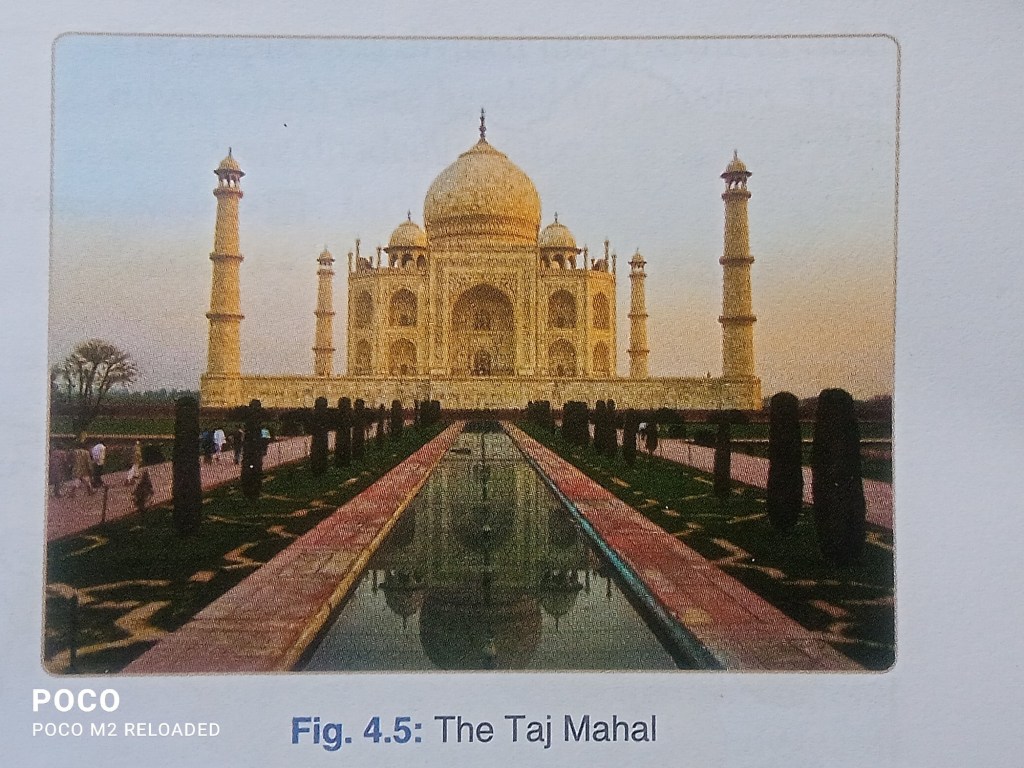
Ans: Shah Jahan is known for his significant contributions to Mughal architecture. His reign saw the construction of iconic structure like the Taj Mahal, The Red Fort, The Jama Masjid. His architectural achievements symbolised the Zenith of Mughal Art and culture.
5. Write a not on Aurangzeb in the battle in Deccan
Ans: Aurangzeb expanded the Mughal Empire into the Deccan region, defeating the Maratha ruler Shivaji’s successor and other southern kingdoms. Although he achieved military success, the prolonged campaigns drained the Empires resources and eventually contributed to is decline. His policies led to increased resistance in the Deccan.
C. Long answer type questions
1. Assess the fact that it was Akbar who expanded and consolidated the Mughal Empire.
Ans: Akbar played a crucial role in expanding the Mughal Empire. He extended Mughal territories through conquest in Gujarat, Bangle, Rajasthan and the Deccan. Beyond military success, Akbar’s policy of Sulh-i-kul fostered religious tolerance which helped integrate diverse communities. His administrative reforms like the Mansabdari system and land revenue system, established a stable governance model. Akbar’s vision and policies made the empire one of the most powerful in the world during his reign.
2. Describe Akbar’s Rajput policy.
Ans: Akbar’s policy was a mix of diplomacy, alliances, and military actions. He married Rajput princesses recruited Rajput nobles into his court , and granted them high ranks. This approach fostered loyalty among the Rajputs who became vital allies and administrators within the empire by winning their trust, Akbar was able to secure the Northwest Frontier and strengthen his rule.
3. Write about the mansabdari system under the Mughals.
Ans: The mansabdari system was military and administrative system introduced by Akbar. Officials known as mansabdars, were assigned ranks that determined their status salary and number of soldiers they maintained. This system helped centralize control and ensured loyalty to the emperor, as appointments and promotions depended on merit and the rulers favour.
4. Justify the fact that land was the main source of revenue for the Mughals.
Ans: Land revenue was the Mughal Empire’s primary source of income as agriculture was the main economic activity, as agriculture dominated. Taxes collected financed the army and administration.
5. Discuss Aurangzeb religious policies.
Ans: Aurangzeb’s religious policies were more orthodox compared to his predecessors. He introduced the jizya tax on non-Muslims banned certain cultural practices, and destroyed some Hindu temples. His policies led to discontent among non-Muslims and weaked alliances that previous had cultivated. This approach eventually contributed to internal dissent and the decline of the empire.
 Site 𝓝𝓲𝓻𝓾'𝓼𝓫𝓵𝓸𝓰