Subject — Social science, Class — VII,
—
C. Write T for True and F for False statements.
1. True – Alfred Wegener was a German geophysicist and meteorologist.
2. False – Tectonic plates move at a very high speed.
3. True – Exogenic movements take place on the surface of the Earth.
4. True – Tsunamis are caused by earthquakes taking place under the sea.
5. False – The focus of an earthquake lies above its epicenter.
—
D. Match the columns.
1. Vesuvius – (d) Active volcano
2. Etna – (e) Dormant volcano
3. Origin of earthquake – (a) Focus
4. Lava – (b) Vent
5. Richter scale – (c) Intensity of earthquake
—
E. Very Short Answer Type Questions (20–30 words)
1. What are tectonic plates?
Ans: Tectonic plates are large slabs of the Earth’s lithosphere that float on the semi-fluid asthenosphere, causing movements that lead to earthquakes, volcanoes, and mountain formation.
2. Describe endogenic and exogenic movements.
Ans: Endogenic movements originate within the Earth (e.g., earthquakes, volcanoes), while exogenic movements occur on the Earth’s surface due to external forces like wind and water erosion.
3. Who was Alfred Wegener?
Alfred Wegener was a German geophysicist and meteorologist known for proposing the theory of continental drift.
4. What is a volcano?
Ans: A volcano is an opening in the Earth’s crust through which molten rock (magma), gases, and ash are expelled during eruptions.
5. List the three types of earthquake waves.
Ans: The three types of earthquake waves are:
i) Primary waves (P-waves)
ii) Secondary waves (S-waves)
iii)Surface waves
—
F. Short Answer Type Questions (50–60 words)
1. Briefly explain the three types of plate movements.
Ans: a) Divergent: Plates move apart, forming new crust (e.g., mid-ocean ridges).
b) Convergent: Plates collide, causing subduction or mountain formation.
c) Transform: Plates slide past each other, causing earthquakes.
2. What is folding? Give examples of fold mountains.
And: The collision of two plates leads to the folding up of the rock layers created a raised area on the earth’s crust. These are called folds.Examples of fold mountains are the Himalayas in India and the Rockies in North America.
3. Describe how block mountains are made.
Ans: Block mountains are formed when large areas of the Earth’s crust are uplifted or tilted between fault lines, leaving higher blocks (horsts) and lower blocks (grabens).
4. Differentiate between dormant volcanoes and extinct volcanoes.
Ans: Dormant volcanoes: Inactive for long periods but may erupt in the future (e.g., Mount Fuji).
Extinct volcanoes: Have not erupted for hundreds of years and may not be erupt in the future.(e.g., Mount Kilimanjaro).
5. What is an earthquake? How is it measured?
Ans: An earthquake is the shaking of the Earth’s surface caused by the movement of tectonic plates.It is measured using a seismograph and the Richter scale.
—
G. Long Answer Type Questions (80–100 words)
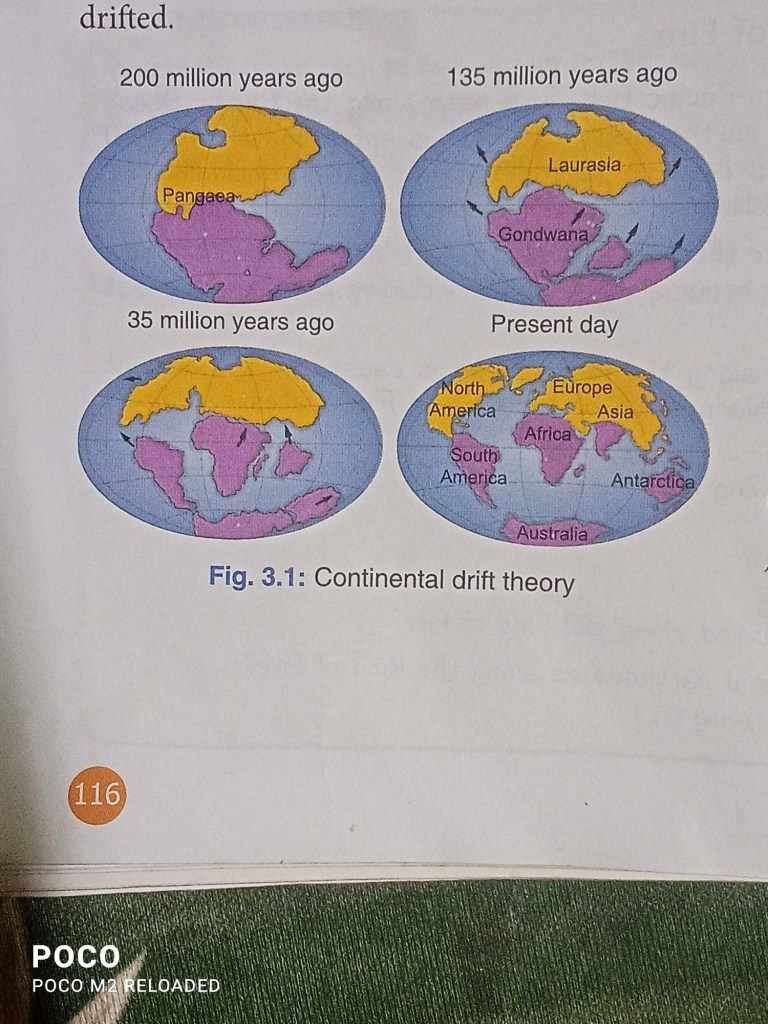
1. Explain the concept of continental drift. Why was the theory replaced and by which theory?
Ans: The concept of continental drift, proposed by Alfred Wegener, suggested that continents were once joined as a supercontinent (Pangaea) and have drifted apart over time. This theory lacked a mechanism to explain how continents moved. It was replaced by the theory of plate tectonics, which explained continental movement through the motion of tectonic plates driven by mantle convection.
2. Explain the theory of plate tectonics.
Ans: The theory of plate tectonics states that the Earth’s lithosphere is divided into tectonic plates that float on the on the soft layer of the mantle. These plates interact at boundaries, causing geological phenomena like earthquakes, volcanic activity, and mountain formation.
3. What is a volcano? Mention different types of volcanoes.
Ans: A volcano is an opening in the Earth’s crust that can let magma, ash, and gases escape during eruptions. Types of volcanoes:
Shield volcanoes: Broad, gently sloping (e.g., Mauna Loa).
Composite volcanoes: Steep and explosive (e.g., Mount St. Helens).
Cinder cone volcanoes: Small, steep, and short-lived.
4. Discuss different types of earthquake waves.
Ans: Primary waves (P-waves): Travel fastest and pass through solids and liquids.
Secondary waves (S-waves): Slower than P-waves and travel only through solids.
Surface waves: Travel along the Earth’s surface, causing most damage.
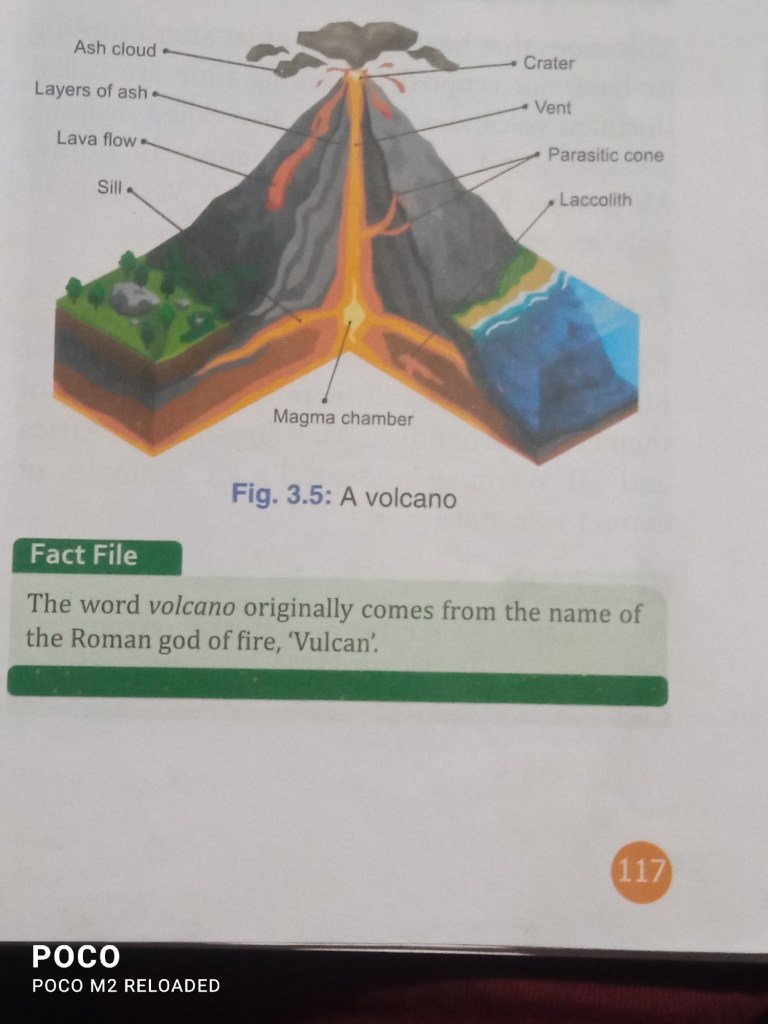
5. Draw and label the diagram for a volcano.
H. Higher-Order Thinking Skills
1. Why most of the damages occur at the epicenter of an earthquake?
Ans: Most damages occur at the epicenter because it is directly above the focus, where the seismic energy is strongest and closest to the surface, causing intense ground shaking.
 Site 𝓝𝓲𝓻𝓾'𝓼𝓫𝓵𝓸𝓰