—
A. Choose the correct answer
1. What are large gorges called?
→ (c) Canyons
2. What are loops of rivers called?
→ (b) Meanders
3. Which one of the following agents forms a cave?
→ (a) Sea wave
4. Accumulation of sediments by glacier is called
→ (c) Moraine
5. Glaciers are slow-moving ______.
→ (b) Mountains
—
B. Fill in the blanks
1. Breaking up of rocks on the Earth’s surface is called weathering.
2. When sea waves cut through a cliff, a sea cave is formed.
3. Delta is the triangular landforms created at the mouths of the river.
4. Glacial lakes are called tarn.
5. In deserts hills of sand are called sand dunes.
—
C. Write T for True and F for False statements
1. The source of a river is called its mouth. → F
2. A lagoon is a landform created by a sea cliff being worn down. → F
3. Rivers of ice are called waterfalls. → F
4. Mushroom rocks have narrow bases and broad tops. → T
5. The valley of a glacier is U-shaped. → T
D. Match the columns
1. Loess – (e) Sand particles deposited by wind
2. Cirque – (d) Hollow in a mountain
3. Sea waves – (a) Sea arch
4. Meanders – (c) River loops
5. Weathering – (b) Decomposition of rocks
E. Very Short Answer Type Questions (20–30 words)
1. What is weathering?
Answer: Weathering is the breaking down of rocks into smaller particles by natural forces like temperature changes, water, wind, and chemical processes.
2. Name the three stages of the course of a river.
Answer: The three stages of the course of a river are:
Upper course
Middle course
Lower course
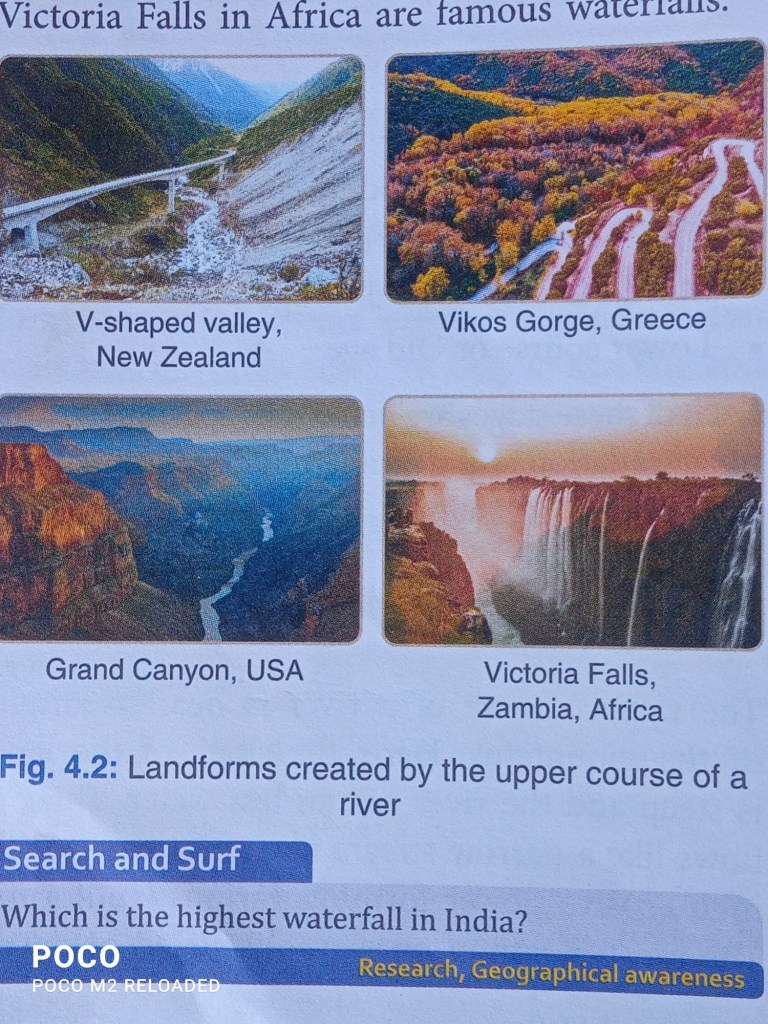
3. What is a V-shaped valley?
Answer:A V-shaped valley is a deep valley with steep sides formed by the erosional activity of a river in its upper course.
4. What are waterfalls?
Answer: Waterfalls are steep drops of water where a river flows over hard rocks, creating a vertical fall.
5. What is an oasis?
Answer: An oasis is a fertile area in a desert with water, often supplied by underground springs.
F. Short Answer Type Questions (50–60 words)
1. Differentiate between degradation and aggradation.
Answer: Degradation: The process of lowering landforms by erosion.
Aggradation: The process of raising the land surface by the deposition of materials like silt, sand, or gravel.
2. Explain meanders and oxbow lakes.
Answer: Meanders: Curved or looped patterns of a river in the middle course.
Oxbow lakes: U-shaped lakes formed when meanders are cut off from the river due to deposition.
3. Discuss the formation of a delta.
Answer: A delta is formed when a river deposits sediments at its mouth as it meets a body of standing water like a sea, slowing its flow and creating a triangular-shaped landform.
4. What is an estuary?
Answer: An estuary is the wide mouth of a river where it meets the sea, and tidal waters mix with river water.
5. Describe how lagoons are formed.
Answer: Lagoons are shallow bodies of water separated from the sea by sandbars, spits, or coral reefs, formed by the deposition of sediments along coastal areas.
G. Long Answer Type Questions (80–100 words)
1. Differentiate between weathering and erosion.
Answer: Weathering: The breakdown of rocks into smaller particles by physical, chemical, or biological processes without movement.
Erosion: The removal and transportation of weathered materials by agents like water, wind, or ice.
2. Discuss various erosional and depositional features formed by a river in its upper and lower course.
Answer: Upper Course: Erosional features like V-shaped valleys, waterfalls, and rapids.
Lower Course: Depositional features like floodplains, deltas, and levees.
3. Describe the landforms created by sea waves.
Answer: Erosional: Sea cliffs, arches, stacks, and caves.
Depositional: Beaches, sandbars, and spits.
4. Illustrate the landforms formed by moving ice.
Answer: Moving ice (glaciers) forms landforms like cirques, moraines, U-shaped valleys, and drumlins through erosion and deposition.
5. How are mushroom rocks formed?
Answer: Mushroom rocks are formed in deserts when wind erosion erodes the lower parts of rocks more than the upper parts, creating a mushroom-like shape.
H. Higher-Order Thinking Skills
1. How does a river play a major role in shaping the Earth’s surface?
Answer: A river shapes the Earth’s surface through erosion, transportation, and deposition, creating various landforms like valleys, deltas, floodplains, and gorges. It also supports ecosystems and human activities.
2. Why is the river most active in its upper course?
Answer: A river is most active in its upper course due to steep gradients that increase velocity, causing intense erosion and the formation of landforms like waterfalls and V-shaped valleys.
 Site 𝓝𝓲𝓻𝓾'𝓼𝓫𝓵𝓸𝓰