A. Choose the correct answer:
1. Which is gas causes the greenhouse effect? Answer: (b) Carbon dioxide
2. Which is the lowest layer of the atmosphere? Answer: (d) Troposphere
3. Radio waves are transmitted back to earth by: Answer: (c) Thermosphere
4. Which is is the coldest layer of the atmosphere? Answer: (c) Mesosphere
5. The stratosphere is also called: Answer: (b) Ozonosphere
B. Fill in the blanks:
1. The main gases present in the atmosphere are nitrogen and oxygen.
2. The troposphere is the lowest layer of the atmosphere.
3. Temperature in the mesosphere layer of the atmosphere decreases with an increase in altitude.
4. Ozone absorbs the harmful ultraviolet rays of the sun.
5. The narrow boundary that separates the stratosphere from the mesosphere is called the stratopouse.
C. Write T for True and F for False statements:
1. Oxygen in the atmosphere creates the greenhouse effect. False
2. Plants absorb carbon dioxide during photosynthesis. True
3. The Earth’s gravitational pull holds the atmosphere close to it. True
4. The atmosphere can be divided into six concentric layers. True
5. As altitude increases the atmosphere becomes thinner. True
E. Very Short Answer Type Questions:
1. List the layers of the atmosphere.
Troposphere, Stratosphere, Mesosphere, Thermosphere, Exosphere.
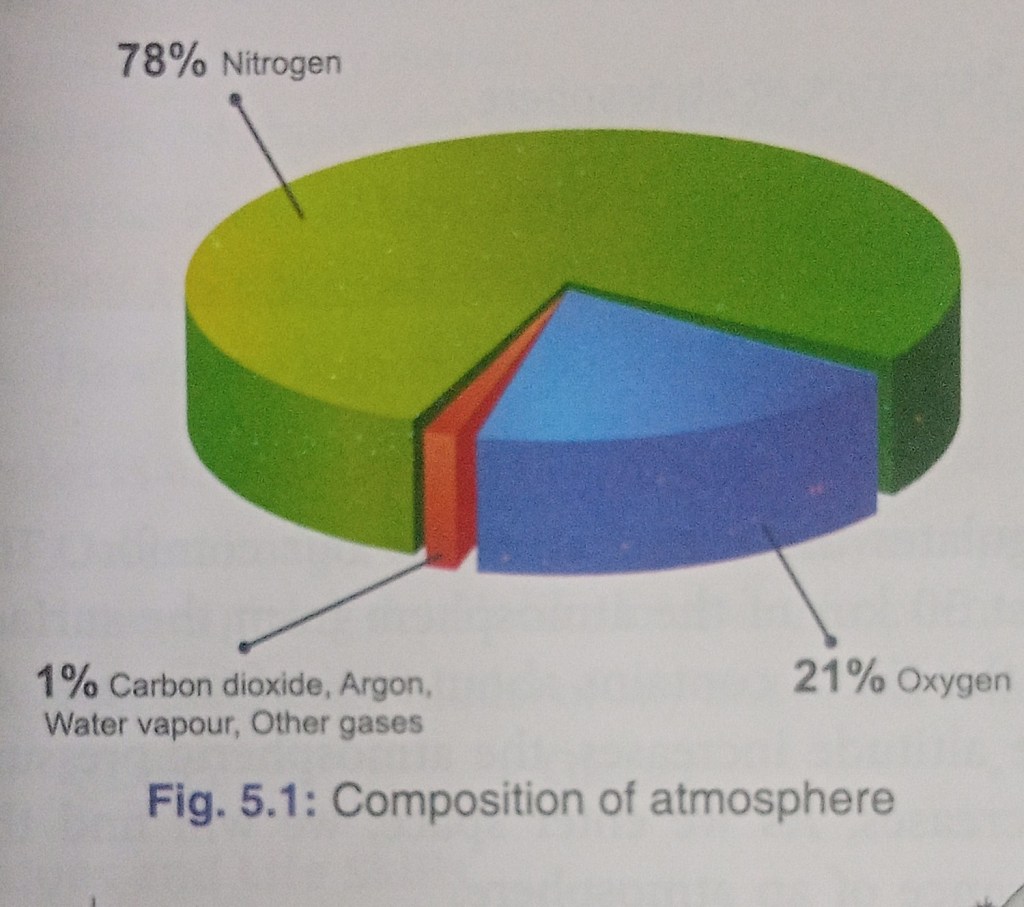
2. Describe the composition of the atmosphere.
Answer: The atmosphere is composed of 78% nitrogen, 21% oxygen, and 1% other gases such as carbon dioxide, argon, and trace gases.
3. What do you understand by the term “atmospheric gases”?
Answer: Atmospheric gases are the mixture of different gases, such as nitrogen, oxygen, carbon dioxide, and trace gases, that make up Earth’s atmosphere.
4. What are the benefits of the ozone layer?
Answer: The ozone layer absorbs harmful ultraviolet (UV) radiation from the sun, protecting living organisms from its damaging effects.
5. Which gases are found in the exosphere?
Answer: Hydrogen and helium are the primary gases found in the exosphere.
F. Short Answer Type Questions:
1. Discuss the thermosphere.
Answer: The thermosphere is the fourth layer of the atmosphere, extending from about 80 km to 700 km above Earth’s surface. It has high temperatures because it absorbs solar radiation, and it is where auroras occur and satellites orbit.
2. Write a note on the stratosphere.
Answer: The stratosphere is the second layer of the atmosphere, lying above the troposphere and extending up to 50 km. It contains the ozone layer, which absorbs UV radiation, and is characterized by stable weather conditions and increasing temperatures with altitude.
3. In which layer do meteors burn up? Why do they burn?
Answer: Meteors burn up in the mesosphere because of friction with the atmospheric particles. This friction generates heat, causing the meteors to incinerate.
4. Write a note on the exosphere.
Answer: The exosphere is the outermost layer of the atmosphere, extending from about 700 km to 10,000 km. It merges with outer space and contains very low-density gases like hydrogen and helium.
5. Which layer allows long-distance wireless communication, and how?
Answer: The thermosphere allows long-distance wireless communication because it contains the ionosphere, a region filled with charged particles that reflect radio waves back to Earth.
—
G. Long Answer Type Questions:
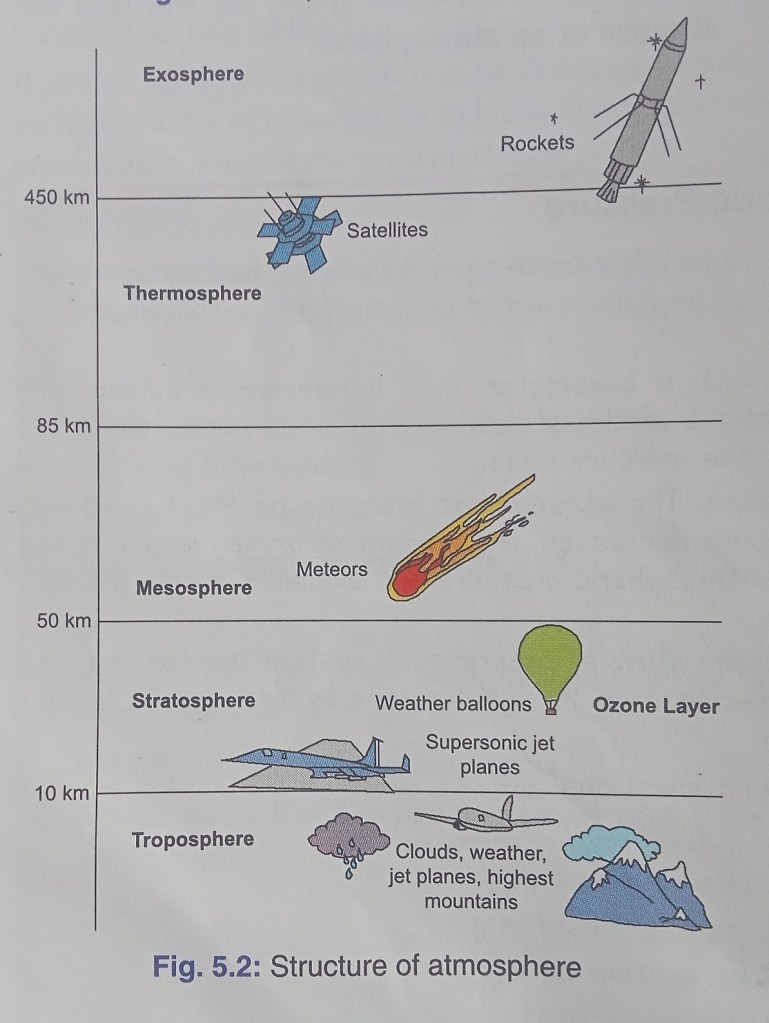
1. With the help of a diagram, explain the structure of our atmosphere.
Answer: The atmosphere consists of five layers:
Troposphere (0–12 km): Weather occurs here.
Stratosphere (12–50 km): Contains the ozone layer.
Mesosphere (50–80 km): Meteors burn up here.
Thermosphere (80–700 km): Satellites orbit; auroras occur.
Exosphere (700–10,000 km): Transition to outer space.
2. Write a note on the composition of atmospheric gases.
The Earth’s atmosphere consists mainly of:
Nitrogen (78%): Maintains balance by diluting oxygen and reducing combustion.
Oxygen (21%): Supports respiration and combustion.
Other Gases (1%): Includes argon, carbon dioxide (important for photosynthesis and heat regulation), water vapor, and trace gases.
3. Differentiate between the mesosphere and the thermosphere.
Mesosphere:
Third layer of the atmosphere (50–80 km).
Coldest layer; temperature decreases with altitude.
Meteors burn up here.
Thermosphere:
Fourth layer (80–700 km).
Temperature increases with altitude due to solar radiation absorption.
Contains the ionosphere; facilitates radio communication.

 Site 𝓝𝓲𝓻𝓾'𝓼𝓫𝓵𝓸𝓰