Let’s Recall
1. Match the following:
Column A Column B
(a) Diwani (iii) Right to collect land revenue (b) “Tiger of Mysore” (i) Tipu Sultan
(c) faujdari adalat. . (iv) criminal court
(d) Rani Channamma (v) Led an anti-British
movement in Kitoor
(e) sipahi. (iii) Sepoy
—
2. Fill in the blanks:
(a) The British conquest of Bengal began with the battle of Plassey.
(b) Haidar Ali and Tipu Sultan were the rulers of Mysore.
(c) Dalhousie implemented the Doctrine of Lapse.
(d) Maratha kingdoms were located mainly in the western part of India.
—
3. State whether true or false:
(a) The Mughal Empire became stronger in the eighteenth century. – False
(b) The English East India Company was the only European company that traded with India. – False
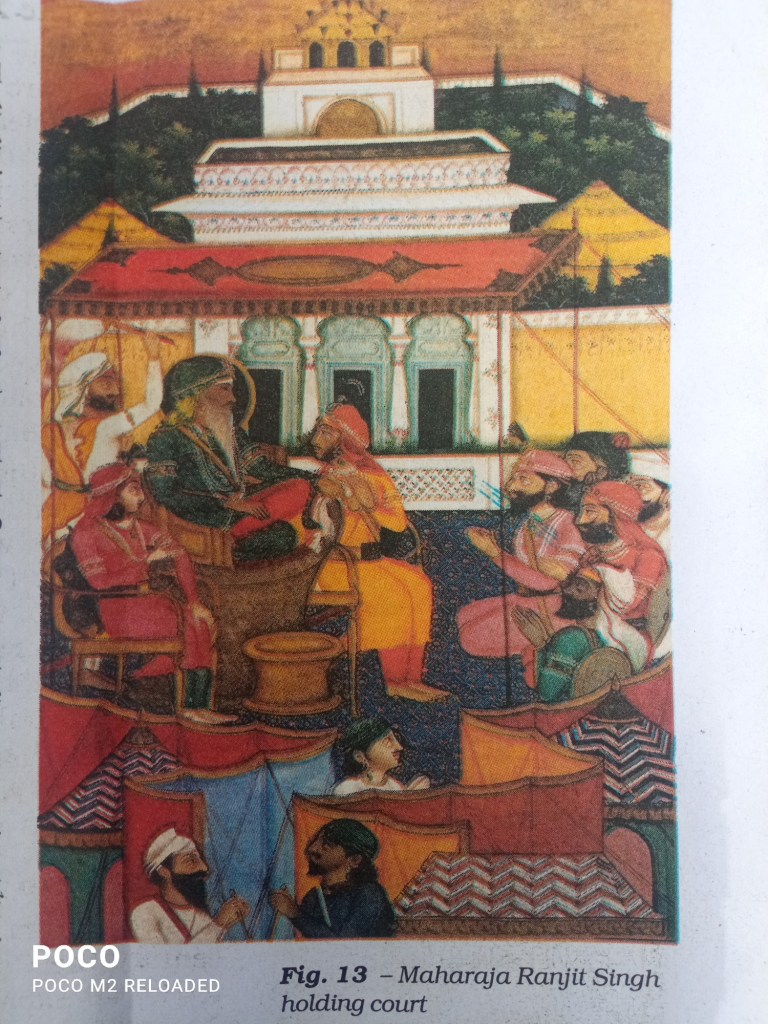
(c) Maharaja Ranjit Singh was the ruler of Punjab. – True
(d) The British did not introduce any administrative changes in the territories they conquered. – False
—
Let’s Discuss
4. What attracted European trading companies to India?
Answer — India was rich in spices, cotton, silk, indigo, and other goods that were in great demand in Europe. These products could be bought at low prices in India and sold at high prices in Europe, offering great profits.
5. What were the areas of conflict between the Bengal nawabs and the East India Company?
Answer — The areas of conflict between the bangle nawab and the East India company where as follows (i)The nawabs opposed the Company’s efforts to expand trade privileges and refuse to pay taxes.
(ii) The Company demanded large concessions and refused to pay duties.
(iii) The nawabs accused the Company of dishonesty in trade.
(iv)The Company wanted political control, which threatened the nawabs’ authority.
6. How did the assumption of Diwani benefit the East India Company?
Answer — The Diwani (right to collect revenue) gave the Company control over Bengal’s financial resources. It allowed them to use Indian revenues to finance trade and maintain their army and administration.
7. Explain the system of “subsidiary alliance”.
Answer — The system meant Indian rulers had to:
(a)Keep British forces in their territory.
(b) Pay for their maintenance.
(c) Not enter alliances or declare war without British permission. In return, they received British “protection.” If they failed to comply, they had to cede territory.
8. In what way was the administration of the Company different from that of Indian rulers?
Answer — The Company ruled to serve its own economic and political interests.
Indian rulers ruled as sovereigns with some traditional legitimacy.
The Company implemented new systems of land revenue, justice, and policing that were more bureaucratic and extractive.
9. Describe the changes that occurred in the composition of the Company’s army.
Answer — The Mughal-style cavalry was replaced with European-style infantry.
Indian soldiers were trained in British drill and discipline.
The army became more professional and structured.
European officers led Indian soldiers (sepoys)
 Site 𝓝𝓲𝓻𝓾'𝓼𝓫𝓵𝓸𝓰