A. Choose the correct answer
1. The fusion of Persian and Hindi led to the development of:
(c) Urdu
2. The Janmasakhis are stories on the life of:
(b) Guru Nanak
3. The text Ragadarapan was translated during the reign of:
(b) Akbar
4. Rajasthani, Pahari, and Deccani were:
(a) Schools of painting
5. Kuchipudi is a dance form of:
(d) Andhra Pradesh
—
B. Write T for True and F for False statements
1. The Gita Govinda is written in Hindi. — F
2. Amir Khusrau was a disciple of the Sufi saint Salim Chishti. — F (He was a disciple of Nizamuddin Auliya)
3. Mewar, Kota, Kishangarh, Bundi, Bikaner and Jodhpur were Pahari school of painting. — F (They were Rajasthani school of painting)
4. Chaitanya introduced kirtanas. — T
5. Nawab Wajid Ali Shah patronized Kuchipudi. — F (He patronized Kathak, not Kuchipudi)
—
C. Fill in the blanks
1. Somadeva is the author of Kathasaritsagar.
2. Amir Khusrau was a poet, scholar, mathematician, and historian who wrote in Persian and Hindavi.
3. Abdur Rahim Khan-i-Khana, popularly known as Rahim, was an important poet at Akbar’s court.
4. The most famous of the kissa is Padmavat written by Malik Muhammed Jayasi.
5. The Sitar and the Tabla were two musical instruments introduced by the Turks in India.
—
D. Very Short Answer Type Questions
1. What is Kathasaritasagara? Who wrote it?
Answer: It is a collection of Indian legends, fairy tales, and folk tales written by Somadeva.
2. What is Gita Govinda and who composed it?
Answer: It is a Sanskrit text describing the love of Krishna and Radha, composed by Jayadeva.
3. Urdu is a mixture of which two languages?
Answer: Urdu is a mixture of Persian and Hindi.
4. When and how did the Hindi language begin to develop?
Answer: Hindi began to develop around the 7th–10th century CE as a form of Apabhramsha, later influenced by Persian during the Delhi Sultanate and Mughal periods.
5. Who were the bauls?
Answer: Bauls were wandering minstrels from Bengal known for their devotional music and songs expressing mystical love for God.
—
E. Short Answer Type Questions (50–60 words)
1. Regional texts are important sources of history. Elaborate.
Answer: Regional texts provide valuable insights into the local culture, traditions, and daily life of people in different parts of India. They record events, rulers, festivals, and art forms specific to regions, helping historians understand diversity in medieval India. Such texts also preserve folklore and oral traditions which are not found in mainstream historical records.
—
2. Write a note on Bengali temple architecture.
Answer: Bengali temple architecture flourished between the 16th and 19th centuries. The temples were built using terracotta and featured intricate carvings depicting scenes from the epics. They often had curved roofs (chala style) inspired by bamboo huts. Temples like the Dakshineswar and Kantanagar showcase this unique architectural style combining local art with religious themes.
—
3. Explain the development of Punjabi literature.
Answer: Punjabi literature evolved during the medieval period under the influence of Bhakti and Sufi movements. Guru Nanak’s hymns in the Guru Granth Sahib are central to Punjabi literature. Saints like Bulleh Shah and Waris Shah enriched it with devotional and romantic poetry, blending Persian, Arabic, and local dialects to create a rich literary tradition.
—
4. What is miniature painting? Which schools of miniature painting are mentioned in the chapter?
Answer: Miniature paintings are small, detailed paintings made on paper, cloth, or ivory using bright colours and intricate designs. They often depict court scenes, nature, and religious themes. The main schools of miniature painting are Rajasthani, Pahari, and Deccani, each with distinctive styles reflecting regional traditions and royal patronage.
—
5. Write a note on Amir Khusrau.
Answer: Amir Khusrau (1253–1325) was a renowned poet, musician, and scholar at the Delhi Sultanate court. He wrote in Persian and Hindavi, contributing to Indian classical music by creating new ragas and instruments like the sitar and tabla. Khusrau’s poetry, blending Sufi mysticism and local culture, greatly influenced the development of Urdu and Hindustani music.
6. Write a short note on Manipuri dance.
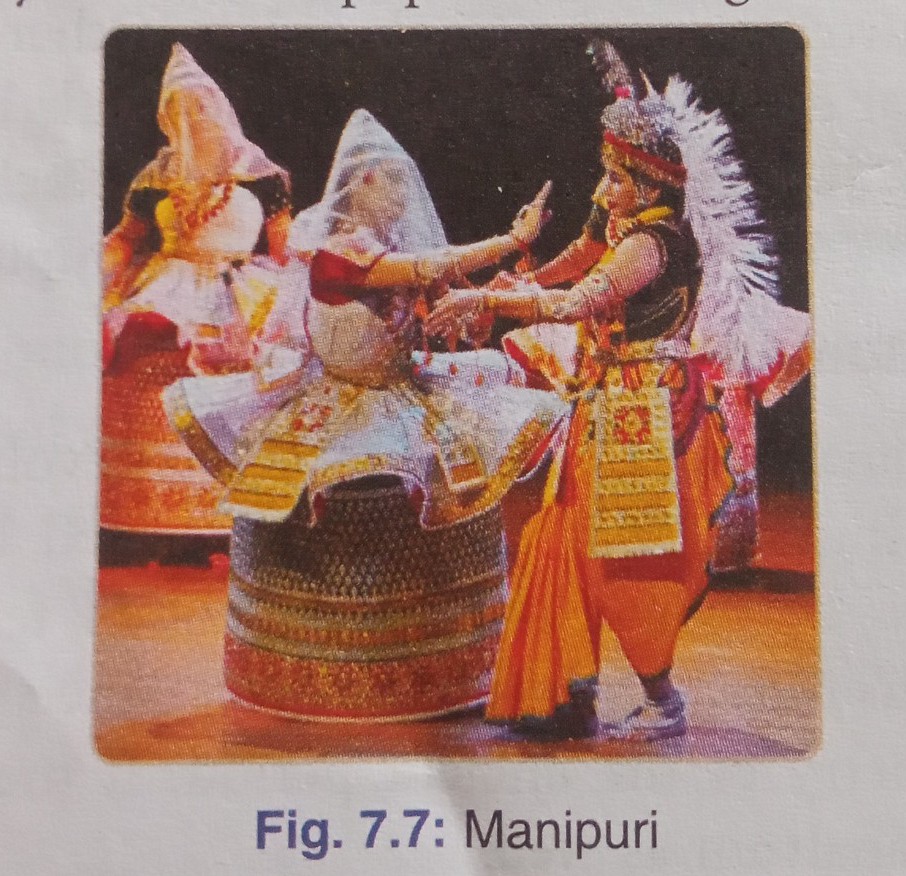
Answer: Manipuri dance is a classical dance form from Manipur, a state in northeast India. It is deeply connected to the worship of Lord Krishna and Radha, depicting Raslila and devotional themes. The dance is graceful, with slow, flowing movements and distinctive costumes, including the cylindrical skirts of female dancers. It combines music, rhythm, and storytelling in a spiritual manner.
F. Long answer type questions
(80–100 words):
1. Describe the painting traditions of medieval India.
Answer: The painting traditions of medieval India were rich and diverse, reflecting regional styles and royal patronage. The Mughal school of painting combined Persian techniques with Indian themes, depicting court life, battles, and nature. Rajasthani and Pahari schools created miniature paintings based on epics like Ramayana and Bhagavata Purana. Deccani paintings were influenced by Persian art but had bright colours and detailed backgrounds. Murals in temples and palaces also flourished, showcasing religious and folk themes. These traditions contributed significantly to India’s cultural and artistic heritage.
—
4. Write a note on the music and dance traditions of the medieval period in India.
Answer: During medieval India, music and dance evolved under the influence of Bhakti and Sufi movements. Devotional music like bhajans, kirtanas, and qawwalis became popular. Persian and Indian styles fused, leading to the development of Hindustani classical music with new ragas and instruments like the sitar and tabla. Folk dances like Lavani and Powada coexisted with classical forms such as Kathak and Bharatanatyam. Court patronage encouraged performances at festivals and ceremonies, while temple traditions preserved devotional dance. These traditions reflected both religious devotion and regional culture.
—
G. Differentiate between the following
1. Ramcharitmanas and Sursagar
Answer: Ramcharitmanas: Written by Tulsidas; based on the life of Lord Rama; composed in Awadhi.
Sursagar: Written by Surdas; devotional poetry dedicated to Lord Krishna; composed in Braj Bhasha.
—
2. Powadas and Lavanis
Answer: Powadas: Narrative ballads popular in Maharashtra; recount heroic deeds and historical events.
Lavanis: Lively folk songs and dances from Maharashtra; performed to entertain and convey social messages.
—
3. Tirumurais and Nalaiyira Divya Prabandham
Answer: Tirumurais: Collection of Tamil hymns dedicated to Lord Shiva; composed by Shaiva saints.
Nalaiyira Divya Prabandham: Collection of 4000 Tamil hymns dedicated to Lord Vishnu; composed by Alvar saints.
 Site 𝓝𝓲𝓻𝓾'𝓼𝓫𝓵𝓸𝓰