A. Tick the correct answer .
1. When did Gandhiji return to India?
✅ 1915
2. Who raised the slogan ‘Swaraj is my birth right’?
✅ Bal Gangadhar Tilak
3. When was the Rowlatt Act executed by the British?
✅ 1919
4. What were the freedom fighters who believed in achieving freedom through peaceful methods known as?
✅ Moderates
B. Match the columns
1. Moderate → (e) W.C. Bonnerjee
2. Radical → (d) Lala Lajpat Rai
3. A.O. Hume → (a) Started the Indian National Congress
4. Swaraj → (b) Self-rule
5. Lord Curzon → (c) Division of Bengal
C. Write short notes on the following
Answer:–
Rowlatt Act – Passed in 1919 by the British, it allowed the government to arrest and imprison people without trial, leading to widespread protests.
2. Dandi March – In 1930, Gandhiji marched from Sabarmati Ashram to Dandi to break the salt law, starting the Civil Disobedience Movement.
3. Simon Commission – A British committee set up in 1927 to suggest constitutional reforms in India, but it had no Indian members, leading to protests.
—
D. Answer the following questions
1. Write a note on the Indian National Congress.-
Answer: The Indian National Congress was Founded in 1885 by A.O. Hume, it was a political party that led the struggle for India’s independence.
2. Write down the differences between the moderates and the radicals. Name any two leaders from each category.
Answer:
Moderates believed in peaceful methods (e.g., Dadabhai Naoroji, Gopal Krishna Gokhale).
Radicals believed in aggressive methods (e.g., Bal Gangadhar Tilak, Lala Lajpat Rai).
3. Why was Bengal divided by the British? What were the results of this partition?
Answer:
Bengal was divided in 1905 to weaken the nationalist movement.
It led to strong protests and the Swadeshi Movement.
4. Name a few movements launched by Gandhiji to achieve freedom for India.
Answer:
Non-Cooperation Movement, Civil Disobedience Movement, Quit India Movement.
—
E. Give reasons
1. Gandhiji withdrew the Non-Cooperation Movement.
– Because of the Chauri Chaura incident in 1922, where violent clashes led to the death of policemen.
2. Rowlatt Act was called the ‘Black Act’.
– Because it took away basic rights like trial by jury and allowed arrest without reason.
Observe and Answer
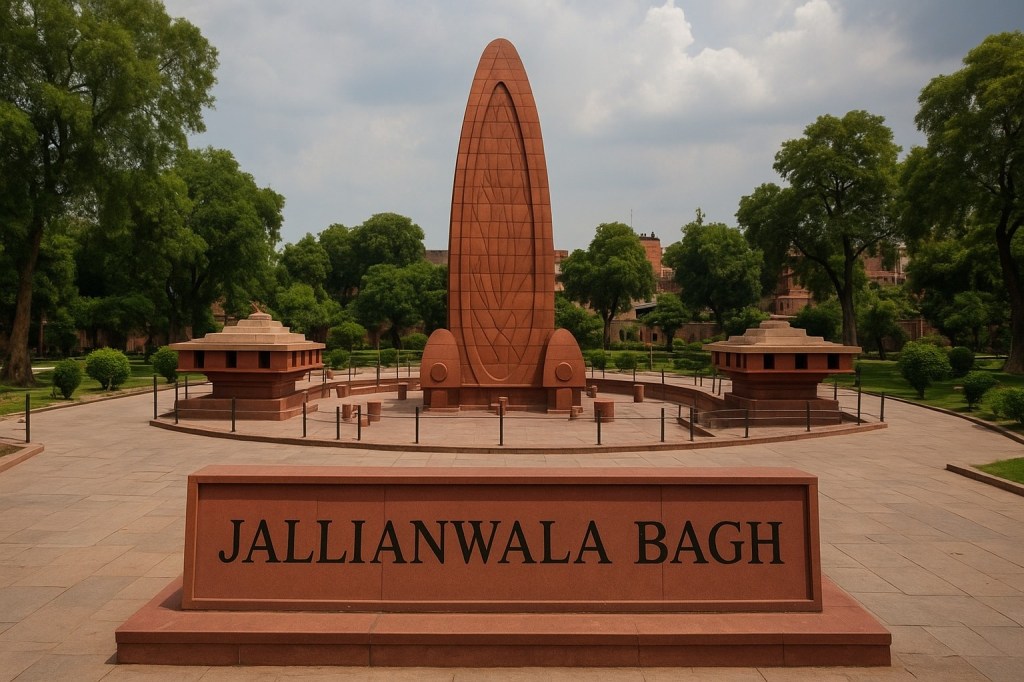
Answer:
This is the Jallianwala Bagh Memorial in Amritsar. It commemorates the tragic massacre of hundreds of innocent Indians by British troops on 13 April 1919. The place reminds us of the sacrifices made for India’s freedom.
Web Chart – Major Events of the Freedom Struggle of India
1885 → Formation of Indian National Congress
1905 → Partition of Bengal
1919 → Jallianwala Bagh Massacre & Rowlatt Act
1942 → Quit India Movement
****************
 Site 𝓝𝓲𝓻𝓾'𝓼𝓫𝓵𝓸𝓰