—
A. Choose the Correct Answer
1. Intermediaries try to buy the produce at cheap rates and pay about:
✅ (b) 30%–40% to the farmers
2. If a farmer sells his produce in a mandi directly without using an intermediary’s services, then:
✅ (b) He will get the maximum profit
3. An organization of farmers where they jointly share their profits is called:
✅ (c) Agricultural Cooperatives
4. Wholesale is the business of selling goods in:
✅ (a) Large quantities at low prices
—
B. True or False
1. A wholesale market is dependent on retailers. — ❌ False
2. The E-Choupal scheme was initiated by the Government of India. — ❌ False
3. The Rural Godown Scheme supplies cold storage facilities to the farmers. — ✅ True
4. Khari Baoli is Asia’s largest wholesale spice and condiments market. — ✅ True
—
C. Fill in the Blanks
1. Wholesale markets supply products in bulk to retailers and traders.
2. Wholesalers do not usually advertise their products or services.
3. Khari baoli is a 17th-century wholesale market.
4. Middlemen and intermediaries exploit farmers and make profits.
—
D. Very Short Answer Type Questions (20–30 words)
1. What is wholesale business?
Answer: It is the buying and selling of goods in large quantities at low prices, usually to retailers or traders rather than directly to consumers.
2. Who is the sanchalak in an E-Choupal?
Answer: A sanchalak is a trained farmer who manages the E-Choupal and helps other farmers access information and services online.
3. What are cooperatives?
Answer: Cooperatives are groups of people who come together voluntarily to meet common economic needs through a jointly owned and democratic organization.
4. Who makes agricultural cooperatives and why?
Answer: Farmers form agricultural cooperatives to share resources, eliminate middlemen, and get fair prices for their produce.
—
E. Short Answer Type Questions (50–60 words)
1. Is it beneficial for farmers to sell their produce in wholesale markets?
Answer: Yes, it helps farmers sell their produce in bulk directly to traders or retailers, ensuring better prices and avoiding middlemen. It also reduces the risk of spoilage and storage loss.
2. Discuss how the profit margins depend on the selling prices in a wholesale marketplace.
Answer: Profit margins depend on the difference between the cost price and selling price. When selling prices rise, profits increase; when prices fall due to oversupply or low demand, profits decrease.
3. What are the new trends in the marketplace?
Answer: New trends include digital marketing, online trading, mobile-based price updates, direct farmer-to-consumer selling, and government-supported platforms like E-NAM and E-Choupal.
4. Write a note on E-Choupal.
Answer: E-Choupal is an ITC initiative that provides farmers with internet access to market prices, weather forecasts, and best farming practices. It reduces the role of middlemen and ensures fair prices for farmers.
—
F. Long Answer Type Questions (80–100 words)
1. Describe the functioning of the Khari Baoli market.
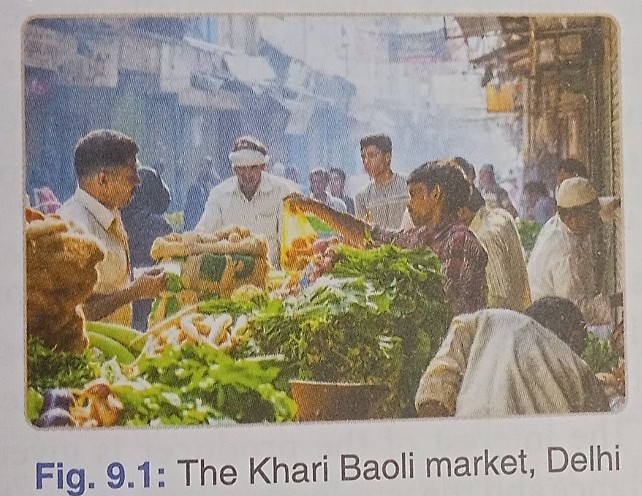
Answer: Khari Baoli, located in Delhi, is Asia’s largest wholesale spice and dry fruit market. Established in the 17th century, it deals in spices, herbs, and dry fruits. Traders from across India buy in bulk here. Goods are sold at wholesale rates to retailers and exporters. It plays an important role in India’s spice trade and supports thousands of traders and workers.
2. Why do farmers receive the least share of profit? Explain the role of intermediaries in it.
Answer: Farmers get a low share of profit because intermediaries buy produce at cheap rates and sell it at higher prices in cities. These middlemen take a large portion of the profit. Due to lack of transport, storage, and market access, farmers depend on them and end up receiving only 30–40% of the final selling price.
3. Discuss the efforts initiated by the government to protect the farmers’ interest.
Answer: The government has taken steps like setting up regulated mandis, fixing Minimum Support Prices (MSP), and promoting cooperatives. Schemes such as the Rural Godown Scheme, E-NAM, and E-Choupal help farmers store produce, access fair markets, and get better prices. These measures aim to reduce the control of intermediaries and improve farmers’ income.
******************
 Site 𝓝𝓲𝓻𝓾'𝓼𝓫𝓵𝓸𝓰