A. Choose the correct answer
1. Where do you think the earliest human beings are believed to have evolved in?
(a) Africa
2. What is Hunsgi in Karnataka?
(b) Palaeolithic site
3. Where are Bhimbetka caves located?
(c) Madhya Pradesh
4. What material was mostly used for making tools and weapons by the early humans?
(b) Stone
5. Which of the following was the longest period of the Stone Age?
(a) Palaeolithic Age
—
B. Write T for True and F for False statements
1. The tools made by the early human beings were very crude and simple. — T
2. The term lithos means wood. — F
3. Fire was one of the greatest discoveries of the Palaeolithic Age. — T
4. The Mesolithic Age was a period of transition. — T
5. The discovery of fire was an unimportant part of early man’s life. — F
—
C. Fill in the blanks
1. Fire seems to have been an accidental discovery.
2. The stone tools of the Mesolithic Age are called microliths.
3. Many Palaeolithic sites in India have been excavated in the Deccan region.
4. Red and white were the most commonly used colours to make cave paintings.
5. Hunsgi is a Palaeolithic site in Karnataka.
—
D. Very Short Answer Type Questions
1. What are fossils?
Answer:
Fossils are the preserved remains or impressions of plants, animals, or humans found in rocks.
2. How do historians differentiate between Palaeolithic Age and Mesolithic Age?
Answer:
They differentiate them on the basis of tools used, lifestyle, and technological development.
3. Why were early human beings called ‘hunter-gatherers’?
Answer:
They hunted animals and gathered fruits, roots, and nuts for food.
4. Name any two Palaeolithic and Mesolithic sites in India.
Answer:
Palaeolithic: Bhimbetka, Hunsgi
Mesolithic: Bagor, Adamgarh
5. What are microliths?
Answer:
Microliths are small, sharp stone tools used during the Mesolithic Age.
E. Short Answer Type Questions (50–60 words)
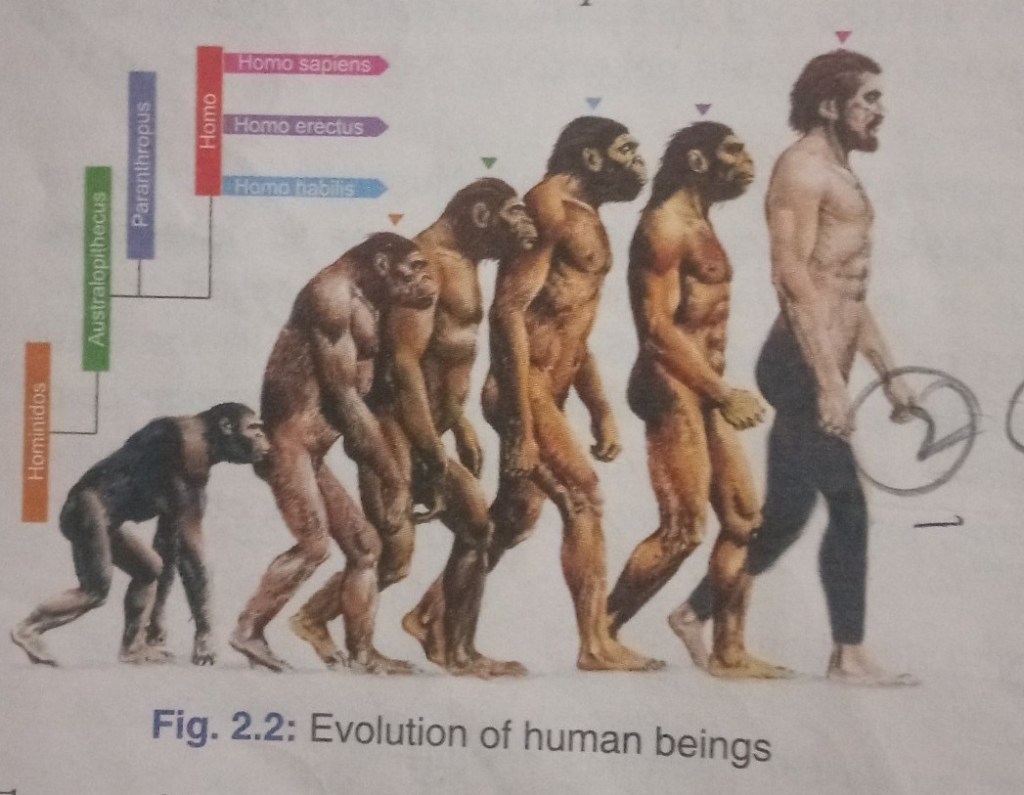
1. List two developments in the evolution of man that differentiated him from his ancestors.
Answer:
Early humans learned to walk upright, which freed their hands to make tools. They also developed a larger brain, which helped them think, plan, communicate, and adapt better to their surroundings.
—
2. What is the Stone Age? Explain briefly.
Answer:
The Stone Age is the earliest period of human history when humans mainly used stone tools. It is divided into the Palaeolithic, Mesolithic, and Neolithic Ages, showing gradual improvement in tools, lifestyle, and skills.
—
3. The discovery of fire was one of the greatest discoveries of the Palaeolithic Age. Discuss.
Answer:
Fire helped early humans cook food, keep warm, scare wild animals, and provide light. It also helped them survive in cold regions and made their life safer and more comfortable.
—
4. Write a note on the Mesolithic Age.
Answer:
The Mesolithic Age was a transition period between the Palaeolithic and Neolithic Ages. Humans used microliths, lived near water sources, hunted smaller animals, and slowly began domesticating animals.
—
5. Discuss the importance of fossils.
Answer:
Fossils help us understand the physical features, lifestyle, and evolution of early humans. They provide evidence about ancient plants, animals, and human ancestors and help historians reconstruct early history.
—
F. Long Answer Type Questions (80–100 words)
1. Describe the different stages of the Palaeolithic Age.
Answer:
The Palaeolithic Age is divided into Lower, Middle, and Upper Palaeolithic stages. In the Lower stage, humans used crude stone tools and lived a nomadic life. During the Middle stage, tools became better shaped, and humans learned to use fire. In the Upper stage, tools became sharper and more specialized. Cave paintings and improved hunting methods also developed during this stage.
—
2. Write a note on the Hunsgi Valley.
Answer:
The Hunsgi Valley, located in Karnataka, is an important Palaeolithic site in India. Archaeologists have found stone tools, hand axes, and cleavers here. These findings show that early humans lived in this region and depended on hunting and gathering. The site helps us understand early human life in the Deccan region.
—
3. The Mesolithic Age was a transition between the Middle Stone Age and the Neolithic Age. Explain.
Answer:
The Mesolithic Age shows changes from a hunting-gathering life to a more settled life. Humans used microliths, began domesticating animals, and lived near rivers and lakes. These changes later led to farming and permanent settlements of the Neolithic Age.
—
4. Rock paintings of the Stone Age are important sources of early human history. Elaborate.
Answer:
Rock paintings show the daily life of early humans such as hunting, dancing, and worship. They give information about animals, tools, clothing, and beliefs. Colours like red and white were commonly used. Bhimbetka caves are famous examples.
G. Difference between the following:
1. Palaeolithic Age and Mesolithic Age (2 marks)
Answer:
The Palaeolithic Age was the Old Stone Age when humans lived a nomadic life and used crude stone tools.
The Mesolithic Age was the Middle Stone Age marked by semi-settled life and the use of small stone tools called microliths.
—
2. Factory Sites and Habitation-cum-Factory Sites (2 marks)
Answer:
Factory sites were places where only stone tools were made near raw materials.
Habitation-cum-factory sites were pore Tools
3. Core Tools and Flake Tools (2 marks)
Answer:
Core tools were heavy tools made by shaping a stone core.
Flake tools were light and sharp tools made from flakes struck off from a core.
******************
 Site 𝓝𝓲𝓻𝓾'𝓼𝓫𝓵𝓸𝓰