B. Write T for True and F for False
1.Leap year comes after three years. — T
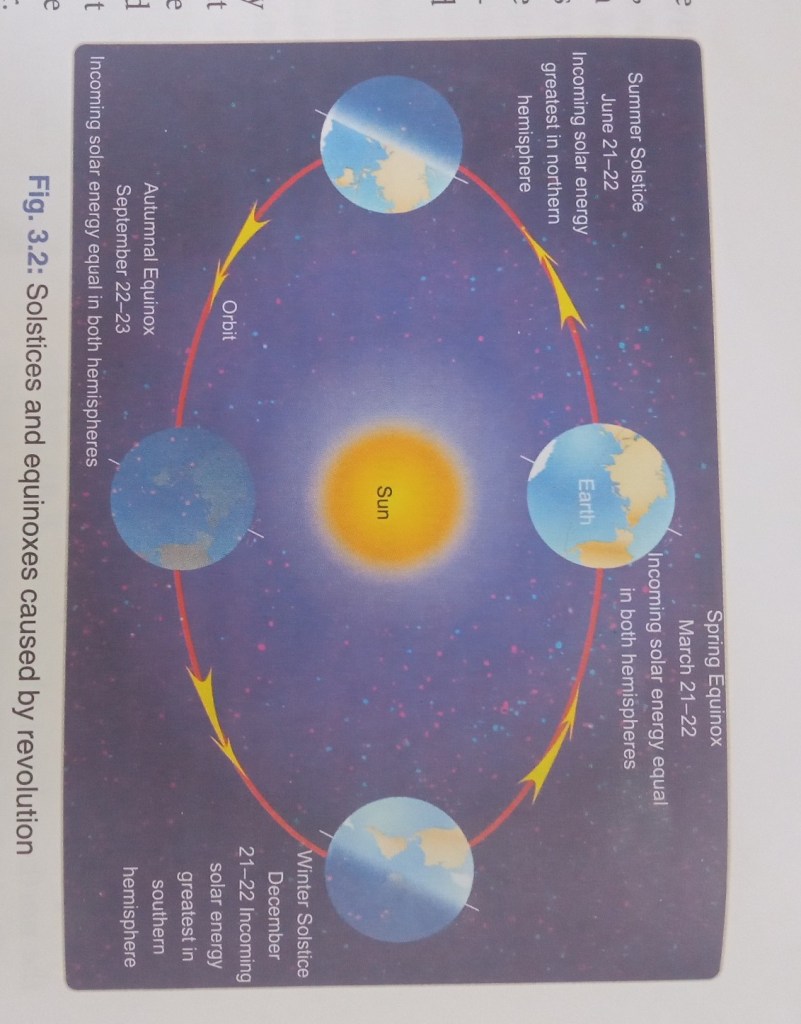
2.Winter solstice occurs on 22nd December. — T
3.The circle of illumination separates day and night. — T
4.The Earth’s movement around the Sun is called rotation. — F
5.The tilting of the Earth’s axis is called inclination. — T
C. Fill in the blanks
1.The Earth revolves around the Sun in an elliptical orbit.
2.The vernal equinox occurs on 21st March.
3.The rotation of the Earth causes day and night.
4.The revolution of the Earth causes change in seasons.
5.The fixed path on which the Earth revolves is called orbit.
6.The inclination of the Earth’s axis causes variation in the length of day and night.
D. Match the columns
1. Rotation —. (c) Spinning of the Earth
2. Leap year — (e) 366 days
3. Path on which Earth revolves — (d) Orbit
4. Axis — (a) Imaginary line joining the poles
5. 23rd September — (b) Autumn equinox
E. Very Short Answer Type Questions
1. What is meant by rotation of the Earth?
Answer:
Rotation of the Earth is the spinning of the Earth on its axis from west to east, taking about 24 hours.
2. Describe the circle of illumination.
Answer:
Circle of illumination is an imaginary circle that divides the Earth into day and night regions.
3. Why do seasons change on the Earth?
Answer:
Seasons change on the Earth due to the inclination of the Earth’s axis and its revolution around the Sun. As the Earth moves around the Sun, different parts receive unequal heat and sunlight, causing seasons.
4. Tell the exact time the Earth takes to complete one round of the Sun.
Answer:
The Earth takes 365 days, 5 hours, 48 minutes and 45 seconds to complete one revolution around the Sun.
5. When does summer solstice occur?
Answer:
The summer solstice occurs on 21st June in the Northern Hemisphere, when the day is the longest and the Sun’s rays fall vertically on the Tropic of Cancer.
Short Answer Type Questions (50–60 words)
1. Examine the consequences if the Earth stays still on its axis.
Answer:
If the Earth stays still on its axis, there will be no day and night. One side of the Earth will always face the Sun and remain very hot, while the other side will be in permanent darkness and extreme cold. Such conditions will make life difficult for plants, animals, and humans.
2. Discuss the need to add one “day” after every four years in our calendar.
Answer:
The Earth takes about 365 days and 6 hours to complete one revolution around the Sun. These extra hours add up to one full day in four years. To adjust this difference and keep the calendar correct, one extra day is added in February every four years, called a leap year.
3.What are the effects of Earth’s rotation?
Answer:
The rotation of the Earth causes day and night. It also causes the apparent movement of the Sun, Moon, and stars from east to west. Rotation helps in fixing time and leads to differences in local time at different longitudes.
4. Describe the term “equinox.”
Answer:
An equinox is the time when the Sun’s rays fall vertically on the Equator. On this day, day and night are equal all over the Earth. Equinox occurs twice a year—on 21st March (spring equinox) and 23rd September (autumn equinox).
5. Compare axis and orbit.
Answer:
The axis is an imaginary line passing through the centre of the Earth and joining the North and South Poles, around which the Earth rotates. The orbit is the fixed elliptical path along which the Earth revolves around the Sun.
G. Long answers type question:
3. Discuss the revolution of the Earth. What are its effects?
Answer:
Revolution is the movement of the Earth around the Sun along its elliptical orbit. The Earth takes about 365 days and 6 hours to complete one revolution. This movement causes the change of seasons, variation in the length of day and night, and the formation of leap years. Revolution combined with the tilt of the Earth’s axis leads to solstices and equinoxes.
 Site 𝓝𝓲𝓻𝓾'𝓼𝓫𝓵𝓸𝓰