Bonku Babu’s Friend    14

Class — V, Subject — English, Lesson — 14 , Real English
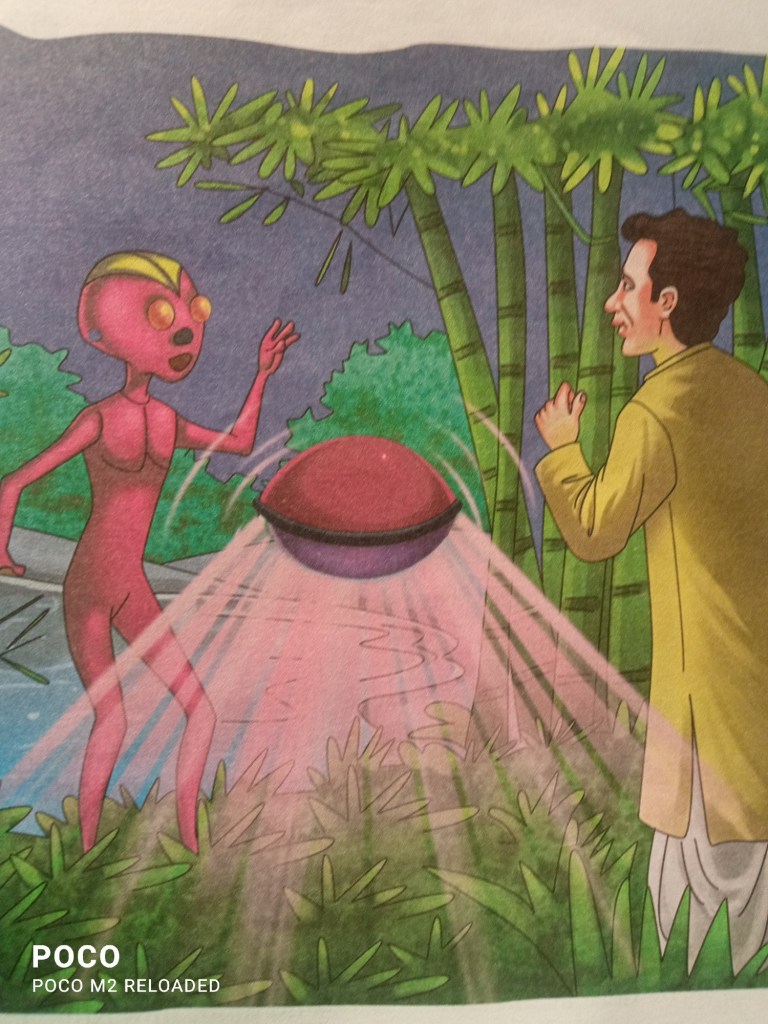
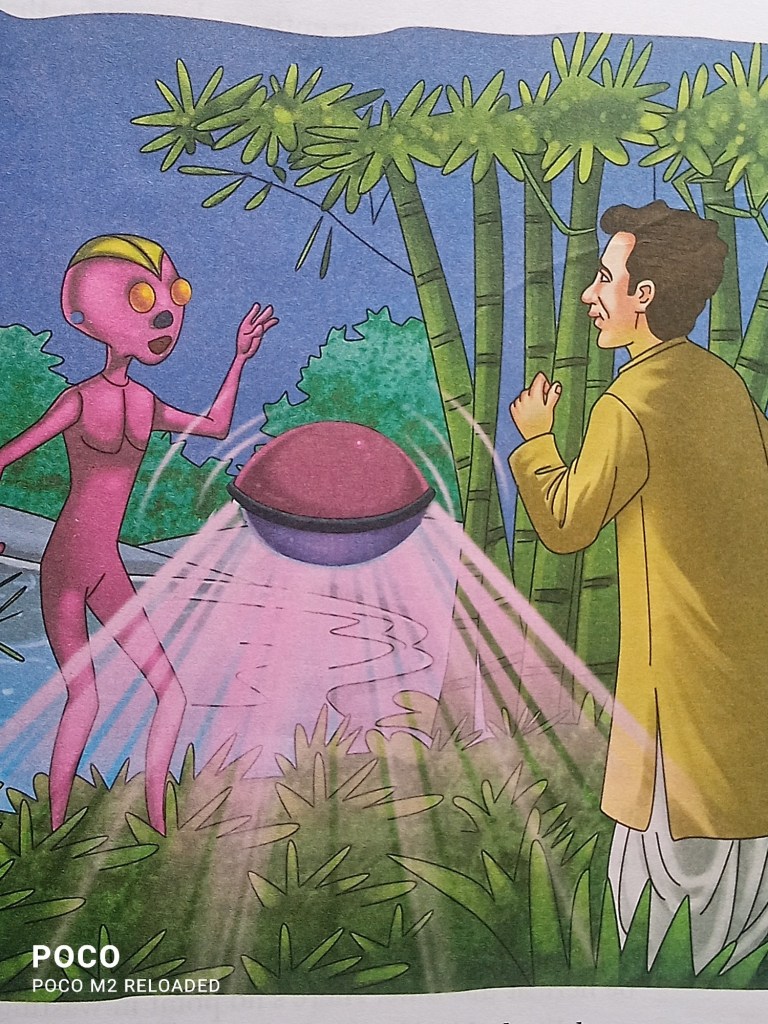
Meeting of Ang and Bonku Babu

A. Questions and answers

1.Who was Ang?

Ans : Ang was an Alien from the planet Craneus.

2. How did Ang come to earth?

Ans : Ang accidentally landed on earth when he intended to go to Pluto.

3. What did he tell Bonku Babu about his planet and about himself?

Ans : Ang felt, proud describing himself as a superior being who knew 14000 languages.

4. What impression did Ang create in Bonku Babu’s mind?

Ans : Ang’s pride and confidence left Bonku Babu feeling that Ang was a powerful and intelligent being.

5. Why did Pancha Ghosh so excited at the Sunday meeting?

Ans:  Pancha Ghosh excited at the Sunday meeting because he was going to tell everyone about bamboo grove ,where all the bamboo around the pond had shed all their leaves.

6. What was the first thing that Bonku Babu did on entering Sripati Babu’s house?

Ans : Bonku Babu burst into a gaffow and laughed  loudly for a whole minute as soon as he entered Sripati Babu’s house.

7. Did the meeting with Ang change Bonku Babu in any way? Give reasons for your answer.

Ans:  Yes, Bonku Babu got the courage to stand up for himself after meeting Ang, because he was the only person to not make fun of him. Often people get the courage to stand up for what is right when they have get support from others.

8. Banku Babu had something to say to the people in Sripati Babu’s house. Write against each of their names what he told them.

Ans :   Chandi Babu: at your age, hiding other people’s shoes and umbrellas is not just childish, but totally wrong. Kindly bring my umbrella and brown Canvas shoes to my house tomorrow.

Nidhi Babu :ย  if you call me Bu,nkum ‘ I will call you Nitwit and you must learn to live with that.

Shripati Babu : you are an important men and must have hangers- on, but please count me out from today.

Pancha Babu:  you are here as well! l Let me inform you that last night, an Ang arrived from the planet Craneus and landed on the pond in your bamboo grove. We had a long chat. The Ang was most amiable.

B2  Ang has been described as a strange creature very different from humans complete the following table with details of his appearance.

Head : Round and Shiny with no hair.

Eyes : Large, bright yellow ,growing

Ears : Tiny holes on each side of the head

Nose :  no visible nose, only two holes

Mouth : A large gaping hole

Arms and legs : Long, thin arms and legs

Hair : No hair

Body : Covered with a shiny pink outfit

B3.
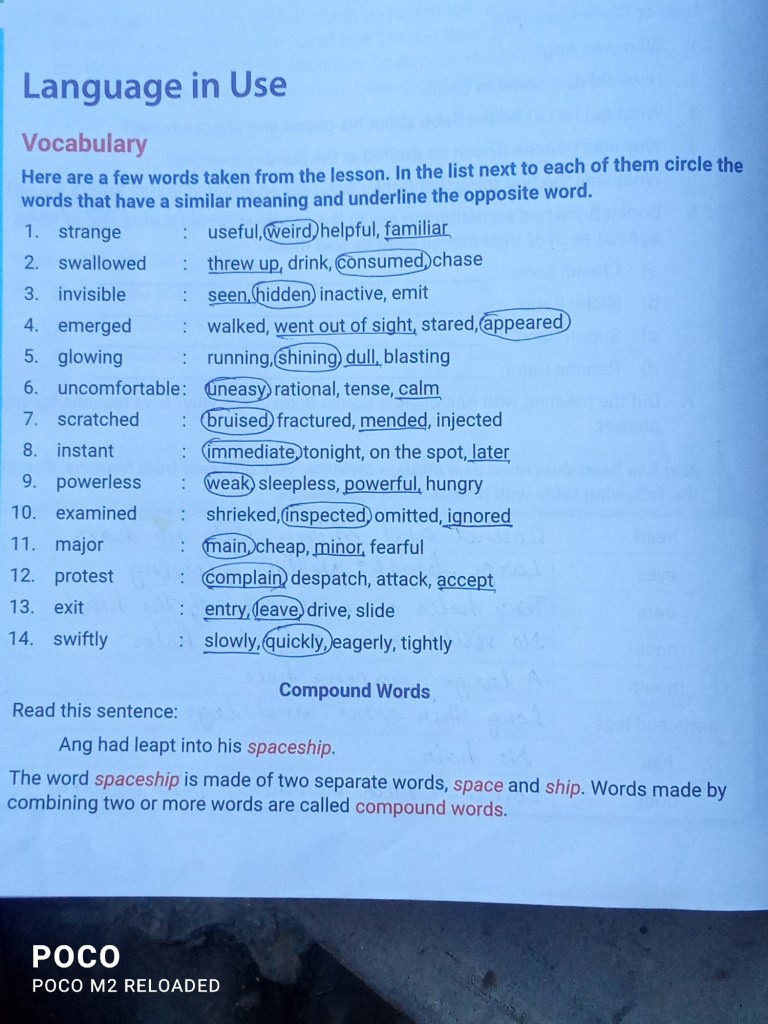
C1.

Match the words in Column A with those in Column B to get some commonly used compound words.

               A                                      B

           arm                                  cycle

           atom                                 friend

            foot                                   chair

            lamp                                 dream

            black                                 bomb

            dark                                   worm

             glow                                   ball

              day                                    room

              pen                                    friend

              motor                                board

Ans :   arm — chair

             atom — bomb

              foot — ball

              lamp — post

              black — board

              dark — room

              glow — worm

              day — dream

              pen — friend

              motor — cycle

C2. Complete the following sentences with the compound words that you got by solving C1

1. My uncle has broad a beautiful red motorcycle which can go very fast.

2. We love playing football in the rain.

3. The teacher drew the figure of a human heart on the blackboard.

4. Divya’s grandmother had a pen friend who lived in Switzerland.

5. The lamp post outside my house broke yesterday.

6. You can see the glow worm shining in the dark forest.

7.Photographs are developed in a dark room.

8. The world will not survive if people start fighting with the atom bomb.

9. My grandfather was sleeping in his day dream.
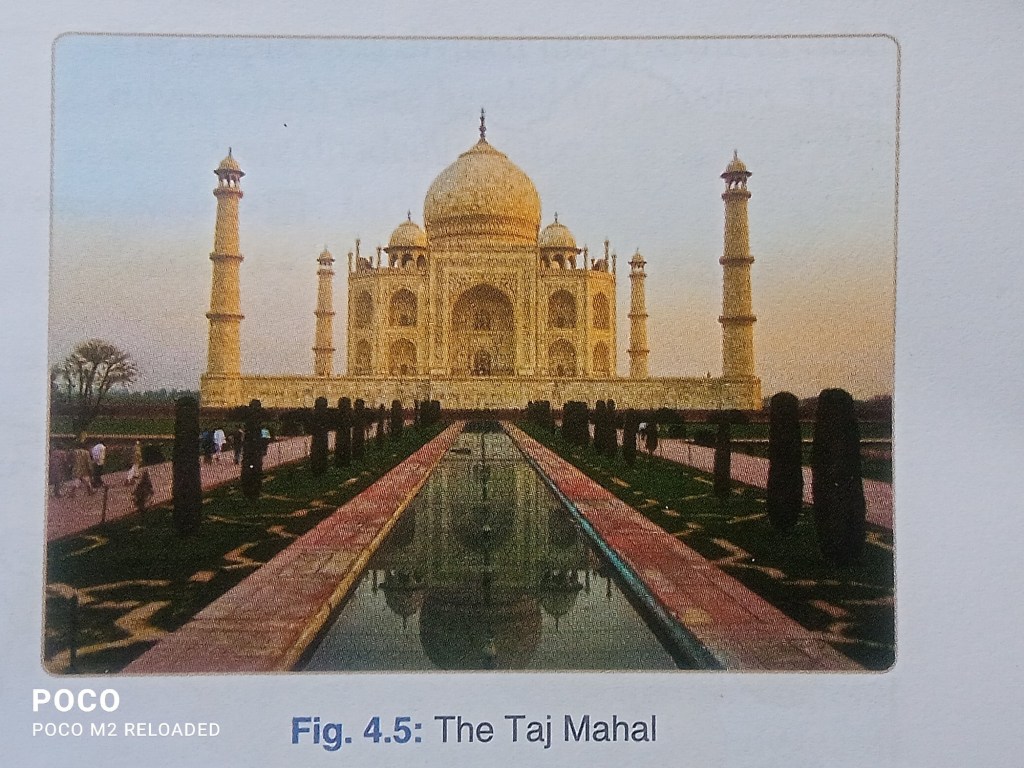
The Mughal Empire

( 16th — 17th Century)

The Taj Mahal is made by Shah Jahan for his beautiful queen Mamtaj Mahal

Question and answers for the chapter “The Mughal Empire” , Class — vii, subject — Social Science.

A. Very short answer type questions:

  1. Name the autobiography of Babu in which language it is written?                 Ans: the autobiography of Babur is called the Baburnama and it was written in chagatai turkic.
  2. Who defeated Humayun twice? Mention the places and years.                                 Ans: Humayun was defeated twice by Sher ShahSuri.The first defeat was at the battle of Chausa in 1539, and the second was at the battle of Kanauj in 1540.
  3. Between whom and when was the battle of Haldighati caught?                                Ans: the Battle of Haldighati was fought between Maharana Pratap of Mewar and the forces of Akbar led by Mansingh I of Amber in 1576.

4. What is the meaning of Noor Jahan who was she

Ans: “Noor Jahan” means ” Light of the world” She was the wife of the Mughal emperor Jahangir originally named mehr-un-nisha.

5. The Mughals were descendants of Two Famous rulers

Ans: The Mughals were descendants of Genghis Khan from the maternal side and Tamerlane ( Taimur) from there paternal site.

B. Short answer type questions:

1. Write a short note on the raign of Sher Shah Suri.

Ans: Sher Shah Suri was an Afghan ruler who established the Sur Empire in North India after defeating the Mughal Emperor Humayun. Sher Shah Suri was known for administrative reforms, including a new tax system, building roads and enhancing trade. Hi policies influenced later Mughal rulers.

2. Describe the administrative changes introduced by Akbar

Ans: Akbar introduced several administrative reforms to strengthen his Empire. He implemented the mansabdari system to organise his army and bureaucracy established a centralized administration, and promoted religious tolerance called sulh-i-kul. His reforms laid the foundation a stable and prosperous Empire.

3. Write a short note on Noor Jahan.

Ans:  Noor Jahan was the influential wife of Emperor Jahangir and one of the most powerful women in Mughal history, She effectively handled the administration and made important decisions on behalf of Jahangir. Known for her intelligence and political acumen, she influence the Mughal court and supported architecture poetry and art.

4. Describe the cultural contribution of Shah Jahan.

Ans: Shah Jahan is known for his significant contributions to Mughal architecture. His reign  saw the construction of iconic structure like the Taj Mahal, The Red Fort, The Jama Masjid. His architectural achievements symbolised the Zenith of Mughal Art and culture.

5. Write a not on Aurangzeb in the battle in Deccan

Ans:  Aurangzeb expanded the Mughal Empire into the Deccan region, defeating the Maratha ruler Shivaji’s successor and other southern kingdoms. Although he achieved military success, the prolonged campaigns drained the Empires resources and eventually contributed to is decline. His  policies led to increased resistance in the Deccan.

C. Long answer type questions

1. Assess the fact that it was Akbar who expanded and consolidated the Mughal Empire.

Ans: Akbar played a crucial role in expanding the Mughal Empire. He extended Mughal territories through conquest in Gujarat, Bangle, Rajasthan and the Deccan. Beyond military success, Akbar’s policy of Sulh-i-kul fostered religious tolerance  which  helped integrate diverse communities. His administrative reforms like the Mansabdari system and land revenue system, established a stable governance model. Akbar’s vision and policies made the empire one of the most powerful in the world during his reign.

2. Describe Akbar’s Rajput policy.

Ans:  Akbar’s policy was a mix of diplomacy, alliances, and military actions. He married Rajput princesses recruited Rajput nobles into his court , and granted them high ranks. This approach fostered loyalty among the Rajputs who became vital allies and  administrators  within the empire by winning their trust, Akbar was able to secure the Northwest Frontier and strengthen his rule.

3. Write about the mansabdari system under the Mughals.

Ans:  The mansabdari system was military and administrative system introduced by Akbar. Officials known as mansabdars, were assigned ranks that determined their status salary  and number of soldiers  they maintained. This system helped centralize control and ensured loyalty to the emperor, as appointments and promotions depended on merit and the rulers favour.

4. Justify the fact that land was the main source of revenue for the  Mughals.

Ans:  Land revenue was the Mughal Empire’s primary source of income as agriculture was the main economic activity, as agriculture dominated. Taxes collected financed the army and administration.

5. Discuss Aurangzeb religious policies.

Ans:  Aurangzeb’s religious policies were more orthodox compared to his predecessors. He introduced the jizya tax on non-Muslims banned certain cultural practices, and destroyed some Hindu temples. His policies led to discontent among non-Muslims and weaked alliances that previous had cultivated. This approach eventually contributed to internal dissent and the decline of the empire.

Teachers Day speech

Good morning respected principal sir, teachers, elders brothers and sisters , friends and all the Guardians.

Today we gather to celebrate the remarkable role teachers play in shaping our lives. A teacher is more than just someone who just someone who imports knowledge; they are mentors, guides, and often, our greatest supporters. Their influence extends far beyond the classroom helping us grow not only academically but also as individuals.

Teachers inspire us to dream big, work hard and believe in ourselves. They have the power to unlock potential we never knew we had pushing us to achieve greatness.

On this Teachers Day, let’s take a moment to express our deepest gratitude for their dedication, patience, and endless encouragement. To all teachers: thank you for your unwavering commitment to shaping a brighter feature.

Happy Teachers Day

Thank you

                    ooooooooooooooooooo

Melodious and enchanting Teachers’ Day speech for a Class 1โ€“4 child:
Writing


๐ŸŒธ Teachers’ Day Speech ๐ŸŒธ


Good morning to everyone!
Respected Principal, dear teachers, and my lovely friends,


Today is a very special day because today we celebrate Teachers’ Day.


A teacher is like a guiding star,
Who helps us shine from near and far.


A teacher is like a candle bright,
Who fills our lives with knowledge and light.
Dear teachers, you teach us to read and write,
To be kind, to do what is right.
You hold our hands and show us the way,
And make us better every day.


Thank you, dear teachers, for your love, care, and patience. We are truly lucky to have wonderful teachers like you.


Happy Teachers’ Day to all my dear teachers!
Thank you and have a wonderful day! ๐ŸŒท

Bonku Babu, Lesson – 13

B1 Choose the correct answer.

  1. We know that Bonku  Babu was a mild- manners man because                    

a) he never laughed.

b) he never reacted even when the students teased him.

c) he was afraid of the aliens.

Ans : (b)

2. Sripati Majumdar liked inviting  people to his house because

a) he liked feeding them.

b) he could talk to them.

c) it made him feel important.

Ans : (c)

3.Chandi Babu was not interested to talk about rockets because

a) he had not seen them take off.

b) he was afraid of them.

c) he would get burnt  if  he went near them.

Ans: (a)              

4. Nidhi Babu, Chandi Babu and others laughed

at Bonku Babu because                                                  (a) he was so quit

b) they thought he was stupid.

c) he wanted to know  what would happen if aliens landed on earth.

Ans : (b)

5.Bonku Babu left Sripati Majumdar’s house early because

a) he was tired of  being made fun of.

b) he wanted to rest home.

c) he wanted to meet the alien.                               Ans : (a)

6. The pink light shining all around in the bamboo grove was coming from

a) a giant football in the field.

b) a bowl of water with coloured fish in it.

c) an upturned giant glass bowl.

Ans : (c)

B2. Answer this questions

1. Why did everyone tease Bonku Babu?

Answer Bonku Babu is a meek and timid village school teacher. The villagers particularly his students and others tease him because of his shy, introverted nature and lack of assertiveness.

2.Whose house did Bonku Babu go to on weekends?

Answer: Bonku Babu went to the lawyer Sripati Majumdar’s house on weekends

3.How was Bonku Babu usually treated by Sripati Majumdar and his friends?

Answer :  Bonku Babu was treated with ridicule and  disrespect by Sripati and his friends, who mocked him for his timid and awkward nature.

4. What did Bonku Babu see in the bamboo grove?

Answer: He saw a pink light shining all around and an upturned joint glass bowl.

5. Why did Bonku Babu feel there was something strange about the night?

Answer :  He likely felt strange because of the unusual humming sound and the pink light in the bamboo grove, which suggested something otherworldly  or  alien to him.

6. What happened after humming sound stopped?

Answer : After the humming sound stopped, the pink light likely disappeared, and Bonku Babu might have realised something extraordinary was happening, possibly related to the alien encounter he imagined.

D1. Fill in the blanks with the correct words from those given in brackets

1. The school is closed on __________ . (weekends/ wekends).

Answer:  weekends

2. I love to__________ seashells from the seashore. (collect / colect)

Answer: collect

3. She borrowed my__________ when it started raining ( umbrella / umbrela)

Answer :  umbrella

4. The moon is a________ of the earth.(satellite/satelite)a

Answer:  satellite

5. Our science room has a glass Case full of  __________ of plants and animals.( specimens/speecimens)

Answer: specimens

6. I saw a small mummy preserved in the _________ (musum/ museum)

7. The child felt an ________ current on touching the wire.(ellectrec/ electric).

8. We suddenly heard loud noise followed by the __________ of glass.( shattering/shattring)

Answer: shattering

9. The old man walked ________ because he had painful joints.(stiffly/steefly)

Answer: stiffly

10. My friend Sonal__________ that I go to her house on her birthday.(insested/insisted)

Answer: insisted

D2. Complete the words by reading there meanings

1 . p_zz_ _d        —   confused                                      Ans : puzzled

2.  in_ _s_ble     —     cannot be seen                          Ans : invisible

3. tr_d_t_ _n       —     a belief or practice               Ans : tradition                         

4.wr_nk_ _d       —     crumpled or Christ                Ans :wrinkled

5. r_p_ _ _ted     —     said something again and                                              again                                                                               Ans :repeated                                                               

6. im_ _rt_ _t      —      central or main                 Ans :important     

7.n_rm_ _lly          —      usually                               Ans :normally                                                           

8. m_s_ _m            —      a place where valuable things are stored                                                        Ans :museam

9. r_ _k_t                —       a space vehicle                Ans :rocket

10. sp_c_m_n        —         a sample                             Ans :specimen

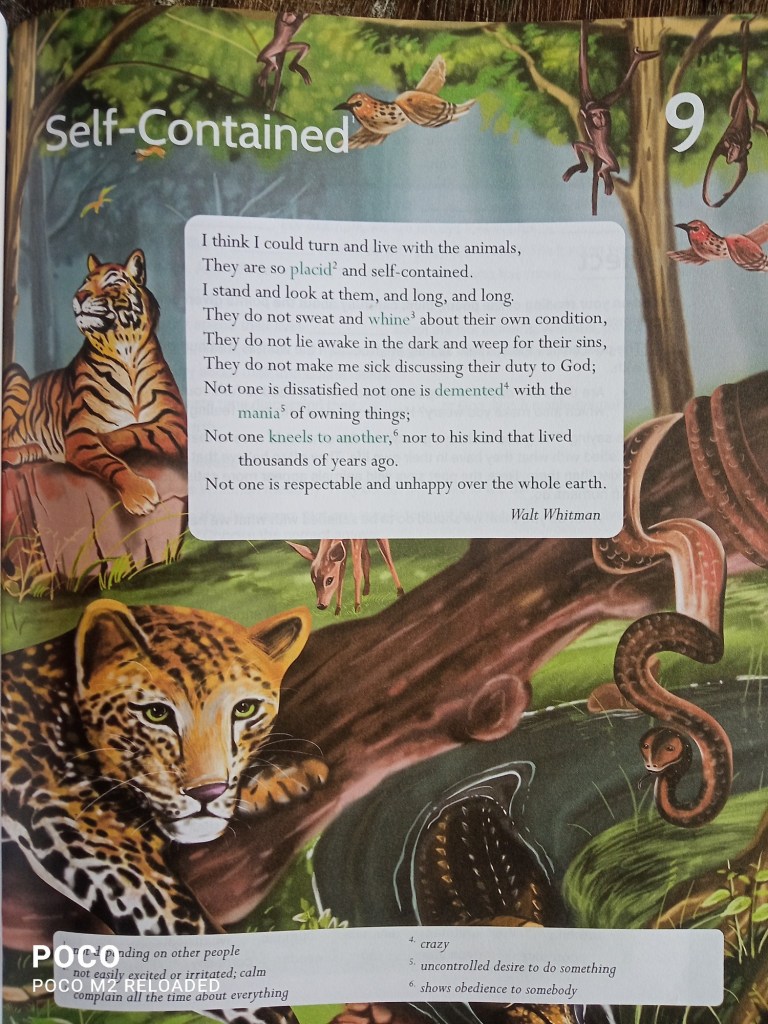
Self-contained, Class-VI, Poem by Walt Whitman, question and answers.

Summary for the poem Self-contained:

The poem Self- Contained written by Walt Whitman, highlights the importance of independence and self reliance. It encourages individuals to believe in themselves, face challenges confidently and manage without always relying on others. The poem promotes inner strength and self confidence.

New Words:

Self-contained– not depending on other people

Placid — calm

Whine — complain all the time about e                  everything

Demented — crazy

Mania — uncontrolled desire to do something

Kneels to another — shows obedience to somebody

Answer this questions

1. What does Whitman mean by ‘ They do not lie awake in the dark and weep for their sins’?

Ans : This line suggest that animals don’t feel guilt or regret like humans do. They live naturally without dwelling on  their actions or feeling remorse for things done in the past.

2. What does this line mean: ‘Not one kneels to another, nor to his kind that lived thousands of years ago’? Choose the correct answer.

a) Animals  unlike humans, believe in hierarchy.

b) Animals cannot kneel.

c) Animals, unlike humans, don’t try to impress others of their species and don’t worship their ancestors either.                                                           Ans : c      

3. What does ‘Not one is respectable and unhappy over the whole earth’ mean ?

Ans : This line means that animals are not concerned with ideas of respect and status as humans are. They are content and not weighed down by concerns about being respected or unhappy with their place in the world.

                     ๐Ÿ˜Š๐Ÿ˜Š๐Ÿ˜Š๐Ÿ˜Š๐Ÿ˜Š๐Ÿ˜Š๐Ÿ˜Š๐Ÿ˜Š

Role of Government in Healthcare, Class-7, Subject- SST,

A. Choose the correct answer

1. Absence of illness and injury means:

(a) Wealth (b) Sanity  (c) Health  (d)  Public Health system                                                         Ans: ( c)

2. The manpower of a country is its

(a) Human resources  (b) Power stations           (c)    Electricity     (d) Political leaders                 Ans:  (a)

3. 21% of all the communicable diseases are:

ย  (a) Waterborneย ย  (b) Terminalย ย ย  (c) Mentalย ย ย ย ย ย  (d) Psychological                                                   Ans : (a)

4. A foreigner can stay in India for medical reasons for:

(a) 15 daysย ย  (b) 3 monthsย ย  (C) 20 daysย ย ย ย ย ย ย ย ย ย ย ย  (d)30 days                                                                Ans : (b)

B. Fill in the blanks.

1. Health of the citizens affects development of a nation.

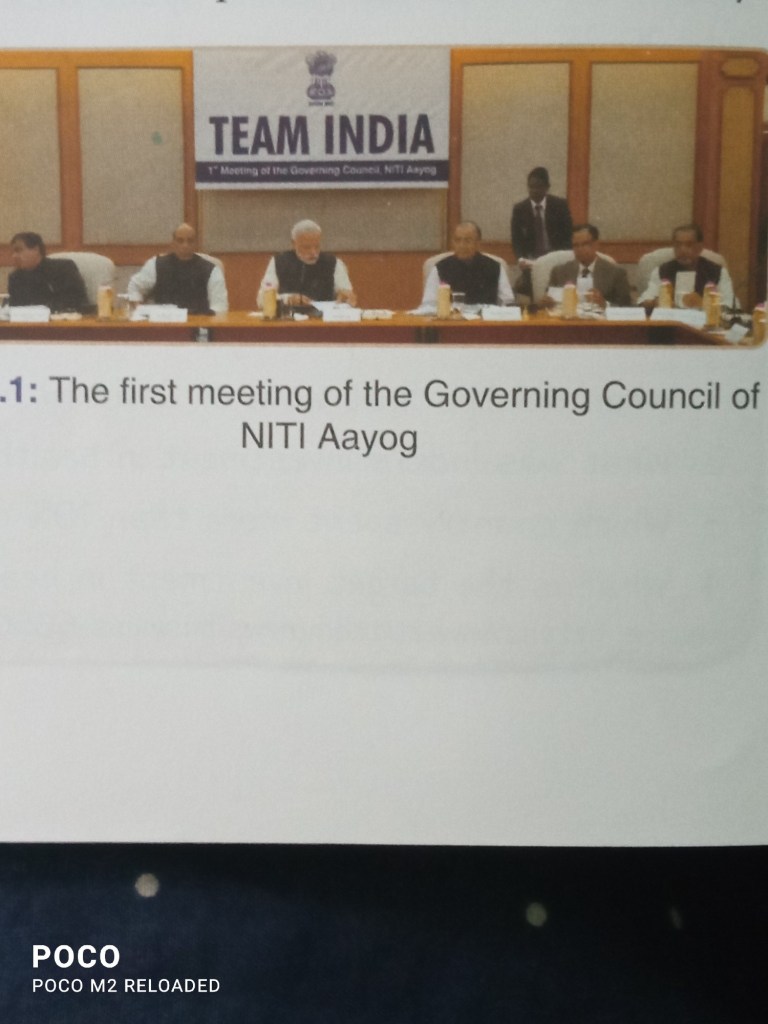
2.Niti Aayog replace the planning commission in 2015

3. The full form of WHO is World Health Organisation.

4. Private Healthcare facilities are very expensive.

C. Match the columns.

  1. International organisation that provides assistance to Public Health Care programs— WHO

2. Private Healthcare —  Healthcare and medicine provided by entities other than the government.

3. The Ministry of Health and Family Welfare —A central government body responsible for forming health policies.

4. Waterborne diseases —- Dysentery jaundice hepatitis diarrhoea.

5. Niti Aayog — Set up on January 1, 2015.

D. Write T for through and F for false statements

1. A person with no illness and injury is considered healthy.     (True)

2. India has only government-run dispensaries and hospitals.     (False)

3. Kerala has the poorest health service facilities in India.      (False)

4. Medical tourism is a growing sector in India.

(True)

E. Very short answer type questions

1. What do you mean by health?

Answer– Health is a state of complete physical mental and social well-being, not marely the absence of disease or Infinity.

2. What are the factors on which the health of a person depends?

Answer– The health of a person depends on factors such as genetics, lifestyle, environment, access to health care, and socio- economic conditions.

3. How does the government private organisations and NGOs try to prevent or treat illness

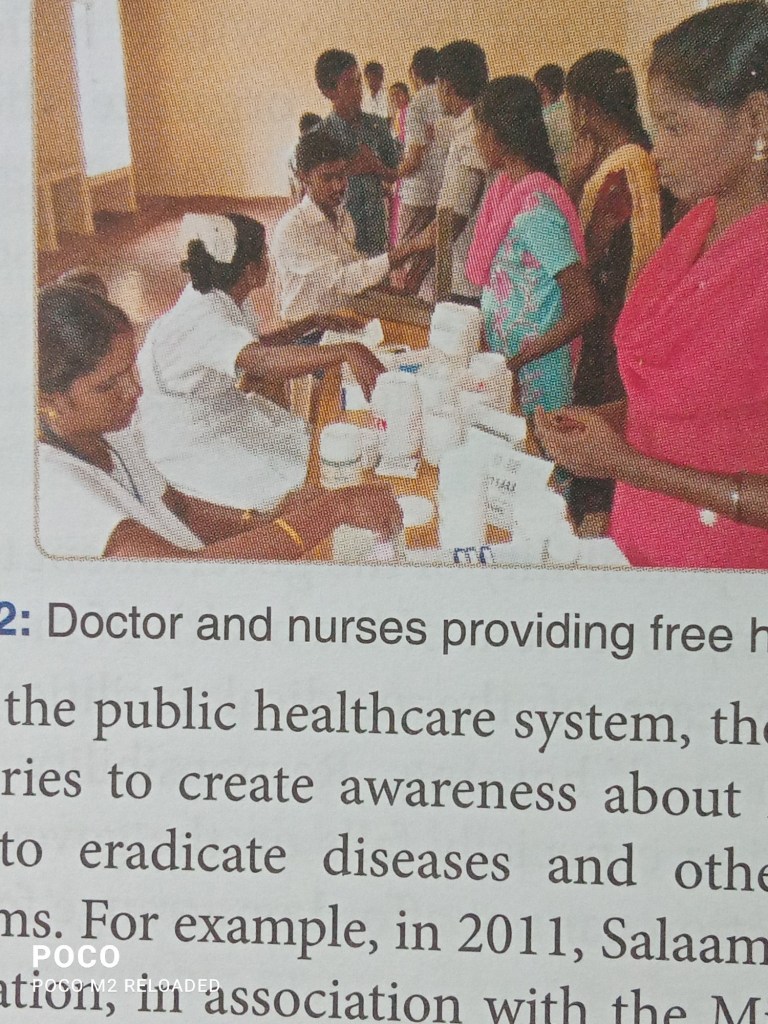
Answer –they implement health policies, run awareness campaigns, provide vaccinations, offer healthcare services, and promote sanitation and hygiene.

4. List the reasons why large sections of the population do not have access to medical care.

Answer— Reasons include poverty, lake of healthcare, infrastructure, geographical barriers, and insufficient healthcare professionals in remote areas.

5. How does the government use the money paid by citizens is Texas

Answer—The government uses tax money to fund public services like healthcare, education, infrastructure, and social welfare programs.

F. Short answer type questions

1. What is Niti Aayog why was it formed

Answer— Niti Aayog is a policy think tank of the Indian government, formed in 2015 to replace the planning commission. It was created to provide strategic and technical advice on economic and social issues.

2. Explain the working of the public health care system

Answer— The public health care system in India is run by the government, providing affordable healthcare services to citizens through a network of hospitals, dispensaries, and healthcare centres. It focuses on preventive care, treatment, and health Promotion.

3. Write a not on Private Health Care system.

Answer — The private healthcare system consist of privately-owned hospitals clinics and healthcare providers. It offers high quality services but is often expensive and primarily accessible to those who can effort it or have insurance coverage.

4. India has become a destination for medical tourism. Elaborate.

Answer— India has emerged as a leading destination for medical tourism due to its advanced healthcare facilities, skilled medical professionals, and affordable treatment cost. Patients from around the world come to India for treatment such as surgeries, organ transplants and specialized medical care.

G. Long answer type question

1. What guidelines have been mentioned in the Directive Principles of State Policy related to healthcare? How do they ensure access of all the resources to all community.

Answer— In the field of healthcare, the Directive Principles of State Policy ensure that:

. Citizens get required means of livelihood.

. Equal pay for equal work is given.

. Sick, aged, unemployed and disabled get works, education, and public assistance.

. Maternity relief is given to working women.

. The level of nutrition and standard of living condition is raised and public health is improved.

To ensure available of resources, public health expenditure in a state is shared by the Central and State the government. NGOs and international organisation like WHO also provide assistant to public health care programmes.

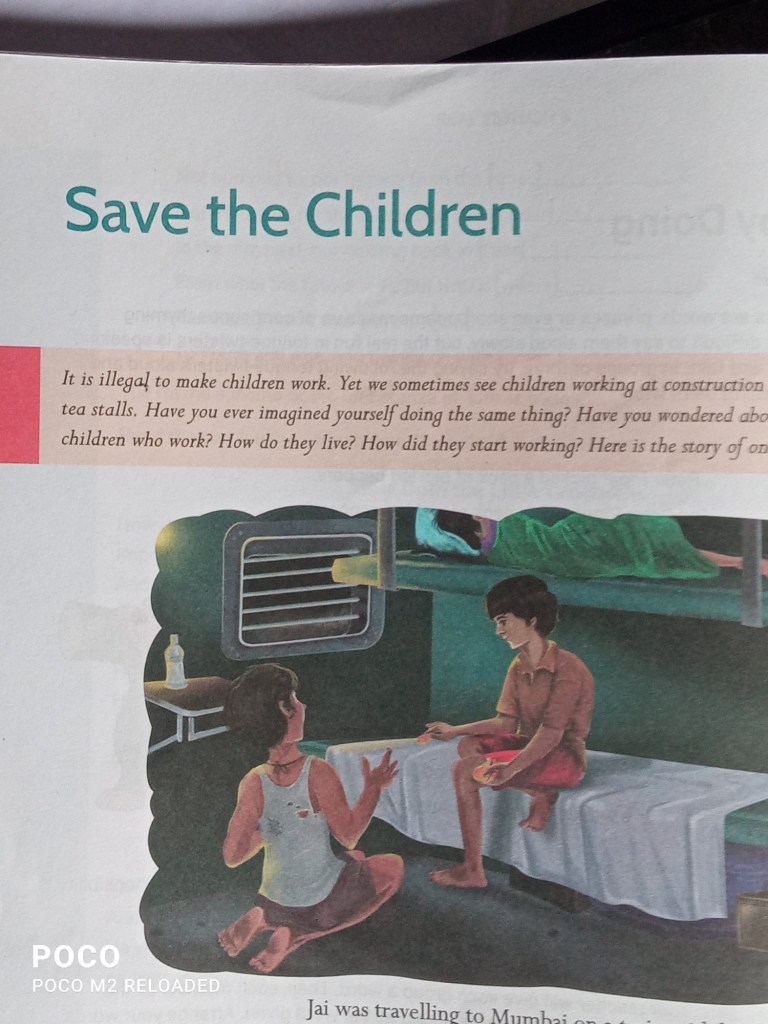
Save the Children,Class- VI,Exercises or questions and answers, Lesson- 12.

B 1. Choose the correct answer.

  1. What were jai’s plans for the holidays?

a) He was going to make new friends.

b) He was going to sleep a lot.

C) He was looking forward to being pampered by his grandmother.

Ans — c

2. Who was Shantu?

a) He was an abandoned boy of ten years.

B) He was a friend of Jai

c) He was a boy travelling to Mumbai with his family on the same train as Jai.

Ans– a

3. What are children like Santu known as?

a)  criminals         b)homeless children     c)whizzkids

Ans — b

4. Why was Shantu left behind by his own father?

a) Shantu was a naughty boy and he was left behind as a punishment.

b) He was not loved by his family.

c) His family was so poor that they could no longer look after him, his three brothers and two sisters.

Ans — c

5. What is the practice of making children work called

a) exploited labour   b) children labour    c)young labour

Ans– b                                                                             B 2. nswer these questions.

1. What do you think would have happened to Shantu’s other brothers and sisters?

Ans – Shantu’s other brothers and sisters likely fates. They may have been abandoned or sent to work in hazardous conditions.

2. How are parents into sending their own children of to work

Ans–Parents are often tricked by promises of a better life for their children, which is a lie.

3. What kind of do working children late

Ans– The life of working children is difficult and dangerous. They are forced to work long hours, sometimes up to 16 hours a day in unsafe conditions.

4.In what kind of work/ factories are small children employed?

Ans — Small children are employed in various hazardous industries such as making crackers, working in construction sites, and Silk factories.

5. In what kind of conditions do such abandoned children live?

Ans — Abandoned children live in terrible conditions. They are often homeless, hungry, and have to fend for themselves. They might sleep on the streets, in small corners, or even in dangerous places like railway stations.

6.Why do you think Jai’s life changed forever after meeting Shantu?

Ans —  Jai’s life changed because meeting Shantu opened his eyes to the harsh reality  of  child labour and poverty. It made him realise how fortunate he was and likely  instilled in him a sense of empathy and a desire to help those less fortunate.

C 1. Think and answer

  1. How is Shantu’s life different from Jai’s?

Ans —  Shantu’s life is filled with hardship and survival struggles. He is an abandoned child, forced to work, faced to work in dangerous conditions to survive. On the other hand, Jai lives a comfortable life with his family.                2. Suggest a few ways to end child labour and exploitation

Ans — Following are few ways to end child labour and exploitation.

a) Enforce lawsย ย ย  b) Provide educationย ย ย ย ย ย ย ย ย ย  ย ย  C) Rate awarenessย ย  d) Support poor families.

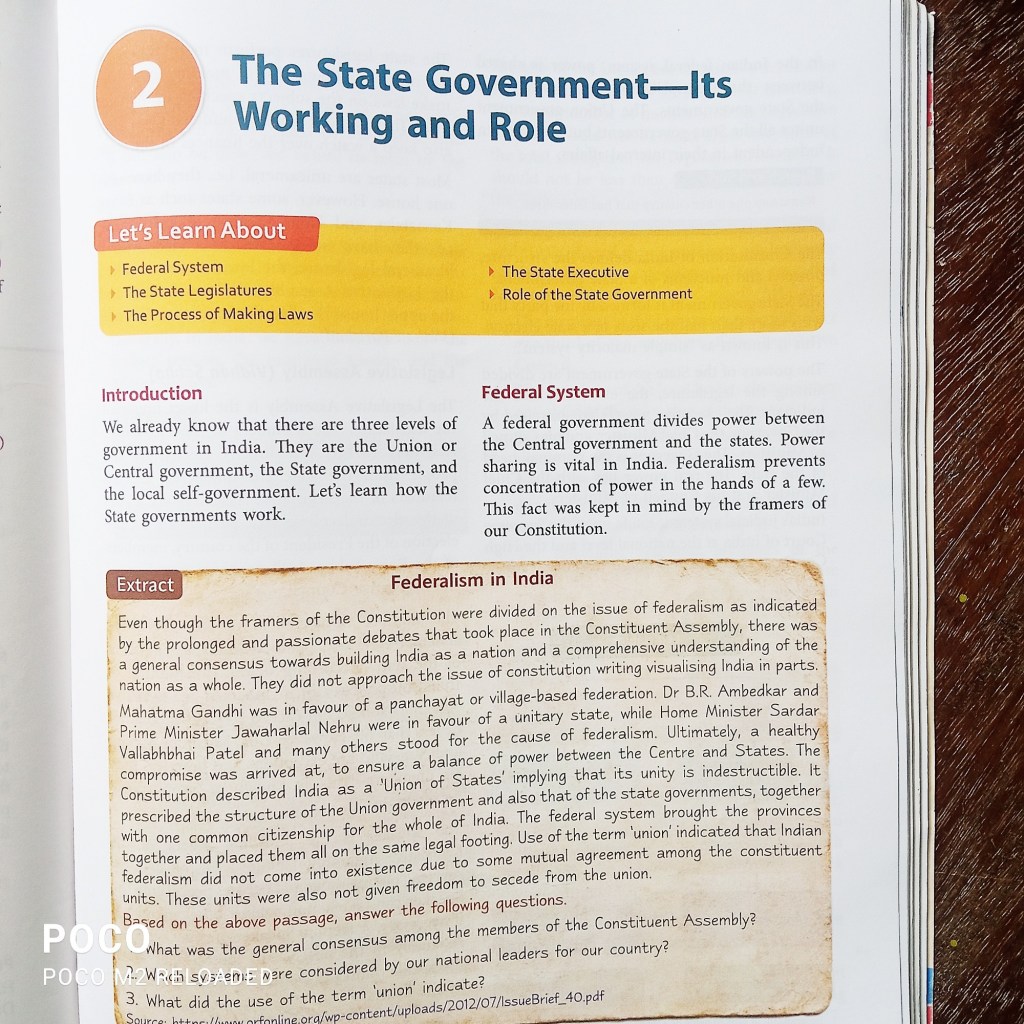
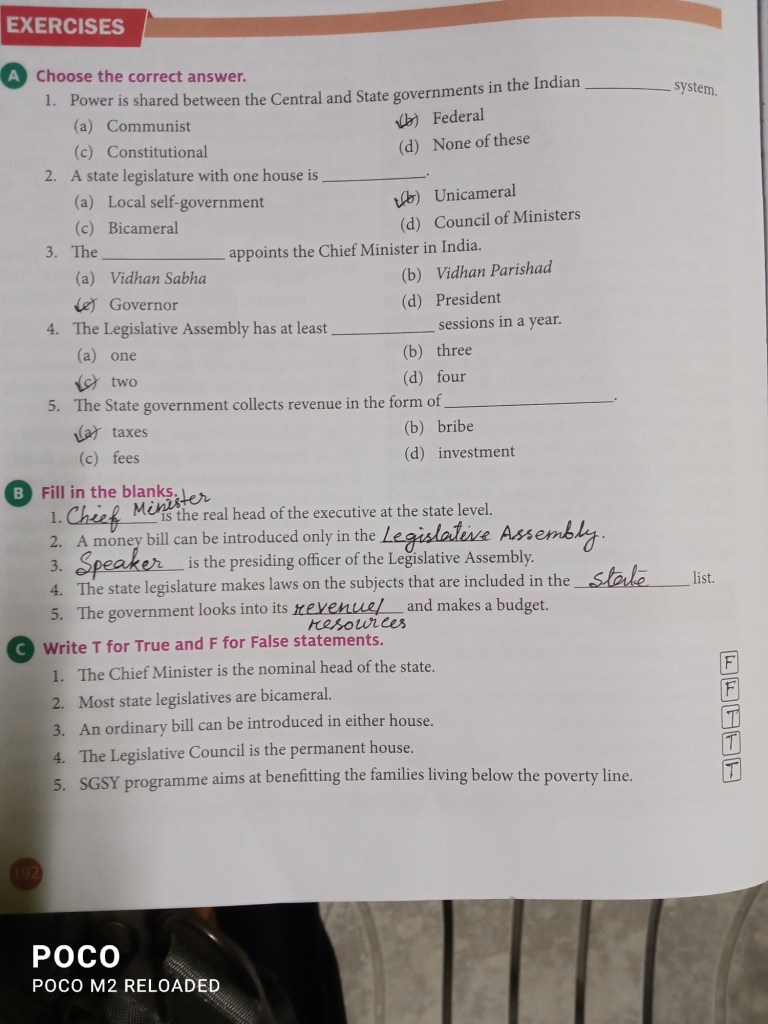
The State government-its working and rules

D. Define the following terms.

  1. Council of Ministers     

  Answer: The council of Ministers is headed by the Chief Minister and includes cabinet ministers and other ministers.

2. Deadlock

Answer: A situation where no progress can be made or no advancement is possible due to disagreement among parties or within a legislature.

3. Proportional representation

Answer : An electoral system in which seats in a legislature are allocated to political parties in proportion to the number of votes each party receives in an election.

4. Simple majority system

Answer: An election system in which the candidate or party that recieves more votes, than any other wins. It does not require an absolute majority.

E. Very short answer questions.

  1. What is federalism?

Answer: Federalism is s system of government in which power is divided between a central authority and constituent political units (like states and provinces.

2. How are the powers of a state government divided?

Answer: The powers of a state government are divided into three branches : the executive, the legislature, and the judiciary.

3. Write about the term of the Legislative Assembly.

Answer: The term of the Legislative Assembly is typically five years, unless dissolved sooner.

4. When are the sessions of the Legislative Assembly held?

Answer: Sessions are held at regular intervals, usually including Budget, Monsoon and Winter session.

5. Explain the composition of the state Legislative Council.

Answer:It’s composition includes members elected by the Legislative Assembly, graduates, teachers, and local authority members as well as members nominated by the Governor.

F. Short answer type questions

1. Describe the main functions of the state legislature

Answer: Making law,s approving the budget, debating policies, representing public interest, and holding the executive accountable.

2. Difference between the Legislative Assembly and legislative council

Answer: The Legislative Assembly is the directly elected lower house; The Legislative Council is the indirectly elected Upper house.

3. How is a Legislative Assembly constituted

Answer A Legislative Assembly is constituted through direct elections where representatives are elected by the voters in their respective constituencies. The number seats is determined based on the population of the state.

4. Mention Qualifications necessary to become an MLA

Answer:  To become a member of the Legislative Assembly (MLA) a person must be the citizen of the country, at least 25 years old, and meet other qualifications as specified by the electoral laws,such as not holding any office of profit under the government.

5. They Chief Minister is the real hat of the state executive elaborate

Answer: The Chief Minister is the head of the state government and leads the executive branch. They are responsible for implementing policies, overseeing the functioning of various departments, and representing the state both internally and externally.

G. Long answer type questions.

1. Describe the process by which a bill becomes a law.

Answer: A bill goes through several stages before becoming a law:

(i) Introduction: The bill is introduced in either house of the legislature.

(ii)First reading: The bill is read out and members discuss its general principles.

(iii)Committee stage: The bill is examined in detail by a committee.

(iv) Second reading: The bill is debated and may be amended.

(v) Third Reading: The final version of the bill is debated and voted on.

(vi) Approval by the other house: The bill is sent to the other house for similar consideration.

(vii) Presidential assent: If both houses pass  the bill, it is sent to the president (or governor in case of state bill) for assent.

(viii)Becoming law:  Once the president (or governor) signs the bill, it becomes law.

2. Write a short note on Council of Ministers.

Answer: The Council of Ministers composed of various ministers including Cabinet Ministers, Ministers of states and Deputy Ministers. They are responsible for different portfolios such as defense, finance, health etc. The Council of Ministers aids and advises the President (or Governor) and is collectively responsible to the legislature.

3. Explain the powers and functions of the Governor.

Answer: The Governor is the constitutional head of a state and performs various functions including:

(i) Summoning and Proroguing sessions of the state legislature.

(ii) Giving assent to bills passed by the state legislature.

(iii) Appointing the Chief Minister and other ministers.

The Cruel King of the Jungle-II,Exercises,

The Cruel King of the Jungle

Exercises

  1. Which of this statement are true and which are false                                       (a)The Lion listened quietly to what the jackal had to say.ย ย ย ย ย  (False)

(b)The Lion liked the vulture’s plan because he was getting old.       (True)

(c) One animal was brought by the jackal to the lion everyday.       (False)

(d) The poor rabbit trembling with fear ran to the lion’s den.       (False)

(e) The rabbit was chased by another lion.  (False)

(f) All the animals were happy when the lion was drowned.      (True)

2.Who said the following and in what situation.

(a)That is the other lion, sir!

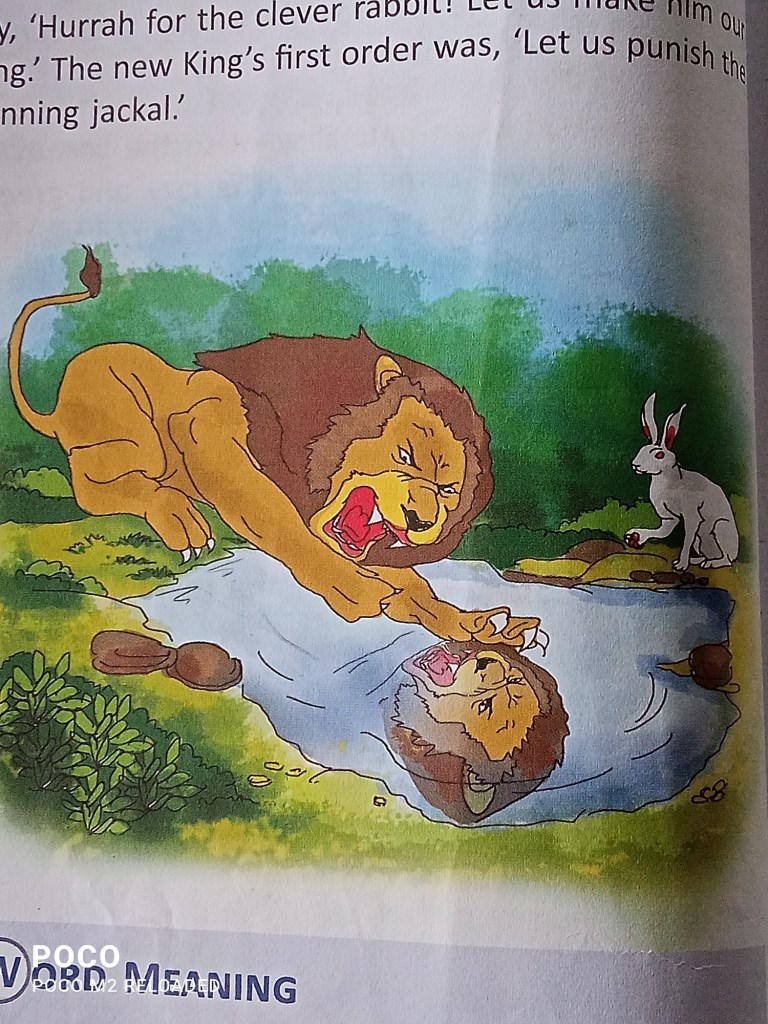
Answer: The rabbit said this to the lion when the image of the lion snarled into the cliff.

(b) Am I not the king of all the beasts?

Answer: It is said by the lion when the jackal informed that all the animals were planning to kill him.

(c) Hurrah for the clever rabbit!

Answer:All the beast of the Jungle said this for the rabbit as he cleverly  killed the lion.

(d)Each day one of us one of us will come to you to become your meal.

Answer: The vulture said this line, when he brought a plan from all the animals in front of the lion.

(e) Let us punish the cunning jackal.

Answer: The clever rabbit said this line, when he became the king of the Jungle.

(f) I’will kill him first and then have my dinner.

Answer:This was said by the lion when the rabbit told him about another lion.

Word Practice

Select the correct meaning of the word bold in each sentence:

(a) I came late because another lionย chased me.

(caught, ran after, attacked)

Ans: ran after

(b)The vulture perched himself on the tree.

(restart, searched,set on a branch)

Ans:  sat on a branch

(c) The Lion in the image also snarled.

(barked, showed his teeth fiercely, roared)

Ans: showed his teeth fiercely

(d) There wasย gloom all over the rabit’s house.

ย  (sadness, darkness, deep sorrow)

Ans: darkness

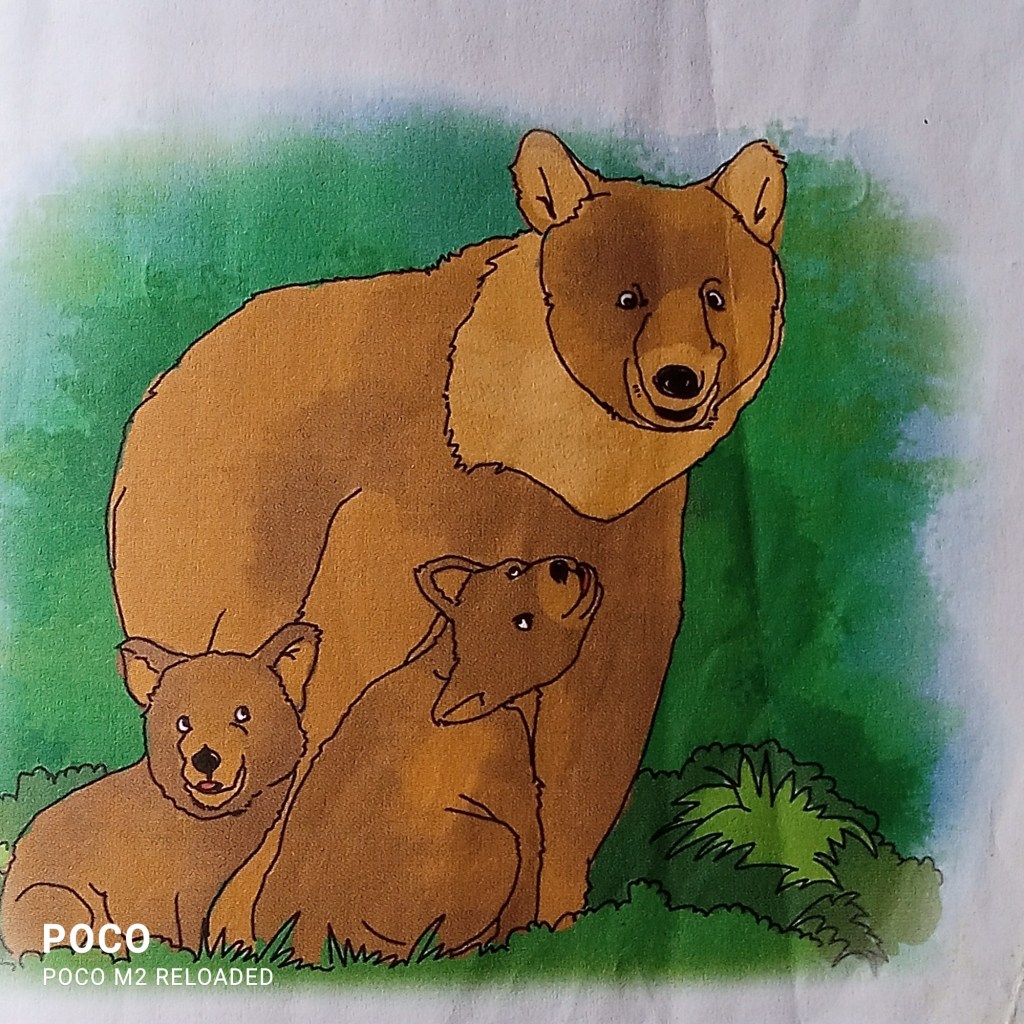
Bhaloo, The Bear– I

Class- IV,Subject- English, Lesson- 13,Exercises.

Mother Bear and her cubs

A. Answer the following questions

1. Why did Mother Bear often punish Bhaloo when he was a little bear?

Answer: When he was a little bear, Mother Bear often punish Bhaloo for his mischief.

2.Why did Baloo and his sister whimper and squeal when there mother wanted to go out hunting at night

Answer Bhaloo and his sister whimper and Squeal when there mother wanted to go out for hunting at night, because she told them to go inside the cave.

3. What stories did Mother Bear sometimes tell the two children during the day?

Answer: Mother Bear sometimes tell them stories about the forest and the great world outside.

4. Who was the greatest enemy of Mother Bear and her family?What advice did she give to the children about him?

Answer: The tiger was the greatest enemy of Mother Bear and her family. Mother Bear warned the cups against sher.She told them that he was not to be trusted and so, they must never go near him or speak to him.

5. Why did Mother Bear want to go the orchard when the cubs were about three months old?

Answer:When the cubs were about three months old, Mother Bear wanted to go to the orchard, because the apples in the orchard on the hill are ripe and she wanted to bring some fruit for her cups.

6. What did she tell the cups before she left the cave?

Answer: Before she left the cave Mother Bear told her cups to be very careful for she heard that sher prowling about that afternoon and sound  angry.

B. Complete the following sentences.

(a) Bhaloo’s small black nose was always sniffing because………….

Answer: he was in  search of food.

(b) Mother bear often slept in the daytime because…………….

Answer: she was tired after being out all night.

(c) Bhaloo liked best to hear about sher because…………

Answer:he was there greatest enemy.

(d) Mother Bear had to push Bhaloo back into the cave because………..

Answer: it was dangerous outside.

(e) The two cups cried out with delight because………

Answer: they loved the red apples their mother brought home.

Create your own website, free on WordPress.com.Create your own website.
Start free