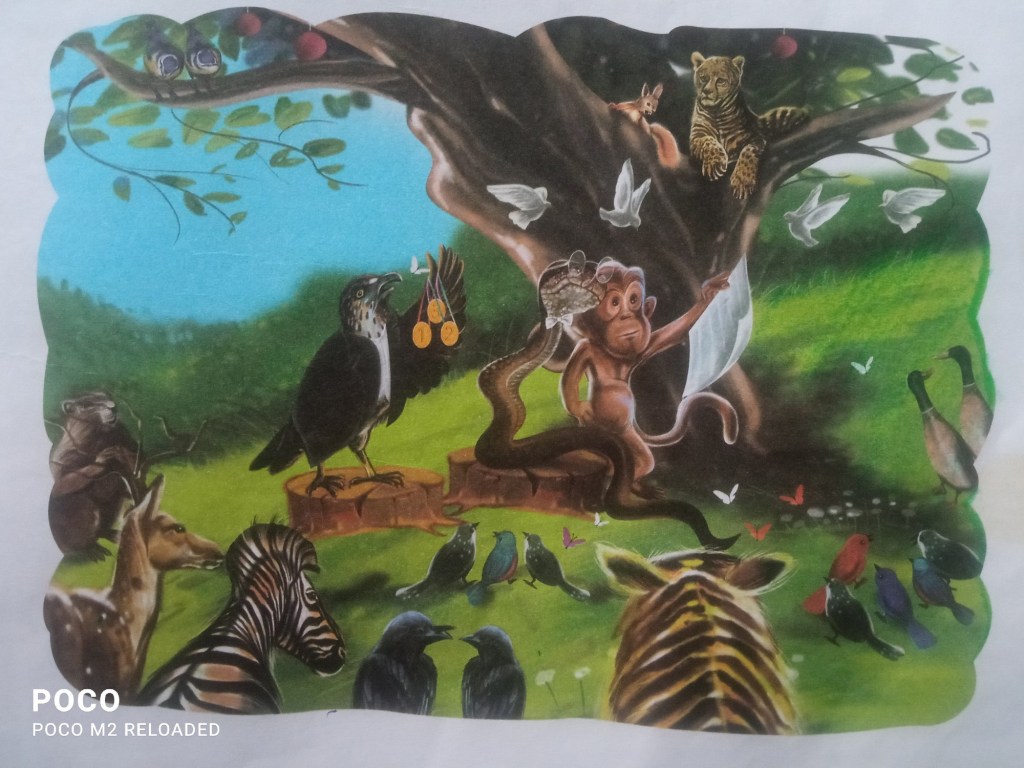
B1. Answer these questions:
1. Why did woodchuck first think that the baby squirrel wanted his food?
Answer:The woodchuck thought that the baby squirrel wanted his food because he arrived early chattering quickly and excitedly.
2. Was Mr Mockingbird truly making fun of the baby squirrel?
Answer:Mr. Mockingbird was not truly making fun of the baby squirrel. He was simply repeating the sounds he heard, which is his natural way of singing. The baby squirrel misunderstood and thought he was being mocked.
3. What was the consequence of Mr Mockingbird’s ability to repeat every song he heard?
Answer:The consequence was that he could remember and repeat every bird’s song, which eventually helped resolve the conflict among birds about which song was the best. His ability made him the best singer in the world.
C1. Think carefully and answer in detail:
1. Find out the definitions of the following:
a) conflict – A serious disagreement or argument, typically a prolonged one.
b) peace – A state or period in which there is no war or conflict; harmony.
2. Identify different types of conflicts (for example, family conflict).
Personal conflict (within oneself)
Interpersonal conflict (between individuals)
Family conflict
Community conflict
Environmental conflict
Political or international conflict
3. How did the advice of the woodchuck ensure that there was peace between the baby squirrel and Mr Mockingbird?
Answer:The woodchuck advised the baby squirrel to learn more and inquire rather than jump to conclusions. This led the squirrel to understand that the mocking-bird wasn’t mocking him, but simply singing. This understanding brought peace.
5. How did the actions of the mocking-bird help to secure peace?
Answer:By remembering and singing all the birds’ songs, the mocking-bird reminded them of their individuality and beauty, leading them to stop competing and appreciate each other’s uniqueness.
D1. Use a physical or online dictionary to find out the meanings of the following words and use them in sentences of your own.
Vocabulary:
1. Ignore – To deliberately pay no attention to something.
Sentence — She chose to ignore the rude comment and walked away calmly.
2. Redirect – To change the direction or focus of something.
Sentence — The teacher redirected the conversation to the main topic.
3. Reassure – To comfort or give confidence to someone.
Sentence — He reassured his friend that everything would be fine.
4. Passive – Accepting things without active response or resistance.
Sentence — She remained passive during the argument.
5. Aggressive – Ready or likely to attack or confront.
Sentence — His aggressive tone scared the younger students.
6. Assertive – Confident and forceful without being aggressive.
Sentence — Being assertive helps in expressing your thoughts clearly.
7. Perspective – A particular attitude or way of viewing something.
Sentence — Try to see the problem from a different perspective.
8. Compromise – A mutual agreement where each side gives up something.
Sentence –They reached a compromise to settle the disagreement.
9. Assumption – A thing that is accepted as true without proof.
Sentence — His assumption about her behavior was wrong.
10. Avoidance – The act of keeping away from something.
Sentence — Avoidance of difficult tasks leads to stress.
—
Conflict-related Phrases:
1. Conflict resolution – Finding a peaceful solution to a disagreement.
Sentence – Good communication is key to conflict resolution.
2. Win-win conflict resolution – A solution where all parties benefit.
Sentence – They used win-win conflict resolution to divide the project fairly.
3. Be accepting – To welcome or tolerate different views.
Sentence – We must be accepting of others’ opinions during a discussion.
4. Setting expectations – Clearly stating what is hoped for or required.
Sentence – Setting expectations early prevents misunderstandings.
5. Suggest alternatives – Offer different options or solutions.
Sentence – She suggested alternatives when the original plan failed.
6. Rolling eyes – A gesture of annoyance or disbelief.
Sentence – He rolled his eyes when asked to clean up again.
7. Looking down – To think someone is less important or worthy.
Sentence – It’s not kind to look down on people because of their job.




 Site 𝓝𝓲𝓻𝓾'𝓼𝓫𝓵𝓸𝓰