I. OBJECTIVE TYPE QUESTIONS
A. Choose the correct answer:
1. Which one of the following is the highest judicial authority in India?
Answer: (a) The Supreme Court
2. Which one of the following refers to the fact that laws apply equally to all persons?
Answer: (c) The Rule of Law
3. The Supreme Court consists of a Chief Justice and not more than:
Answer: (a) 33 other judges
4. The Supreme Court has got Appellate Jurisdiction in:
Answer: (d) all of these (Constitutional, Criminal, and Civil cases)
5. At present, how many High Courts are there in our Country?
Answer: (d) 25
B. State True or False:
1. To reduce time and expenditure, the Lok Adalats have been started.
Answer: True
2. Under the Legal Aid Scheme, any person can take free legal services.
Answer: False (Note: Free legal aid is specifically for weaker sections like SC/ST, women, children, and poor people, not literally everyone).
3. The High Court is the highest court of justice in a state.
Answer: True
4. The Criminal cases cannot be heard by Magistrates.
Answer: False (Magistrates can hear criminal cases).
5. The President can remove a judge only on grounds of mental infirmity or misbehaviour.
Answer: False (Once appointed, it is extremely difficult to remove a judge, requiring a special constitutional procedure/impeachment).
II. SHORT ANSWER TYPE QUESTIONS
1. List the structure of Indian judiciary.
Answer: The Indian judiciary has a pyramid-like three-tier structure:
Supreme Court (Highest court at the national level)
High Courts (Highest courts at the state level)
Subordinate/District Courts (Courts at the district/local level)
2. Why do we need Lok Adalats?
Answer: We need Lok Adalats to solve dispute cases speedily and without spending much money.
3. Describe the main features of the criminal law cases.
Answer: Deals with crimes against society (e.g., theft, robbery, harassment, murder).
Begins by filing an FIR (First Information Report) with the police.
The police investigate the crime, after which the case goes to court.
If found guilty, the accused can be sent to jail or fined.
4. What are the main features of civil law?
Answer: The main features of civil law:
(i) Deals with harm to individual rights (e.g., land disputes, rent issues, divorce).
(ii) A petition is filed directly in court by the affected person.
(iii) The court provides specific solutions (e.g., asking a tenant to pay rent or vacate).
5. In your opinion, what are the two advantages of Public Interest Litigation (PIL)?
Answer: (i) Easy access to justice: Anyone can file a case on behalf of those whose rights are violated.
(ii) Simple procedure: A simple letter or postcard addressed to the High Court or Supreme Court can be accepted as a PIL.
III. LONG ANSWER TYPE QUESTIONS
1. Write a short note on the jurisdictions of the Supreme Court.
Answer:
Original Jurisdiction: The power to directly hear cases for the first time. This includes disputes between the Centre and States, or cases involving Fundamental Rights.
Appellate Jurisdiction: The power to hear appeals against decisions made by lower courts/High Courts in constitutional, civil, and criminal matters.
2. Discuss the composition of High Courts in India.
Answer:
(a) The composition of High Courts in India are:
A High Court consists of a Chief Justice and other judges.
(b) The number of judges is decided by the President based on the population and area of the state.
(c) The President appoints judges after consulting the Chief Justice of India and the Governor of the state.
3. What are the functions of the judiciary?
Answer: Functions of the judiciary:
(i) Resolving Disputes: Solves issues between citizens, governments, or states.
(ii) Judicial Review: Can cancel any law made by Parliament if it violates the Constitution.
(iii) Upholding Laws and Rights: Ensures citizens enjoy their Fundamental Rights.
4. Discuss the accessibility of people to the courts in India.
Answer: In theory, all citizens can access courts.
However, for poor people, courts are often difficult to reach due to high costs, long procedures, and paperwork.
To improve access, mechanisms like PIL (Public Interest Litigation) and Free Legal Aid have been introduced.
5. Why do you think the introduction of Public Interest Litigation (PIL) is a significant step in ensuring access to justice for all?
Answer: PIL allowed poor and uneducated people—who cannot afford court fees or complex legal processes—to get justice.
Any public-spirited person or group can fight a case on their behalf, making justice reachable for millions.
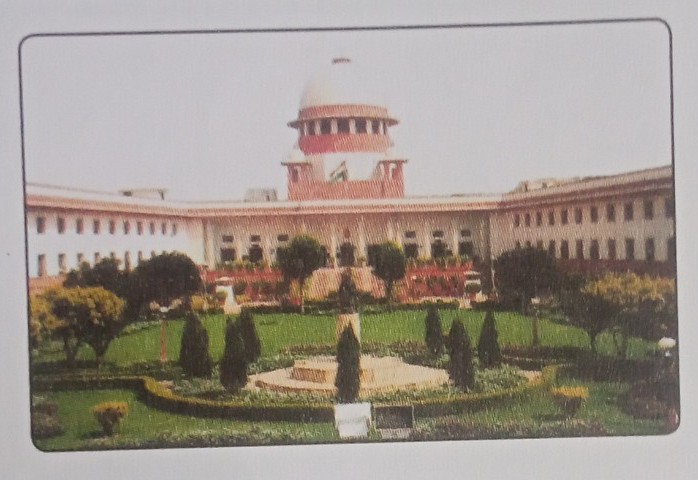
IV. PICTURE STUDY
1. Where is the Supreme Court located in India?
Answer: New Delhi
2. How does the Supreme Court serve as a ‘Court of Record’?
Answer: All judgments and decisions of the Supreme Court are printed and kept as permanent records. Lower courts follow these decisions as laws.
3. What is the Appellate Jurisdiction of the Supreme Court?
Answer: It means the Supreme Court has the power to hear appeals against judgments given by lower courts or High Courts.

