Featured

Bonku Babu’s Friend    14

Class — V, Subject — English, Lesson — 14 , Real English
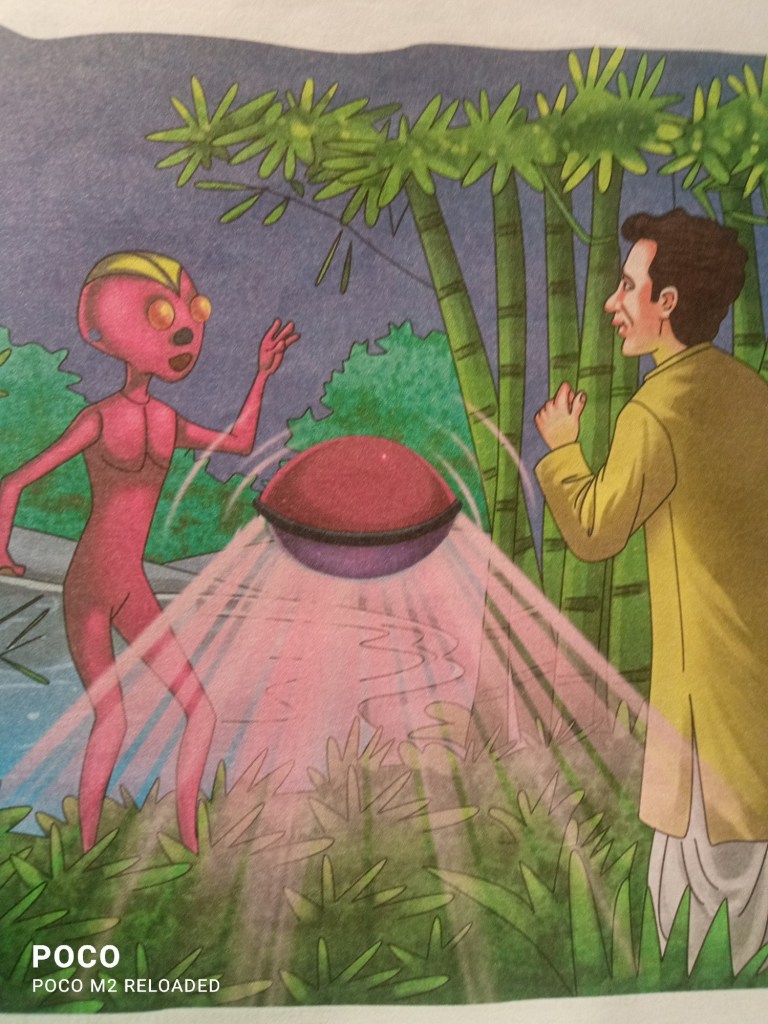
Meeting of Ang and Bonku Babu

A. Questions and answers

1.Who was Ang?

Ans : Ang was an Alien from the planet Craneus.

2. How did Ang come to earth?

Ans : Ang accidentally landed on earth when he intended to go to Pluto.

3. What did he tell Bonku Babu about his planet and about himself?

Ans : Ang felt, proud describing himself as a superior being who knew 14000 languages.

4. What impression did Ang create in Bonku Babu’s mind?

Ans : Ang’s pride and confidence left Bonku Babu feeling that Ang was a powerful and intelligent being.

5. Why did Pancha Ghosh so excited at the Sunday meeting?

Ans:  Pancha Ghosh excited at the Sunday meeting because he was going to tell everyone about bamboo grove ,where all the bamboo around the pond had shed all their leaves.

6. What was the first thing that Bonku Babu did on entering Sripati Babu’s house?

Ans : Bonku Babu burst into a gaffow and laughed  loudly for a whole minute as soon as he entered Sripati Babu’s house.

7. Did the meeting with Ang change Bonku Babu in any way? Give reasons for your answer.

Ans:  Yes, Bonku Babu got the courage to stand up for himself after meeting Ang, because he was the only person to not make fun of him. Often people get the courage to stand up for what is right when they have get support from others.

8. Banku Babu had something to say to the people in Sripati Babu’s house. Write against each of their names what he told them.

Ans :   Chandi Babu: at your age, hiding other people’s shoes and umbrellas is not just childish, but totally wrong. Kindly bring my umbrella and brown Canvas shoes to my house tomorrow.

Nidhi Babu :ย  if you call me Bu,nkum ‘ I will call you Nitwit and you must learn to live with that.

Shripati Babu : you are an important men and must have hangers- on, but please count me out from today.

Pancha Babu:  you are here as well! l Let me inform you that last night, an Ang arrived from the planet Craneus and landed on the pond in your bamboo grove. We had a long chat. The Ang was most amiable.

B2  Ang has been described as a strange creature very different from humans complete the following table with details of his appearance.

Head : Round and Shiny with no hair.

Eyes : Large, bright yellow ,growing

Ears : Tiny holes on each side of the head

Nose :  no visible nose, only two holes

Mouth : A large gaping hole

Arms and legs : Long, thin arms and legs

Hair : No hair

Body : Covered with a shiny pink outfit

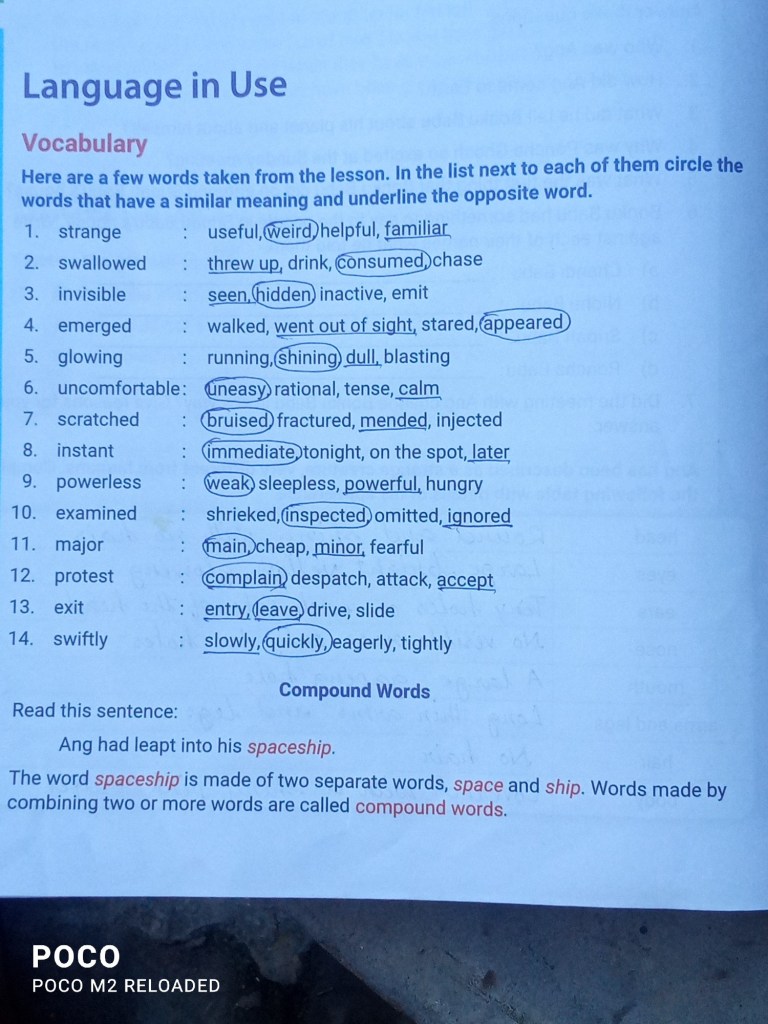
B3.
C1.

Match the words in Column A with those in Column B to get some commonly used compound words.

               A                                      B

           arm                                  cycle

           atom                                 friend

            foot                                   chair

            lamp                                 dream

            black                                 bomb

            dark                                   worm

             glow                                   ball

              day                                    room

              pen                                    friend

              motor                                board

Ans :   arm — chair

             atom — bomb

              foot — ball

              lamp — post

              black — board

              dark — room

              glow — worm

              day — dream

              pen — friend

              motor — cycle

C2. Complete the following sentences with the compound words that you got by solving C1

1. My uncle has broad a beautiful red motorcycle which can go very fast.

2. We love playing football in the rain.

3. The teacher drew the figure of a human heart on the blackboard.

4. Divya’s grandmother had a pen friend who lived in Switzerland.

5. The lamp post outside my house broke yesterday.

6. You can see the glow worm shining in the dark forest.

7.Photographs are developed in a dark room.

8. The world will not survive if people start fighting with the atom bomb.

9. My grandfather was sleeping in his day dream.
Featured

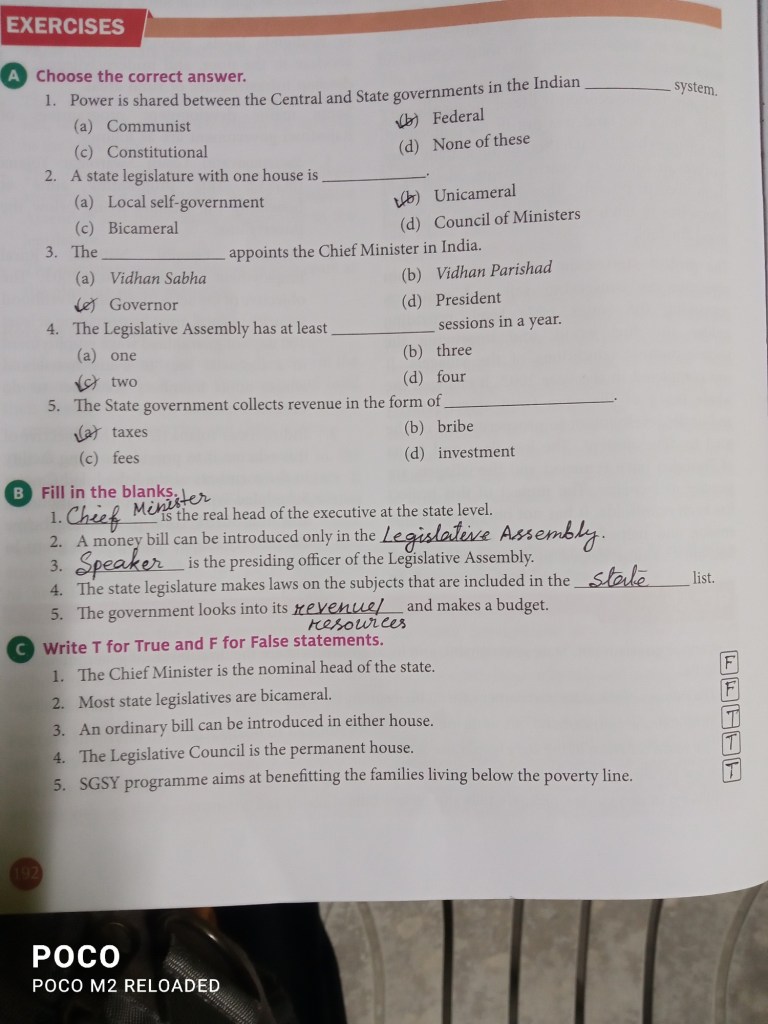
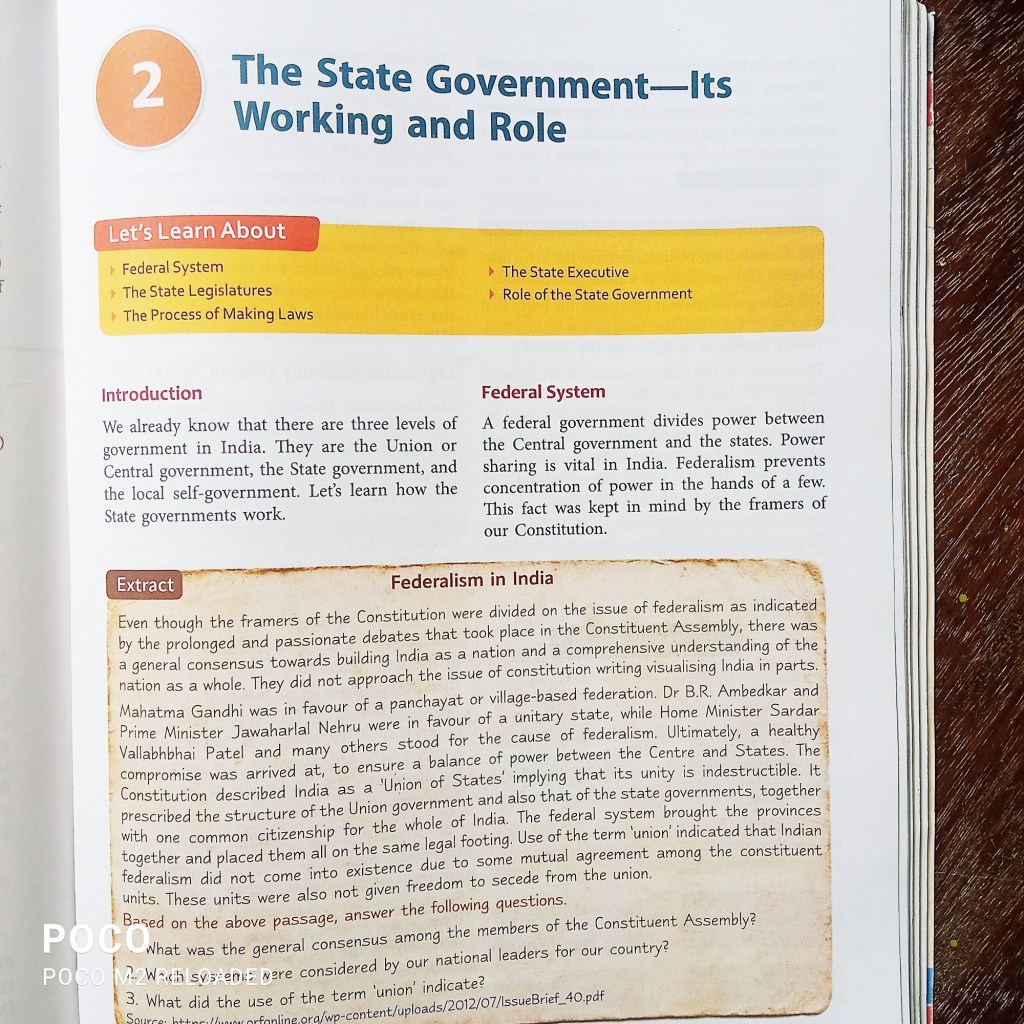
The State government-its working and rules

D. Define the following terms.

  1. Council of Ministers     

  Answer: The council of Ministers is headed by the Chief Minister and includes cabinet ministers and other ministers.

2. Deadlock

Answer: A situation where no progress can be made or no advancement is possible due to disagreement among parties or within a legislature.

3. Proportional representation

Answer : An electoral system in which seats in a legislature are allocated to political parties in proportion to the number of votes each party receives in an election.

4. Simple majority system

Answer: An election system in which the candidate or party that recieves more votes, than any other wins. It does not require an absolute majority.

E. Very short answer questions.

  1. What is federalism?

Answer: Federalism is s system of government in which power is divided between a central authority and constituent political units (like states and provinces.

2. How are the powers of a state government divided?

Answer: The powers of a state government are divided into three branches : the executive, the legislature, and the judiciary.

3. Write about the term of the Legislative Assembly.

Answer: The term of the Legislative Assembly is typically five years, unless dissolved sooner.

4. When are the sessions of the Legislative Assembly held?

Answer: Sessions are held at regular intervals, usually including Budget, Monsoon and Winter session.

5. Explain the composition of the state Legislative Council.

Answer:It’s composition includes members elected by the Legislative Assembly, graduates, teachers, and local authority members as well as members nominated by the Governor.

F. Short answer type questions

1. Describe the main functions of the state legislature

Answer: Making law,s approving the budget, debating policies, representing public interest, and holding the executive accountable.

2. Difference between the Legislative Assembly and legislative council

Answer: The Legislative Assembly is the directly elected lower house; The Legislative Council is the indirectly elected Upper house.

3. How is a Legislative Assembly constituted

Answer A Legislative Assembly is constituted through direct elections where representatives are elected by the voters in their respective constituencies. The number seats is determined based on the population of the state.

4. Mention Qualifications necessary to become an MLA

Answer:  To become a member of the Legislative Assembly (MLA) a person must be the citizen of the country, at least 25 years old, and meet other qualifications as specified by the electoral laws,such as not holding any office of profit under the government.

5. They Chief Minister is the real hat of the state executive elaborate

Answer: The Chief Minister is the head of the state government and leads the executive branch. They are responsible for implementing policies, overseeing the functioning of various departments, and representing the state both internally and externally.

G. Long answer type questions.

1. Describe the process by which a bill becomes a law.

Answer: A bill goes through several stages before becoming a law:

(i) Introduction: The bill is introduced in either house of the legislature.

(ii)First reading: The bill is read out and members discuss its general principles.

(iii)Committee stage: The bill is examined in detail by a committee.

(iv) Second reading: The bill is debated and may be amended.

(v) Third Reading: The final version of the bill is debated and voted on.

(vi) Approval by the other house: The bill is sent to the other house for similar consideration.

(vii) Presidential assent: If both houses pass  the bill, it is sent to the president (or governor in case of state bill) for assent.

(viii)Becoming law:  Once the president (or governor) signs the bill, it becomes law.

2. Write a short note on Council of Ministers.

Answer: The Council of Ministers composed of various ministers including Cabinet Ministers, Ministers of states and Deputy Ministers. They are responsible for different portfolios such as defense, finance, health etc. The Council of Ministers aids and advises the President (or Governor) and is collectively responsible to the legislature.

3. Explain the powers and functions of the Governor.

Answer: The Governor is the constitutional head of a state and performs various functions including:

(i) Summoning and Proroguing sessions of the state legislature.

(ii) Giving assent to bills passed by the state legislature.

(iii) Appointing the Chief Minister and other ministers.

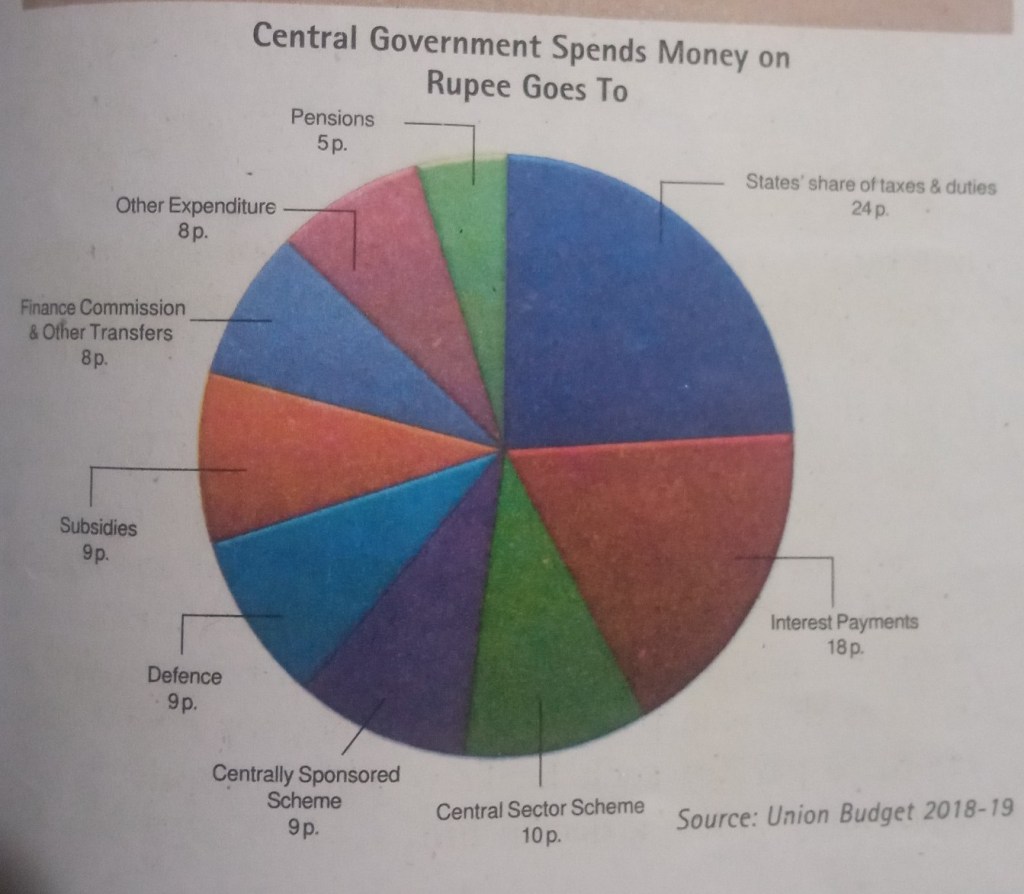
Public Facilities, class -8, Subject -Social Science (Social and Political Life), solved exercises.


1. Why do you think there are so few cases of private water supply in the world?

Answer:
Water is a basic necessity for life. Supplying water to everyone requires huge infrastructure and investment, which private companies usually avoid because profit is low. Also, water is considered a public good, so governments take responsibility to ensure equal access for all people.


2. Do you think water in Chennai is available to and affordable by all? Discuss.

Answer:
No, water in Chennai is not equally available or affordable to all.
Rich people can buy water from private tankers, while poor people depend on irregular public supply. During water shortages, poor people suffer more. This shows inequality in access to water.


3. How is the sale of water by farmers to water dealers in Chennai affecting local people
Can local people object? Can the government do anything?

Answer:
The sale of groundwater by farmers reduces water levels, causing shortage for local people.
Yes, local people can object through protests and complaints.
The government can:
Regulate groundwater use
Ban illegal extraction
Improve public water supply


4. Why are most private hospitals and private schools located in cities and not in rural areas?

Answer:
Private hospitals and schools are mostly in cities because:
(I) Cities have more paying customers
(ii) Better infrastructure and facilities
(iii) Higher profits
(iv) Rural areas have low income and fewer facilities, so private institutions avoid them.


5. Do you think the distribution of public facilities in our country is adequate and fair? Give an example.

Answer:
No, the distribution is not adequate or fair.
For example, cities have better hospitals, schools, and roads, while villages often lack proper water supply and transport.


6. Public facilities in my area
(I) Facility
Is it available?
How can it be improved?
(ii) Water
Yes, but irregular
Regular supply, clean water
(iii) Electricity
Yes
Reduce power cuts
(iv) Roads
Partly
Repair damaged roads
(v) Public Transport
Limited
More buses, better timing


7. Are these public facilities shared equally by all people in your area?

Answer:
No, public facilities are not shared equally.
Poor people face more problems in accessing water, healthcare, and transport compared to rich people.


8. How does the Census collect data on public facilities?

Answer:
The Census collects data by:
Visiting houses
Asking questions about water, electricity, toilets, etc.
Recording information every 10 years


9. What could be the impact of private educational institutions growing and government institutions becoming less important?

Answer:
The impact may be:
Education becomes expensive
Poor students suffer
Inequality increases
Government schools are important to ensure education for all.

Republic day Speech for a student

High-quality Republic Day speech for a student, suitable for school:


Respected Principal, honoured teachers, and my dear friends,
Today, we proudly celebrate 26 January โ€“ the Republic Day of India. On this day in 1950, our country adopted its Constitution and became a sovereign democratic republic.
Our Constitution gives us important rights and duties and teaches us the values of justice, liberty, equality, and fraternity. These values guide us to become good citizens of our nation.
As students, it is our responsibility to study sincerely, respect our teachers, and contribute positively to society. The future of our country depends on us.
Let us promise to work hard and serve our nation with honesty and unity.


Jai Hind! Jai Bharat!

Republic day Speech


Respected Principal, my dear colleagues, and beloved students,
Today we gather to celebrate 26 January โ€“ the Republic Day of India. On this historic day in 1950, our nation adopted the Constitution of India, laying the foundation of our democracy.
As teachers, we believe that education shapes responsible citizens. The Constitution teaches us the values of justice, equality, liberty, and fraternity, and it is our duty to pass these values on to our students.
Republic Day reminds us that freedom comes with responsibility. Let us encourage our students to respect the Constitution, serve the nation with honesty, and uphold unity in diversity.
May we all work together to build an India that is educated, disciplined, and compassionate.


Jai Hind!

Equality in Democracy, Class – 7, Subject – Social science, solved exercises


A. Choose the correct answer
1. India is a democratic country as it has:
(a) elected head of the state
(b) elected representative of the people
(c) Universal Adult Franchise
(d) all of these
Answer: (d) all of these


2. Political equality is affected when there is:
(a) only one political party
(b) multi-party system
(c) Universal Adult Franchise
(d) none of these
Answer: (a) only one political party


3. Rule of law means:
(a) special laws for elected leaders
(b) same law for all the citizens
(c) special laws for ruling the country
(d) when armed forces rule the country
Answer: (b) same law for all the citizens


4. โ€œEqual wages for equal workโ€ means there is:
(a) political equality
(b) social equality
(c) economic equality
(d) religious equality
Answer: (c) economic equality


B. Fill in the blanks
1. The Indian __________ is the primary source of all laws, rules and regulations in our country.
Answer: Constitution
2. The __________ is the __________ head of the executive.
Answer: President, nominal
3. In India, the practice of bonded labour restricts __________ freedom.
Answer: personal
4. Indian citizens can vote after attaining the age of __________ years.
Answer: 18
5. __________ gave the term โ€œUnity in Diversityโ€ for India.
Answer: Jawaharlal Nehru


C. Match the columns
Column A | Column B
Rosa Parks | (b) Civil Rights Movement in the USA
Adult in India | (c) 18 years and above
Dr. B. R. Ambedkar | (d) Fought for the self-respect of the backward classes
Mid-day meals | (a) Special scheme for school children


D. Very Short Answer Type Questions (20โ€“30 words)
1. What is the primary source of laws in India?
Answer: The Constitution of India is the primary source of all laws, rules and regulations in the country.


2. Write the names of the three organs of the government.
Answer: The three organs of the government are the Legislature, the Executive and the Judiciary.


3. Which revolution led to the foundation of individual dignity? What was its main slogan?
Answer: The French Revolution led to the foundation of individual dignity. Its main slogan was Liberty, Equality and Fraternity.


4. Which article of the Constitution of India prohibits discrimination?
Answer: Article 15 of the Constitution of India prohibits discrimination.


5. How can you say that India follows Universal Adult Franchise?
Answer: India follows Universal Adult Franchise because every citizen above 18 years has the right to vote without discrimination.


E. Short Answer Type Questions (50โ€“60 words)
1. What is meant by equality in a democracy?
Answer: Equality in a democracy means that all citizens are treated equally before law. Everyone enjoys equal rights and freedoms without discrimination based on caste, religion, gender or economic status.


2. What is social equality?
Answer: Social equality means that all individuals are treated equally in society. There is no discrimination based on caste, religion, gender or social background, and everyone gets equal respect and opportunities.


3. Which movement swept through various nations demanding the right to vote for women in the 19th and 20th centuries?
Answer: The Womenโ€™s Suffrage Movement swept through various nations in the 19th and 20th centuries demanding voting rights for women.


4. What steps have governments in India taken to bring social equality?
Answer: The Indian government has taken steps like abolition of untouchability, reservation for backward classes, right to education, mid-day meal scheme and laws against discrimination to promote social equality.


5. What does economic equality mean?
Answer: Economic equality means equal opportunities to earn a livelihood. It includes equal pay for equal work, fair wages and reducing the gap between the rich and the poor.

F. Long Answer Type Questions
(80โ€“100 words)
1. Political equality is provided by the Indian Constitution. Explain.
Answer:
Political equality means giving every citizen equal political rights. The Indian Constitution provides political equality through Universal Adult Franchise, which gives all citizens above 18 years the right to vote without discrimination. It ensures equal opportunity to contest elections and form political parties. The Constitution also guarantees equality before law and prohibits discrimination on the basis of caste, religion, gender or class. Thus, political power lies with the people, making Indian democracy inclusive and representative.


2. How is social equality sought to be achieved by the Constitution of India?
Answer:
The Constitution of India aims to achieve social equality by removing social discrimination and inequality. Article 15 prohibits discrimination on the grounds of caste, religion, race, sex or place of birth. Untouchability has been abolished under Article 17. The government has introduced reservations, laws against social injustice, and welfare schemes for backward classes, women and minorities. Education, equal opportunities and legal protection help promote dignity and equality for all citizens.


3. What is meant by economic equality? How is it sought to be achieved?
Answer:
Economic equality means providing equal opportunities to earn a livelihood and reducing economic disparities among citizens. It does not mean equal income for all but fair wages and equal pay for equal work. The Constitution promotes economic equality through minimum wage laws, labour welfare laws, land reforms and poverty alleviation programmes. Government schemes for employment, education and social security help reduce the gap between the rich and the poor.


4. Discuss how the Indian Constitution divides powers between different organs of the government.
Answer:
The Indian Constitution divides powers among three organs of governmentโ€”the Legislature, Executive and Judiciary. The Legislature makes laws, the Executive implements laws, and the Judiciary interprets laws. This separation of powers prevents misuse of authority and ensures smooth functioning of democracy. Each organ works independently but also keeps a check on the others through a system of checks and balances. This division protects citizensโ€™ rights and maintains the rule of law.


5. What privileges have been given to Indian citizens keeping in mind Article 15 of the Indian Constitution?
Answer:
Article 15 of the Indian Constitution prohibits discrimination on grounds of religion, race, caste, sex or place of birth. At the same time, it allows special provisions for women, children and socially backward classes. Reservation in education and jobs, scholarships, and welfare schemes are provided to uplift disadvantaged groups. These privileges help promote equality, social justice and inclusive development, ensuring that weaker sections get equal opportunities in society.


G. Higher-Order Thinking Skills
1. The government has to accommodate various differences present in our country. Why is it so?
Answer:
India is a diverse country with different religions, languages, cultures, castes and traditions. To maintain unity and harmony, the government must accommodate these differences. Respecting diversity ensures equality, prevents discrimination and strengthens democracy. Inclusive policies help people feel secure and respected, promoting national integration.


2. What is the significance of equality in democracy?
Answer:
Equality is the foundation of democracy. It ensures that all citizens enjoy equal rights, opportunities and protection under law. Without equality, democracy cannot function properly, as discrimination leads to injustice and social conflict. Equality promotes dignity, participation and trust in democratic institutions.

                             *******************

Understanding Diversity, Chapter -1, Subject – Social and Political Life, solved exercises

B. Write T for True and F for False
1. India has 25 States and 7 Union Territories. โ†’ F
2. Differences in society and its structure create unrest. โ†’ T
3. India is not a secular country. โ†’ F
4. Classical and folk are the two main types of dances in India. โ†’ T
5. Diversity in languages has added a great variety to our literature. โ†’ T

C. Fill in the blanks
1. Culture refers to the ideas, customs, beliefs and social behaviour of a particular country or group.
2. The North Indian School of music is called Hindustani while the South Indian School of music is called Carnatic.
3. Diversity adds flavour to our lives and enriches our culture.
4. Our National Flag and National Song remind us of Indiaโ€™s capacity to unite.
5. Geographical features influence the lifestyle and occupation of people.
D. Very Short Answer Type Questions (20โ€“30 words)
1. What is diversity?

Answer:
Diversity means differences among people in terms of language, religion, food, dress, customs, traditions and ways of living.


2. How many States and Union Territories are there in India?

Answer:
India has 28 States and 8 Union Territories.
3. What do you understand by the term โ€˜inequalityโ€™?

Answer:
Inequality means a situation where people do not get equal rights, opportunities and resources in society.


4. What do you understand by the term โ€˜cultureโ€™?

Answer:
Culture includes the ideas, beliefs, customs, traditions, art, music and social behaviour of a group of people.


5. In which of his books did Jawaharlal Nehru coin the phrase โ€˜unity in diversityโ€™?

Answer:
Jawaharlal Nehru used the phrase โ€œunity in diversityโ€ in his book The Discovery of India.


E. Short Answer Type Questions (50โ€“60 words)
1. Write a note on the linguistic diversity of India.

Answer:
India shows great linguistic diversity. People speak many languages such as Hindi, Bengali, Tamil, Telugu, Marathi and Gujarati. These languages belong to different language families. Linguistic diversity has enriched Indian literature and culture and reflects the countryโ€™s rich heritage.


2. Write a note on the religious diversity of India.

Answer:
India is home to many religions like Hinduism, Islam, Christianity, Sikhism, Buddhism and Jainism. People of different religions live together and celebrate different festivals. Religious diversity promotes tolerance and peaceful coexistence in India.


3. What are the two main schools of music in India?

Answer:
The two main schools of Indian classical music are Hindustani and Carnatic. Hindustani music developed in North India, while Carnatic music developed in South India. Both styles are rich and have unique features.


4. Discuss why Indiaโ€™s diversity is recognized as a source of its strength.

Answer:
Indiaโ€™s diversity is a source of strength because it encourages unity, mutual respect and understanding among people. Different cultures, traditions and languages enrich national life and help people live together peacefully.


5. Examine how Indiaโ€™s struggle for freedom depicts unity in diversity.

Answer:
During Indiaโ€™s freedom struggle, people from different regions, religions and languages united against British rule. Leaders and common people worked together, showing strong unity in diversity and national integration.


F. Long Answer Type Questions (80โ€“100 words)
1. List any five ways in which Kerala is different from Ladakh.

Answer:
Kerala and Ladakh are very different from each other in many ways.
Kerala has a hot and wet climate, while Ladakh has a cold and dry climate.
Kerala has plains, rivers and backwaters, whereas Ladakh has mountains and plateaus.
People in Kerala grow rice and coconut, while people in Ladakh grow barley and vegetables.
Houses in Kerala are made to suit heavy rainfall, while houses in Ladakh are made to protect from cold.
Food, clothing and lifestyle also differ due to climate.


2. India is a land of diverse cultures and religions. Elaborate.

Answer:
India is a land of great cultural and religious diversity. People in India follow different religions such as Hinduism, Islam, Christianity, Sikhism, Buddhism and Jainism. Each religion has its own festivals, customs and traditions. People speak different languages, eat different kinds of food and wear different dresses. There are various forms of art, dance and music across regions. Despite these differences, people live together peacefully and respect each otherโ€™s beliefs, making India a unique and diverse country.


3. Despite the diversity, there is a strong feeling of oneness among the people of India. Elaborate.

Answer:
India has many languages, religions and cultures, yet its people feel united. This feeling of oneness comes from a shared history, common freedom struggle and national symbols like the National Flag and National Anthem. Festivals are celebrated together, and people help each other in times of need. The Constitution treats everyone equally and promotes unity. Thus, despite differences, Indians feel proud to belong to one nation, showing unity in diversity.


G. Higher-Order Thinking Skills
1. Why do people living in different parts of the world look different and behave differently?

Answer:
People living in different parts of the world look and behave differently due to differences in climate, geography and environment. Climate affects food habits, clothing and physical features. Geography influences occupations and lifestyle. Culture, traditions, language and religion also shape behaviour. Over time, these factors create differences in appearance, habits and ways of living among people in different regions.


2. Why is diversity an essential component of our world and life?

Answer:
Diversity is essential because it enriches our lives and helps us learn from one another. It promotes creativity, understanding and mutual respect among people. Different cultures, ideas and traditions make the world interesting and vibrant. Diversity also teaches tolerance and cooperation, helping people live together peacefully. Without diversity, life would be monotonous and less meaningful.

                           ******************

Advertising, Chapter – 5, Class – 7, Subject – Social science(Social and Political Life), solved exercises

A. Choose the correct answer


1. Communication to persuade a consumer to buy a product is called:
(a) Advertisement
2. USP in advertising means:
(c) Unique Selling Proposition
3. Which of the following statements shows a disadvantage of advertising?
(b) Encourages consumerism among people
4. Print advertisement can be seen in:
(d) All of these

B. Fill in the blanks


1. Advertising convinces the consumer to buy the products.
2. Brand value of a product is built with the help of advertising.
3. Advertising is an important source of income for the media.
4. Consumerism is one of the biggest drawbacks of advertising.
5. Celebrities endorse the product which influences the consumerโ€™s decision.

C. Write T for True and F for False
1. Consumerism means to buy limited things and only when required.
F
2. Some advertisements are run during particular time slots in order to reach the target audience.
T
3. Social advertising educates and raises awareness about a particular social issue.
T
4. Advertisements do not help to form or establish stereotypes.
F
5. Advertising is expensive and as such most small businesses canโ€™t affort it.

T
D. Define the following terms
1.Print media

Answer:
Print media refers to advertisements published in newspapers, magazines, pamphlets, posters and brochures.


2.Brand

Answer:
A brand is the unique name, symbol or image that identifies a product and distinguishes it from others.


3.Social advertising

Answer:
Social advertising spreads awareness about social issues like health, education, environment and consumer rights.


4.Commercial advertising

Answer:
Commercial advertising promotes goods and services to increase their sales and profits.


E. Very Short Answer Type Questions (20โ€“30 words)


1.What is advertising?

Answer:
Advertising is a form of communication that persuades people to buy goods or services by providing information about them.


2. What is the main purpose of an advertisement?

Answer:
The main purpose of an advertisement is to inform, attract and convince consumers to buy a product or service.


3. List some of the different advertisement media available.

Answer:
Newspapers, magazines, television, radio, internet, hoardings, posters and social media are different advertisement media.


4. What is Jago Grahak Jago? How does it help consumers?

Answer:
Jago Grahak Jago is a government campaign that spreads awareness about consumer rights and helps consumers avoid cheating.


F. Short Answer Type Questions (50โ€“60 words)
1. What is social advertising? What is its purpose?

Answer:
Social advertising focuses on spreading awareness about social problems such as cleanliness, education, health and environment. Its purpose is to educate people, change social behaviour and promote social welfare rather than selling products.


2. Explain commercial advertising in detail.

Answer:
Commercial advertising is done by companies to promote their products or services. It highlights features, price and benefits to attract customers. Its main aim is to increase sales and earn profit.


3. List some advantages of advertisements.

Answer:
Advertisements create awareness about products, help consumers make informed choices, increase sales, promote competition and help businesses grow.


4. Discuss the relationship between media and the advertisement industry.

Answer:
Media provides platforms like TV, newspapers and the internet for advertisements. Advertising provides income to media. Thus, both depend on each other for growth.


G. Long Answer Type Questions (80โ€“100 words)
1. Discuss different advertising techniques.

Answer:
Advertisers use many techniques to attract consumers. These include celebrity endorsement, catchy slogans, emotional appeal, repetition, attractive visuals and special offers. Some ads target children while others target specific age groups. Advertisements are also shown at specific time slots to reach the right audience. These techniques help in influencing consumer choices and increasing sales.


2. Write about the disadvantages of advertising.

Answer:
Advertising encourages consumerism and unnecessary buying. It may create false needs, spread misleading information and promote stereotypes. Advertising also increases product prices as companies recover advertising costs from consumers. Small businesses may not afford expensive advertisements, leading to unfair competition.


3. Explain how advertisement helps to create a brand and increase sales.

Answer:
Advertisements help create brand identity by repeatedly showing the product name, logo and features. This builds trust and familiarity among consumers. A strong brand attracts more customers and increases sales. Advertising also highlights the uniqueness of a product, helping it stand out in the market.
4. Write a note on the social responsibility of advertisers.

Answer:
Advertisers should provide truthful information and avoid misleading claims. They should not promote harmful products or stereotypes. Advertisements must respect social values and consumer rights. Responsible advertising helps protect consumers and builds trust in the market.


H. Higher-Order Thinking Skills
1. Why do celebrities endorse many products used by children?

Answer:
Children easily get influenced by celebrities they admire. Companies use celebrities to attract children and increase sales as children trust and follow them.


2. Why do governments spend money on advertising their programmes or schemes?

Answer:
Governments advertise schemes to inform people about their benefits. Advertising helps reach a large population and ensures public participation and awareness.

Understanding Marginalisation, Class -8, Chapter – 7, Social science (Civics ), solved exercises


1. What do you understand by the word โ€˜marginalisationโ€™?

Answer:
Marginalisation means pushing a group of people to the edge of society. Such groups have less access to education, jobs, land and political power, and they often face discrimination and neglect.


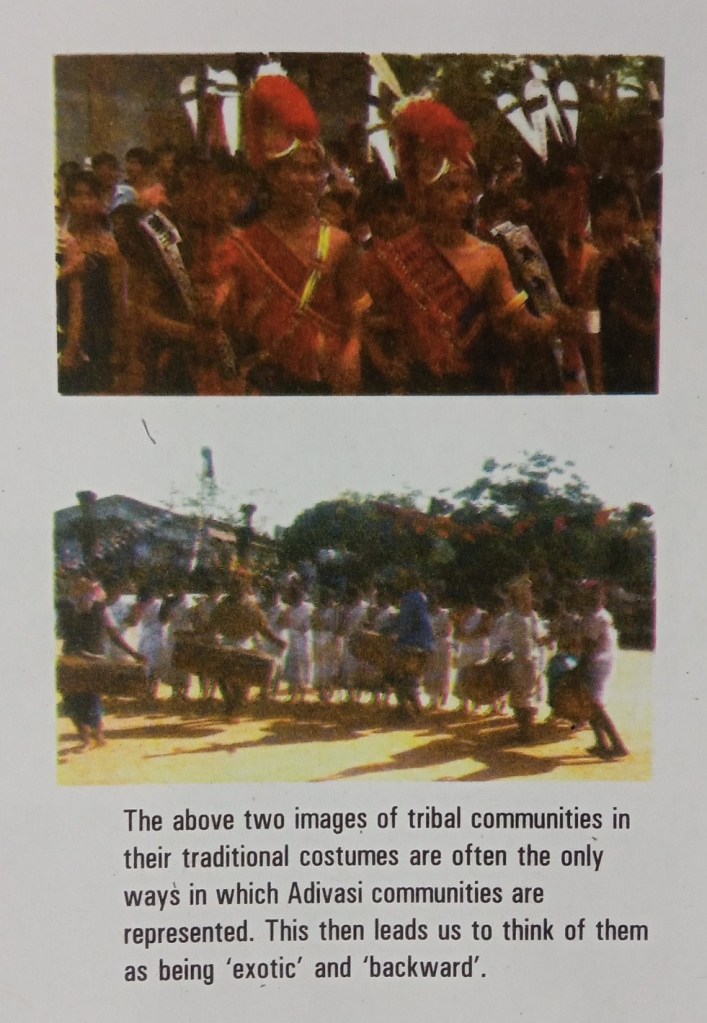
2. List two reasons why Adivasis are becoming increasingly marginalised.

Answer:
Many Adivasis have been displaced from their forests due to mining, industries and dams.
They have limited access to education, healthcare and employment opportunities.


3. Write one reason why the Constitutionโ€™s safeguards to protect minority communities are very important.

Answer:
Constitutional safeguards are important because they protect minority communities from discrimination and ensure equality, freedom of religion and equal opportunities.


4. What do you understand by the term โ€˜minorityโ€™?

Answer:
A minority is a community that is smaller in number compared to the rest of the population and may face social, economic or political disadvantage.


5. Give two reasons to support the statement:

Answer :

โ€œMuslims are a marginalised community.โ€
Muslims have lower literacy rates and limited access to higher education compared to many other communities.
Many Muslims face economic poverty and discrimination in many other fields.


6. What would you tell your friend about the lives of Adivasis? (Any three points)

Answer:
Adivasis have a deep connection with forests and depend on them for livelihood.
They have rich cultures, languages, music and traditions.
Many Adivasis struggle due to displacement, poverty and lack of basic facilities.


7. Write a short story on Adivasis.

Answer:
Ramu lived in a small Adivasi village near a forest. His family depended on forest produce for food and income. When a factory was built nearby, many villagers lost their land. Still, Ramu dreamed of studying and helping his community protect their rights and culture.


8. Do you agree that economic marginalisation and social marginalisation are interlinked? Why?

Answer:
Yes, economic and social marginalisation are interlinked because lack of money leads to poor education and healthcare, which further causes social discrimination and exclusion from society.

Motions of the Earth, Class -6, Subject -Social Science,(Geography) Solved exercises.


B. Write T for True and F for False


1.Leap year comes after three years. โ€” T
2.Winter solstice occurs on 22nd December. โ€” T
3.The circle of illumination separates day and night. โ€” T
4.The Earthโ€™s movement around the Sun is called rotation. โ€” F
5.The tilting of the Earthโ€™s axis is called inclination. โ€” T


C. Fill in the blanks
1.The Earth revolves around the Sun in an elliptical orbit.
2.The vernal equinox occurs on 21st March.
3.The rotation of the Earth causes day and night.
4.The revolution of the Earth causes change in seasons.
5.The fixed path on which the Earth revolves is called orbit.
6.The inclination of the Earthโ€™s axis causes variation in the length of day and night.
D. Match the columns
1. Rotation โ€”.ย ย ย ย  (c) Spinning of the Earth
2. Leap year โ€” (e) 366 days
3. Path on which Earth revolves โ€” (d) Orbit
4. Axis โ€” (a) Imaginary line joining the poles
5. 23rd September โ€” (b) Autumn equinox


E. Very Short Answer Type Questions

1. What is meant by rotation of the Earth?

Answer:
Rotation of the Earth is the spinning of the Earth on its axis from west to east, taking about 24 hours.

2. Describe the circle of illumination.

Answer:
Circle of illumination is an imaginary circle that divides the Earth into day and night regions.


3. Why do seasons change on the Earth?

Answer:
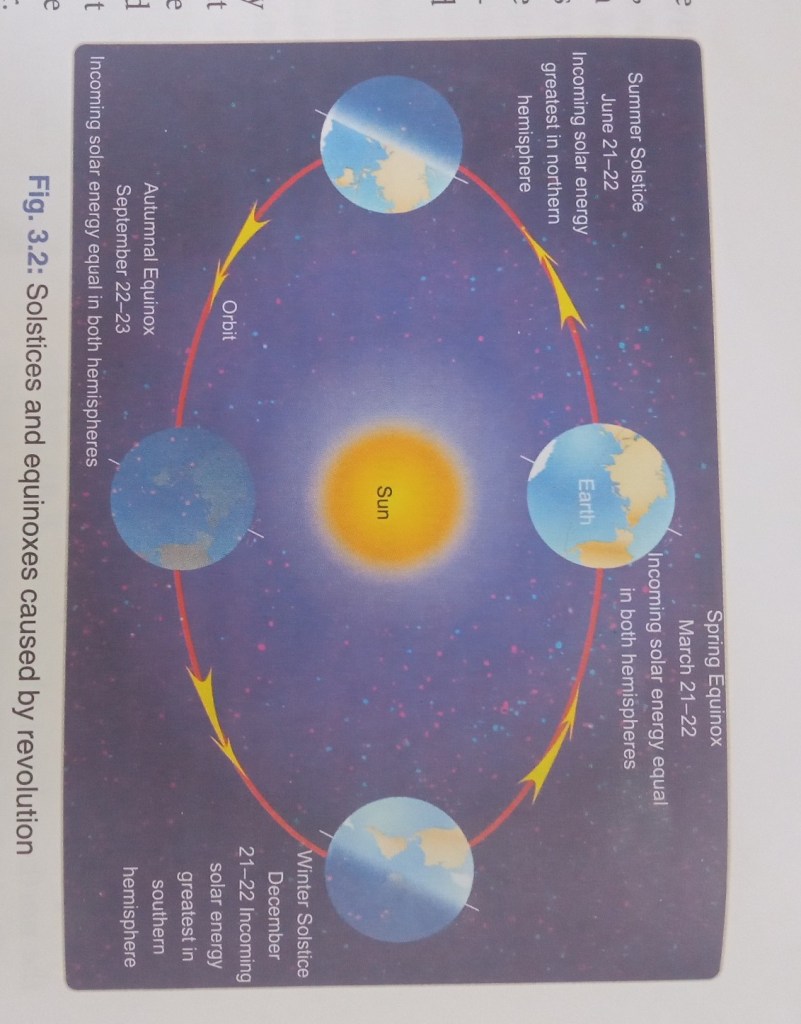
Seasons change on the Earth due to the inclination of the Earthโ€™s axis and its revolution around the Sun. As the Earth moves around the Sun, different parts receive unequal heat and sunlight, causing seasons.


4. Tell the exact time the Earth takes to complete one round of the Sun.

Answer:
The Earth takes 365 days, 5 hours, 48 minutes and 45 seconds to complete one revolution around the Sun.


5. When does summer solstice occur?

Answer:
The summer solstice occurs on 21st June in the Northern Hemisphere, when the day is the longest and the Sunโ€™s rays fall vertically on the Tropic of Cancer.

Short Answer Type Questions (50โ€“60 words)


1. Examine the consequences if the Earth stays still on its axis.
Answer:
If the Earth stays still on its axis, there will be no day and night. One side of the Earth will always face the Sun and remain very hot, while the other side will be in permanent darkness and extreme cold. Such conditions will make life difficult for plants, animals, and humans.


2. Discuss the need to add one โ€œdayโ€ after every four years in our calendar.
Answer:
The Earth takes about 365 days and 6 hours to complete one revolution around the Sun. These extra hours add up to one full day in four years. To adjust this difference and keep the calendar correct, one extra day is added in February every four years, called a leap year.

3.What are the effects of Earthโ€™s rotation?
Answer:
The rotation of the Earth causes day and night. It also causes the apparent movement of the Sun, Moon, and stars from east to west. Rotation helps in fixing time and leads to differences in local time at different longitudes.


4. Describe the term โ€œequinox.โ€
Answer:
An equinox is the time when the Sunโ€™s rays fall vertically on the Equator. On this day, day and night are equal all over the Earth. Equinox occurs twice a yearโ€”on 21st March (spring equinox) and 23rd September (autumn equinox).

5. Compare axis and orbit.
Answer:
The axis is an imaginary line passing through the centre of the Earth and joining the North and South Poles, around which the Earth rotates. The orbit is the fixed elliptical path along which the Earth revolves around the Sun.

G. Long answers type question:

3. Discuss the revolution of the Earth. What are its effects?
Answer:
Revolution is the movement of the Earth around the Sun along its elliptical orbit. The Earth takes about 365 days and 6 hours to complete one revolution. This movement causes the change of seasons, variation in the length of day and night, and the formation of leap years. Revolution combined with the tilt of the Earthโ€™s axis leads to solstices and equinoxes.

The Desert Region, Chapter -9, Subject – Social Studies, Class – 5, solved exercises.


A. Tick the correct answer

1. In which continent is the Arabian Desert located?
โœ… Asia


2. Which of the following latitudes passes through the centre of Saudi Arabia?
โœ… Tropic of Cancer


3. Which of the following minerals is found in the largest quantity in Saudi Arabia?
โœ… Crude oil


4. Which of the following cities is the capital of Saudi Arabia?
โœ… Riyadh


B. Fill in the blanks

1. The largest and continuous stretch of dry and sandy desert in Saudi Arabia is known as Rub-al-Khali.


2. Sandstorms blow away sand from place to place forming sand dunes.


3. Arabian horses are known for their swiftness and faithfulness.


4. Long loose white cotton gowns worn by the Bedouins are called thobes.


C. Match the columns

Column A Column B

1. The Great Basin Desert (d) North America
2. The Great Australian Desert (f) Australia
3. The Gobi Desert (e) China
4. The Atacama Desert (c) South America
5. The Thar Desert (b) India
6. The Sahara Desert (a) Africa


D. Answer the following questions

1. Where is Saudi Arabia located?
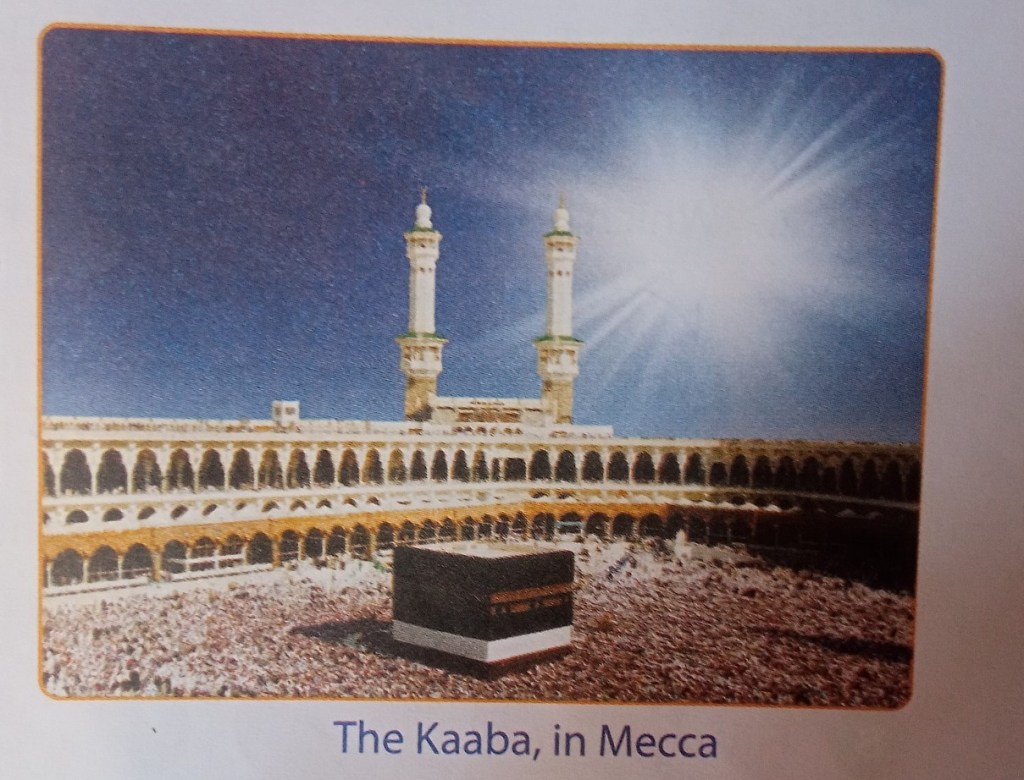
Saudi Arabia is located in South-West Asia on the Arabian Peninsula.

2. Name the neighbouring countries of Saudi Arabia.
Saudi Arabia is bordered by Jordan, Iraq, Kuwait, Qatar, the UAE, Oman and Yemen.

3. Describe the climate of Saudi Arabia.
Saudi Arabia has a hot and dry desert climate. Rainfall is very low, summers are extremely hot and winters are mild.

4. How has Saudi Arabia developed in such a short time?
Saudi Arabia has developed rapidly due to the discovery of large reserves of crude oil, which brought wealth and modern development.

5. Write a note on the religion and culture of the people of Saudi Arabia.
Most people of Saudi Arabia follow Islam. Arabic is their language. People wear traditional clothes, follow Islamic customs and live a simple cultural life.


E. Give reasons

1. Rainfall in Saudi Arabia is very scanty.
Rainfall in Saudi Arabia is very scanty because it lies in a desert region, far away from the sea, and receives very little moisture-bearing winds.


2. Crude oil is known as โ€œliquid goldโ€.
Crude oil is called โ€œliquid goldโ€ because it is very valuable, earns huge income, and is used to produce fuel, electricity and many useful products.


3. Most of the land surface in a desert is sandy.
Most of the land surface in a desert is sandy because strong winds blow away fine soil, leaving behind sand and forming sand dunes.

                         *****************

The Earliest People, Class – 6, Chapter – 2, Social science(History), solved exercises.


A. Choose the correct answer

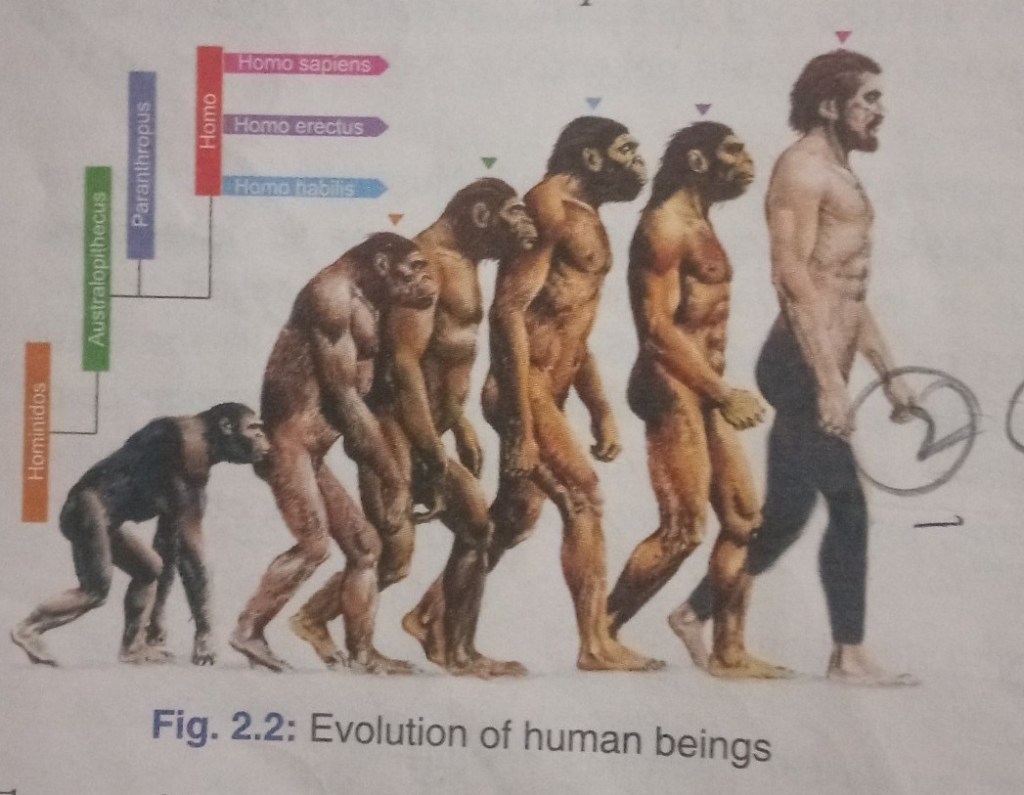
1. Where do you think the earliest human beings are believed to have evolved in?
(a) Africa


2. What is Hunsgi in Karnataka?
(b) Palaeolithic site


3. Where are Bhimbetka caves located?
(c) Madhya Pradesh


4. What material was mostly used for making tools and weapons by the early humans?
(b) Stone


5. Which of the following was the longest period of the Stone Age?
(a) Palaeolithic Age


B. Write T for True and F for False statements

1. The tools made by the early human beings were very crude and simple. โ€” T


2. The term lithos means wood. โ€” F


3. Fire was one of the greatest discoveries of the Palaeolithic Age. โ€” T


4. The Mesolithic Age was a period of transition. โ€” T


5. The discovery of fire was an unimportant part of early man’s life. โ€” F


C. Fill in the blanks

1. Fire seems to have been an accidental discovery.


2. The stone tools of the Mesolithic Age are called microliths.


3. Many Palaeolithic sites in India have been excavated in the Deccan region.


4. Red and white were the most commonly used colours to make cave paintings.


5. Hunsgi is a Palaeolithic site in Karnataka.


D. Very Short Answer Type Questions

1. What are fossils?

Answer:
Fossils are the preserved remains or impressions of plants, animals, or humans found in rocks.


2. How do historians differentiate between Palaeolithic Age and Mesolithic Age?

Answer:
They differentiate them on the basis of tools used, lifestyle, and technological development.


3. Why were early human beings called โ€˜hunter-gatherersโ€™?

Answer:
They hunted animals and gathered fruits, roots, and nuts for food.


4. Name any two Palaeolithic and Mesolithic sites in India.

Answer:
Palaeolithic: Bhimbetka, Hunsgi
Mesolithic: Bagor, Adamgarh


5. What are microliths?

Answer:
Microliths are small, sharp stone tools used during the Mesolithic Age.


E. Short Answer Type Questions (50โ€“60 words)

1. List two developments in the evolution of man that differentiated him from his ancestors.

Answer:

Early humans learned to walk upright, which freed their hands to make tools. They also developed a larger brain, which helped them think, plan, communicate, and adapt better to their surroundings.


2. What is the Stone Age? Explain briefly.

Answer:

The Stone Age is the earliest period of human history when humans mainly used stone tools. It is divided into the Palaeolithic, Mesolithic, and Neolithic Ages, showing gradual improvement in tools, lifestyle, and skills.


3. The discovery of fire was one of the greatest discoveries of the Palaeolithic Age. Discuss.

Answer:

Fire helped early humans cook food, keep warm, scare wild animals, and provide light. It also helped them survive in cold regions and made their life safer and more comfortable.


4. Write a note on the Mesolithic Age.

Answer:

The Mesolithic Age was a transition period between the Palaeolithic and Neolithic Ages. Humans used microliths, lived near water sources, hunted smaller animals, and slowly began domesticating animals.


5. Discuss the importance of fossils.

Answer:

Fossils help us understand the physical features, lifestyle, and evolution of early humans. They provide evidence about ancient plants, animals, and human ancestors and help historians reconstruct early history.


F. Long Answer Type Questions (80โ€“100 words)

1. Describe the different stages of the Palaeolithic Age.

Answer:

The Palaeolithic Age is divided into Lower, Middle, and Upper Palaeolithic stages. In the Lower stage, humans used crude stone tools and lived a nomadic life. During the Middle stage, tools became better shaped, and humans learned to use fire. In the Upper stage, tools became sharper and more specialized. Cave paintings and improved hunting methods also developed during this stage.


2. Write a note on the Hunsgi Valley.

Answer:

The Hunsgi Valley, located in Karnataka, is an important Palaeolithic site in India. Archaeologists have found stone tools, hand axes, and cleavers here. These findings show that early humans lived in this region and depended on hunting and gathering. The site helps us understand early human life in the Deccan region.


3. The Mesolithic Age was a transition between the Middle Stone Age and the Neolithic Age. Explain.

Answer:

The Mesolithic Age shows changes from a hunting-gathering life to a more settled life. Humans used microliths, began domesticating animals, and lived near rivers and lakes. These changes later led to farming and permanent settlements of the Neolithic Age.


4. Rock paintings of the Stone Age are important sources of early human history. Elaborate.

Answer:

Rock paintings show the daily life of early humans such as hunting, dancing, and worship. They give information about animals, tools, clothing, and beliefs. Colours like red and white were commonly used. Bhimbetka caves are famous examples.


G. Difference between the following:


1. Palaeolithic Age and Mesolithic Age (2 marks)

Answer:

The Palaeolithic Age was the Old Stone Age when humans lived a nomadic life and used crude stone tools.
The Mesolithic Age was the Middle Stone Age marked by semi-settled life and the use of small stone tools called microliths.


2. Factory Sites and Habitation-cum-Factory Sites (2 marks)

Answer:

Factory sites were places where only stone tools were made near raw materials.
Habitation-cum-factory sites were pore Tools

3. Core Tools and Flake Tools (2 marks)

Answer:

Core tools were heavy tools made by shaping a stone core.
Flake tools were light and sharp tools made from flakes struck off from a core.

                            ******************


Design a site like this with WordPress.com
Get started