Understanding Diversity, Chapter -1, Subject – Social and Political Life, solved exercises

B. Write T for True and F for False
1. India has 25 States and 7 Union Territories. → F
2. Differences in society and its structure create unrest. → T
3. India is not a secular country. → F
4. Classical and folk are the two main types of dances in India. → T
5. Diversity in languages has added a great variety to our literature. → T

C. Fill in the blanks
1. Culture refers to the ideas, customs, beliefs and social behaviour of a particular country or group.
2. The North Indian School of music is called Hindustani while the South Indian School of music is called Carnatic.
3. Diversity adds flavour to our lives and enriches our culture.
4. Our National Flag and National Song remind us of India’s capacity to unite.
5. Geographical features influence the lifestyle and occupation of people.
D. Very Short Answer Type Questions (20–30 words)
1. What is diversity?

Answer:
Diversity means differences among people in terms of language, religion, food, dress, customs, traditions and ways of living.


2. How many States and Union Territories are there in India?

Answer:
India has 28 States and 8 Union Territories.
3. What do you understand by the term ‘inequality’?

Answer:
Inequality means a situation where people do not get equal rights, opportunities and resources in society.


4. What do you understand by the term ‘culture’?

Answer:
Culture includes the ideas, beliefs, customs, traditions, art, music and social behaviour of a group of people.


5. In which of his books did Jawaharlal Nehru coin the phrase ‘unity in diversity’?

Answer:
Jawaharlal Nehru used the phrase “unity in diversity” in his book The Discovery of India.


E. Short Answer Type Questions (50–60 words)
1. Write a note on the linguistic diversity of India.

Answer:
India shows great linguistic diversity. People speak many languages such as Hindi, Bengali, Tamil, Telugu, Marathi and Gujarati. These languages belong to different language families. Linguistic diversity has enriched Indian literature and culture and reflects the country’s rich heritage.


2. Write a note on the religious diversity of India.

Answer:
India is home to many religions like Hinduism, Islam, Christianity, Sikhism, Buddhism and Jainism. People of different religions live together and celebrate different festivals. Religious diversity promotes tolerance and peaceful coexistence in India.


3. What are the two main schools of music in India?

Answer:
The two main schools of Indian classical music are Hindustani and Carnatic. Hindustani music developed in North India, while Carnatic music developed in South India. Both styles are rich and have unique features.


4. Discuss why India’s diversity is recognized as a source of its strength.

Answer:
India’s diversity is a source of strength because it encourages unity, mutual respect and understanding among people. Different cultures, traditions and languages enrich national life and help people live together peacefully.


5. Examine how India’s struggle for freedom depicts unity in diversity.

Answer:
During India’s freedom struggle, people from different regions, religions and languages united against British rule. Leaders and common people worked together, showing strong unity in diversity and national integration.


F. Long Answer Type Questions (80–100 words)
1. List any five ways in which Kerala is different from Ladakh.

Answer:
Kerala and Ladakh are very different from each other in many ways.
Kerala has a hot and wet climate, while Ladakh has a cold and dry climate.
Kerala has plains, rivers and backwaters, whereas Ladakh has mountains and plateaus.
People in Kerala grow rice and coconut, while people in Ladakh grow barley and vegetables.
Houses in Kerala are made to suit heavy rainfall, while houses in Ladakh are made to protect from cold.
Food, clothing and lifestyle also differ due to climate.


2. India is a land of diverse cultures and religions. Elaborate.

Answer:
India is a land of great cultural and religious diversity. People in India follow different religions such as Hinduism, Islam, Christianity, Sikhism, Buddhism and Jainism. Each religion has its own festivals, customs and traditions. People speak different languages, eat different kinds of food and wear different dresses. There are various forms of art, dance and music across regions. Despite these differences, people live together peacefully and respect each other’s beliefs, making India a unique and diverse country.


3. Despite the diversity, there is a strong feeling of oneness among the people of India. Elaborate.

Answer:
India has many languages, religions and cultures, yet its people feel united. This feeling of oneness comes from a shared history, common freedom struggle and national symbols like the National Flag and National Anthem. Festivals are celebrated together, and people help each other in times of need. The Constitution treats everyone equally and promotes unity. Thus, despite differences, Indians feel proud to belong to one nation, showing unity in diversity.


G. Higher-Order Thinking Skills
1. Why do people living in different parts of the world look different and behave differently?

Answer:
People living in different parts of the world look and behave differently due to differences in climate, geography and environment. Climate affects food habits, clothing and physical features. Geography influences occupations and lifestyle. Culture, traditions, language and religion also shape behaviour. Over time, these factors create differences in appearance, habits and ways of living among people in different regions.


2. Why is diversity an essential component of our world and life?

Answer:
Diversity is essential because it enriches our lives and helps us learn from one another. It promotes creativity, understanding and mutual respect among people. Different cultures, ideas and traditions make the world interesting and vibrant. Diversity also teaches tolerance and cooperation, helping people live together peacefully. Without diversity, life would be monotonous and less meaningful.

                           ******************
Advertising, Chapter – 5, Class – 7, Subject – Social science(Social and Political Life), solved exercises

A. Choose the correct answer


1. Communication to persuade a consumer to buy a product is called:
(a) Advertisement
2. USP in advertising means:
(c) Unique Selling Proposition
3. Which of the following statements shows a disadvantage of advertising?
(b) Encourages consumerism among people
4. Print advertisement can be seen in:
(d) All of these

B. Fill in the blanks


1. Advertising convinces the consumer to buy the products.
2. Brand value of a product is built with the help of advertising.
3. Advertising is an important source of income for the media.
4. Consumerism is one of the biggest drawbacks of advertising.
5. Celebrities endorse the product which influences the consumer’s decision.

C. Write T for True and F for False
1. Consumerism means to buy limited things and only when required.
F
2. Some advertisements are run during particular time slots in order to reach the target audience.
T
3. Social advertising educates and raises awareness about a particular social issue.
T
4. Advertisements do not help to form or establish stereotypes.
F
5. Advertising is expensive and as such most small businesses can’t affort it.

T
D. Define the following terms
1.Print media

Answer:
Print media refers to advertisements published in newspapers, magazines, pamphlets, posters and brochures.


2.Brand

Answer:
A brand is the unique name, symbol or image that identifies a product and distinguishes it from others.


3.Social advertising

Answer:
Social advertising spreads awareness about social issues like health, education, environment and consumer rights.


4.Commercial advertising

Answer:
Commercial advertising promotes goods and services to increase their sales and profits.


E. Very Short Answer Type Questions (20–30 words)


1.What is advertising?

Answer:
Advertising is a form of communication that persuades people to buy goods or services by providing information about them.


2. What is the main purpose of an advertisement?

Answer:
The main purpose of an advertisement is to inform, attract and convince consumers to buy a product or service.


3. List some of the different advertisement media available.

Answer:
Newspapers, magazines, television, radio, internet, hoardings, posters and social media are different advertisement media.


4. What is Jago Grahak Jago? How does it help consumers?

Answer:
Jago Grahak Jago is a government campaign that spreads awareness about consumer rights and helps consumers avoid cheating.


F. Short Answer Type Questions (50–60 words)
1. What is social advertising? What is its purpose?

Answer:
Social advertising focuses on spreading awareness about social problems such as cleanliness, education, health and environment. Its purpose is to educate people, change social behaviour and promote social welfare rather than selling products.


2. Explain commercial advertising in detail.

Answer:
Commercial advertising is done by companies to promote their products or services. It highlights features, price and benefits to attract customers. Its main aim is to increase sales and earn profit.


3. List some advantages of advertisements.

Answer:
Advertisements create awareness about products, help consumers make informed choices, increase sales, promote competition and help businesses grow.


4. Discuss the relationship between media and the advertisement industry.

Answer:
Media provides platforms like TV, newspapers and the internet for advertisements. Advertising provides income to media. Thus, both depend on each other for growth.


G. Long Answer Type Questions (80–100 words)
1. Discuss different advertising techniques.

Answer:
Advertisers use many techniques to attract consumers. These include celebrity endorsement, catchy slogans, emotional appeal, repetition, attractive visuals and special offers. Some ads target children while others target specific age groups. Advertisements are also shown at specific time slots to reach the right audience. These techniques help in influencing consumer choices and increasing sales.


2. Write about the disadvantages of advertising.

Answer:
Advertising encourages consumerism and unnecessary buying. It may create false needs, spread misleading information and promote stereotypes. Advertising also increases product prices as companies recover advertising costs from consumers. Small businesses may not afford expensive advertisements, leading to unfair competition.


3. Explain how advertisement helps to create a brand and increase sales.

Answer:
Advertisements help create brand identity by repeatedly showing the product name, logo and features. This builds trust and familiarity among consumers. A strong brand attracts more customers and increases sales. Advertising also highlights the uniqueness of a product, helping it stand out in the market.
4. Write a note on the social responsibility of advertisers.

Answer:
Advertisers should provide truthful information and avoid misleading claims. They should not promote harmful products or stereotypes. Advertisements must respect social values and consumer rights. Responsible advertising helps protect consumers and builds trust in the market.


H. Higher-Order Thinking Skills
1. Why do celebrities endorse many products used by children?

Answer:
Children easily get influenced by celebrities they admire. Companies use celebrities to attract children and increase sales as children trust and follow them.


2. Why do governments spend money on advertising their programmes or schemes?

Answer:
Governments advertise schemes to inform people about their benefits. Advertising helps reach a large population and ensures public participation and awareness.

Understanding Marginalisation, Class -8, Chapter – 7, Social science (Civics ), solved exercises


1. What do you understand by the word ‘marginalisation’?

Answer:
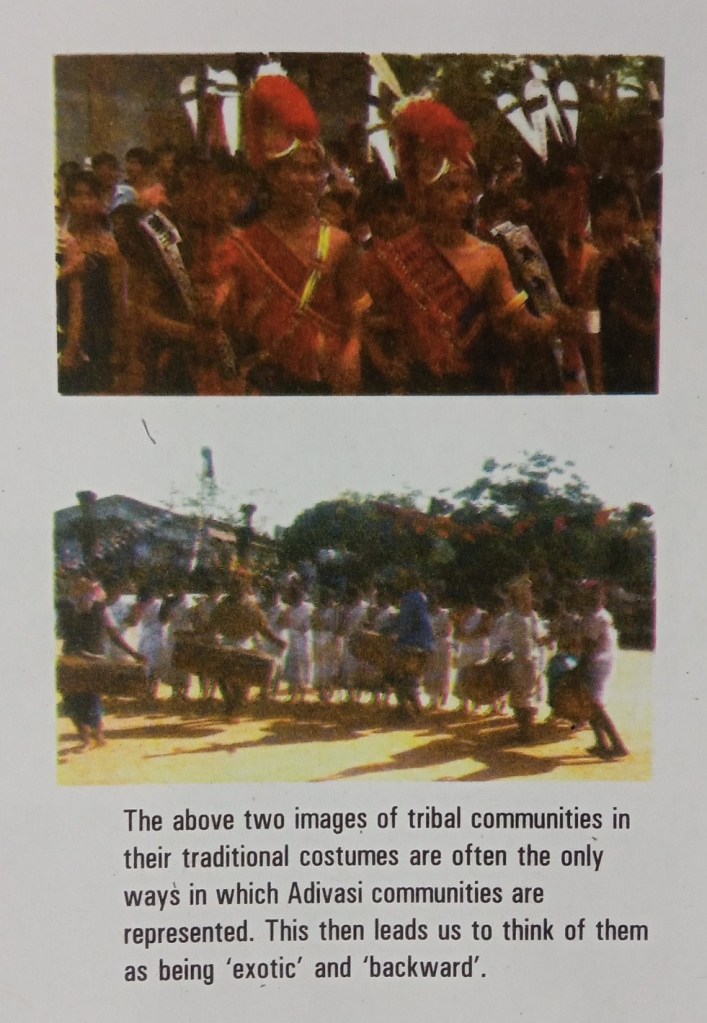
Marginalisation means pushing a group of people to the edge of society. Such groups have less access to education, jobs, land and political power, and they often face discrimination and neglect.


2. List two reasons why Adivasis are becoming increasingly marginalised.

Answer:
Many Adivasis have been displaced from their forests due to mining, industries and dams.
They have limited access to education, healthcare and employment opportunities.


3. Write one reason why the Constitution’s safeguards to protect minority communities are very important.

Answer:
Constitutional safeguards are important because they protect minority communities from discrimination and ensure equality, freedom of religion and equal opportunities.


4. What do you understand by the term ‘minority’?

Answer:
A minority is a community that is smaller in number compared to the rest of the population and may face social, economic or political disadvantage.


5. Give two reasons to support the statement:

Answer :

“Muslims are a marginalised community.”
Muslims have lower literacy rates and limited access to higher education compared to many other communities.
Many Muslims face economic poverty and discrimination in many other fields.


6. What would you tell your friend about the lives of Adivasis? (Any three points)

Answer:
Adivasis have a deep connection with forests and depend on them for livelihood.
They have rich cultures, languages, music and traditions.
Many Adivasis struggle due to displacement, poverty and lack of basic facilities.


7. Write a short story on Adivasis.

Answer:
Ramu lived in a small Adivasi village near a forest. His family depended on forest produce for food and income. When a factory was built nearby, many villagers lost their land. Still, Ramu dreamed of studying and helping his community protect their rights and culture.


8. Do you agree that economic marginalisation and social marginalisation are interlinked? Why?

Answer:
Yes, economic and social marginalisation are interlinked because lack of money leads to poor education and healthcare, which further causes social discrimination and exclusion from society.

Motions of the Earth, Class -6, Subject -Social Science,(Geography) Solved exercises.


B. Write T for True and F for False


1.Leap year comes after three years. — T
2.Winter solstice occurs on 22nd December. — T
3.The circle of illumination separates day and night. — T
4.The Earth’s movement around the Sun is called rotation. — F
5.The tilting of the Earth’s axis is called inclination. — T


C. Fill in the blanks
1.The Earth revolves around the Sun in an elliptical orbit.
2.The vernal equinox occurs on 21st March.
3.The rotation of the Earth causes day and night.
4.The revolution of the Earth causes change in seasons.
5.The fixed path on which the Earth revolves is called orbit.
6.The inclination of the Earth’s axis causes variation in the length of day and night.
D. Match the columns
1. Rotation —.     (c) Spinning of the Earth
2. Leap year — (e) 366 days
3. Path on which Earth revolves — (d) Orbit
4. Axis — (a) Imaginary line joining the poles
5. 23rd September — (b) Autumn equinox


E. Very Short Answer Type Questions

1. What is meant by rotation of the Earth?

Answer:
Rotation of the Earth is the spinning of the Earth on its axis from west to east, taking about 24 hours.

2. Describe the circle of illumination.

Answer:
Circle of illumination is an imaginary circle that divides the Earth into day and night regions.


3. Why do seasons change on the Earth?

Answer:
Seasons change on the Earth due to the inclination of the Earth’s axis and its revolution around the Sun. As the Earth moves around the Sun, different parts receive unequal heat and sunlight, causing seasons.


4. Tell the exact time the Earth takes to complete one round of the Sun.

Answer:
The Earth takes 365 days, 5 hours, 48 minutes and 45 seconds to complete one revolution around the Sun.


5. When does summer solstice occur?

Answer:
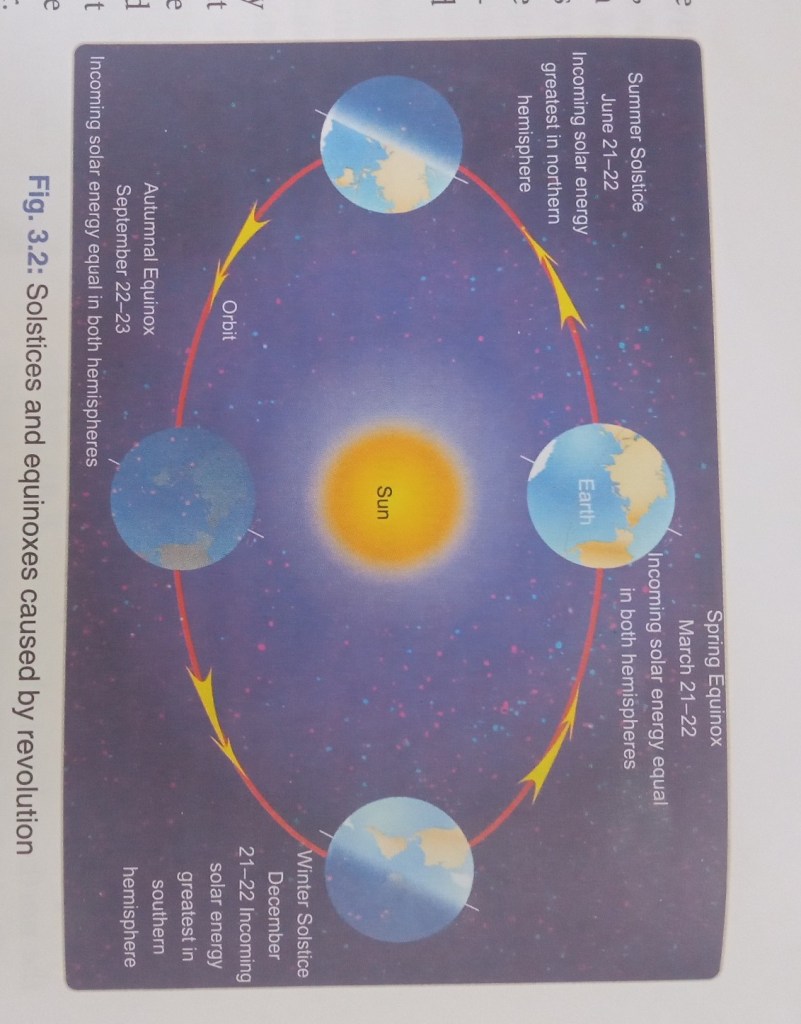
The summer solstice occurs on 21st June in the Northern Hemisphere, when the day is the longest and the Sun’s rays fall vertically on the Tropic of Cancer.

Short Answer Type Questions (50–60 words)


1. Examine the consequences if the Earth stays still on its axis.
Answer:
If the Earth stays still on its axis, there will be no day and night. One side of the Earth will always face the Sun and remain very hot, while the other side will be in permanent darkness and extreme cold. Such conditions will make life difficult for plants, animals, and humans.


2. Discuss the need to add one “day” after every four years in our calendar.
Answer:
The Earth takes about 365 days and 6 hours to complete one revolution around the Sun. These extra hours add up to one full day in four years. To adjust this difference and keep the calendar correct, one extra day is added in February every four years, called a leap year.

3.What are the effects of Earth’s rotation?
Answer:
The rotation of the Earth causes day and night. It also causes the apparent movement of the Sun, Moon, and stars from east to west. Rotation helps in fixing time and leads to differences in local time at different longitudes.


4. Describe the term “equinox.”
Answer:
An equinox is the time when the Sun’s rays fall vertically on the Equator. On this day, day and night are equal all over the Earth. Equinox occurs twice a year—on 21st March (spring equinox) and 23rd September (autumn equinox).

5. Compare axis and orbit.
Answer:
The axis is an imaginary line passing through the centre of the Earth and joining the North and South Poles, around which the Earth rotates. The orbit is the fixed elliptical path along which the Earth revolves around the Sun.

G. Long answers type question:

3. Discuss the revolution of the Earth. What are its effects?
Answer:
Revolution is the movement of the Earth around the Sun along its elliptical orbit. The Earth takes about 365 days and 6 hours to complete one revolution. This movement causes the change of seasons, variation in the length of day and night, and the formation of leap years. Revolution combined with the tilt of the Earth’s axis leads to solstices and equinoxes.

The Desert Region, Chapter -9, Subject – Social Studies, Class – 5, solved exercises.


A. Tick the correct answer

1. In which continent is the Arabian Desert located?
✅ Asia


2. Which of the following latitudes passes through the centre of Saudi Arabia?
✅ Tropic of Cancer


3. Which of the following minerals is found in the largest quantity in Saudi Arabia?
✅ Crude oil


4. Which of the following cities is the capital of Saudi Arabia?
✅ Riyadh


B. Fill in the blanks

1. The largest and continuous stretch of dry and sandy desert in Saudi Arabia is known as Rub-al-Khali.


2. Sandstorms blow away sand from place to place forming sand dunes.


3. Arabian horses are known for their swiftness and faithfulness.


4. Long loose white cotton gowns worn by the Bedouins are called thobes.


C. Match the columns

Column A Column B

1. The Great Basin Desert (d) North America
2. The Great Australian Desert (f) Australia
3. The Gobi Desert (e) China
4. The Atacama Desert (c) South America
5. The Thar Desert (b) India
6. The Sahara Desert (a) Africa


D. Answer the following questions

1. Where is Saudi Arabia located?
Saudi Arabia is located in South-West Asia on the Arabian Peninsula.

2. Name the neighbouring countries of Saudi Arabia.
Saudi Arabia is bordered by Jordan, Iraq, Kuwait, Qatar, the UAE, Oman and Yemen.

3. Describe the climate of Saudi Arabia.
Saudi Arabia has a hot and dry desert climate. Rainfall is very low, summers are extremely hot and winters are mild.

4. How has Saudi Arabia developed in such a short time?
Saudi Arabia has developed rapidly due to the discovery of large reserves of crude oil, which brought wealth and modern development.

5. Write a note on the religion and culture of the people of Saudi Arabia.
Most people of Saudi Arabia follow Islam. Arabic is their language. People wear traditional clothes, follow Islamic customs and live a simple cultural life.


E. Give reasons

1. Rainfall in Saudi Arabia is very scanty.
Rainfall in Saudi Arabia is very scanty because it lies in a desert region, far away from the sea, and receives very little moisture-bearing winds.


2. Crude oil is known as “liquid gold”.
Crude oil is called “liquid gold” because it is very valuable, earns huge income, and is used to produce fuel, electricity and many useful products.


3. Most of the land surface in a desert is sandy.
Most of the land surface in a desert is sandy because strong winds blow away fine soil, leaving behind sand and forming sand dunes.

                         *****************

The Earliest People, Class – 6, Chapter – 2, Social science(History), solved exercises.


A. Choose the correct answer

1. Where do you think the earliest human beings are believed to have evolved in?
(a) Africa


2. What is Hunsgi in Karnataka?
(b) Palaeolithic site


3. Where are Bhimbetka caves located?
(c) Madhya Pradesh


4. What material was mostly used for making tools and weapons by the early humans?
(b) Stone


5. Which of the following was the longest period of the Stone Age?
(a) Palaeolithic Age


B. Write T for True and F for False statements

1. The tools made by the early human beings were very crude and simple. — T


2. The term lithos means wood. — F


3. Fire was one of the greatest discoveries of the Palaeolithic Age. — T


4. The Mesolithic Age was a period of transition. — T


5. The discovery of fire was an unimportant part of early man’s life. — F


C. Fill in the blanks

1. Fire seems to have been an accidental discovery.


2. The stone tools of the Mesolithic Age are called microliths.


3. Many Palaeolithic sites in India have been excavated in the Deccan region.


4. Red and white were the most commonly used colours to make cave paintings.


5. Hunsgi is a Palaeolithic site in Karnataka.


D. Very Short Answer Type Questions

1. What are fossils?

Answer:
Fossils are the preserved remains or impressions of plants, animals, or humans found in rocks.


2. How do historians differentiate between Palaeolithic Age and Mesolithic Age?

Answer:
They differentiate them on the basis of tools used, lifestyle, and technological development.


3. Why were early human beings called ‘hunter-gatherers’?

Answer:
They hunted animals and gathered fruits, roots, and nuts for food.


4. Name any two Palaeolithic and Mesolithic sites in India.

Answer:
Palaeolithic: Bhimbetka, Hunsgi
Mesolithic: Bagor, Adamgarh


5. What are microliths?

Answer:
Microliths are small, sharp stone tools used during the Mesolithic Age.


E. Short Answer Type Questions (50–60 words)

1. List two developments in the evolution of man that differentiated him from his ancestors.

Answer:

Early humans learned to walk upright, which freed their hands to make tools. They also developed a larger brain, which helped them think, plan, communicate, and adapt better to their surroundings.


2. What is the Stone Age? Explain briefly.

Answer:

The Stone Age is the earliest period of human history when humans mainly used stone tools. It is divided into the Palaeolithic, Mesolithic, and Neolithic Ages, showing gradual improvement in tools, lifestyle, and skills.


3. The discovery of fire was one of the greatest discoveries of the Palaeolithic Age. Discuss.

Answer:

Fire helped early humans cook food, keep warm, scare wild animals, and provide light. It also helped them survive in cold regions and made their life safer and more comfortable.


4. Write a note on the Mesolithic Age.

Answer:

The Mesolithic Age was a transition period between the Palaeolithic and Neolithic Ages. Humans used microliths, lived near water sources, hunted smaller animals, and slowly began domesticating animals.


5. Discuss the importance of fossils.

Answer:

Fossils help us understand the physical features, lifestyle, and evolution of early humans. They provide evidence about ancient plants, animals, and human ancestors and help historians reconstruct early history.


F. Long Answer Type Questions (80–100 words)

1. Describe the different stages of the Palaeolithic Age.

Answer:

The Palaeolithic Age is divided into Lower, Middle, and Upper Palaeolithic stages. In the Lower stage, humans used crude stone tools and lived a nomadic life. During the Middle stage, tools became better shaped, and humans learned to use fire. In the Upper stage, tools became sharper and more specialized. Cave paintings and improved hunting methods also developed during this stage.


2. Write a note on the Hunsgi Valley.

Answer:

The Hunsgi Valley, located in Karnataka, is an important Palaeolithic site in India. Archaeologists have found stone tools, hand axes, and cleavers here. These findings show that early humans lived in this region and depended on hunting and gathering. The site helps us understand early human life in the Deccan region.


3. The Mesolithic Age was a transition between the Middle Stone Age and the Neolithic Age. Explain.

Answer:

The Mesolithic Age shows changes from a hunting-gathering life to a more settled life. Humans used microliths, began domesticating animals, and lived near rivers and lakes. These changes later led to farming and permanent settlements of the Neolithic Age.


4. Rock paintings of the Stone Age are important sources of early human history. Elaborate.

Answer:

Rock paintings show the daily life of early humans such as hunting, dancing, and worship. They give information about animals, tools, clothing, and beliefs. Colours like red and white were commonly used. Bhimbetka caves are famous examples.


G. Difference between the following:


1. Palaeolithic Age and Mesolithic Age (2 marks)

Answer:

The Palaeolithic Age was the Old Stone Age when humans lived a nomadic life and used crude stone tools.
The Mesolithic Age was the Middle Stone Age marked by semi-settled life and the use of small stone tools called microliths.


2. Factory Sites and Habitation-cum-Factory Sites (2 marks)

Answer:

Factory sites were places where only stone tools were made near raw materials.
Habitation-cum-factory sites were pore Tools

3. Core Tools and Flake Tools (2 marks)

Answer:

Core tools were heavy tools made by shaping a stone core.
Flake tools were light and sharp tools made from flakes struck off from a core.

                            ******************


Human Resources, Class – 8, Subject – Social science (Geography ),solved exercises.


1. Answer the following questions

(i) Why are people considered a resource?

Answer:
People are considered a resource because they use their knowledge, skills and abilities to create goods and services and help in the development of a country.

(ii) What are the causes for the uneven distribution of population in the world?

Answer:
Uneven distribution of population is due to differences in climate, landforms, soil fertility, availability of water, minerals, industries, transport facilities and job opportunities.

(iii) The world population has grown very rapidly. Why?

Answer:
The world population has grown rapidly due to better medical facilities, improved sanitation, increased food production and a decline in death rate.

(iv) Discuss the role of any two factors influencing population change.

Answer:

Birth rate: High birth rate increases population.

Death rate: Low death rate due to better healthcare increases population.


(v) What is meant by population composition?

Answer:
Population composition refers to the structure of the population based on age, sex, literacy level, occupation and health.

(vi) What are population pyramids? How do they help in understanding the population of a country?

Answer:
Population pyramids are graphical representations showing the age and sex composition of a population.
They help us understand the size of working population, dependent population and future population growth.


2. Tick (✔) the correct answer

(i) Which does the term population distribution refer to?
✔ (c) The way in which people are spread across a given area.

(ii) Which are three main factors that cause population change?
✔ (b) Births, deaths and migration.

(iii) In 1999, the world population reached
✔ (c) 6 billion.

(iv) What is a population pyramid?
✔ (a) A graphical presentation of the age, sex composition of a population.


3. Complete the sentences

Words given: sparsely, favourable, fallow, artificial, fertile, natural, extreme, densely

1. When people are attracted to an area it becomes densely populated.


2. Factors that influence this include favourable climate; good supplies of natural resources and fertile land.

                               ***************

Tenali Raman and the Two Thieves,Class- 2, Subject – English, solved exercises.


A. Choose the correct answer

1. Tenali Raman used to work at the court of
👉 Emperor Krishnadevaraya


2. Tenali Raman heard the cry of a
👉 rustling of leaves at night


3. The thieves were hiding in
👉 the bushes


4. Tenali Raman and his wife filled the trunk with
👉 stones


5. The thieves ______ Tenali Raman’s plans.
👉 understood


B. Answer these questions

1. How did Tenali Raman know that some thieves were hiding in the bushes?
👉 He heard the rustling of leaves on a hot night when there was no breeze.


2. What did Tenali Raman tell his wife?
👉 He told her that thieves were planning to rob their house.


3. Why did Tenali Raman fill the trunk with stones?
👉 To trick the thieves and make them believe the trunk had treasure.


4. Why did the thieves wait before drawing water from the well?
👉 They wanted Tenali Raman and his wife to go inside and fall asleep.


5. Why did Tenali Raman thank the thieves?
👉 Because they watered his plants by drawing water from the well all night.


A. Add ‘-ing’ to these words

1. water + ing = watering


2. open + ing = opening


3. carry + ing = carrying


4. sleep + ing = sleeping


5. thank + ing = thanking


6. wait + ing = waiting


7. draw + ing = drawing


8. steal + ing = stealing


B. Unscramble the words and match with their meanings

No. Jumbled word Correct word Meaning (letter)

1. adbakery backyard e. moving about without any aim
2. tourc court c. the area in a palace where a king/queen talks to ministers and meets common people
3. stringul rustling g. noise made by leaves when one steps on them
4. runkt trunk a. a large box, usually made of metal
5. moringa morning f. early morning
6. dadispointpe disappointed b. upset
7. sauteerr treasure d. a thing of great value


A. Write the -ing forms of these words

1. hide + ing = hiding


2. promise + ing = promising


3. plan + ing = planning


4. forgive + ing = forgiving


5. drop + ing = dropping


6. manage + ing = managing


7. rustle + ing = rustling


8. rob + ing = robbing

The Mauryan Empire,Class – 6 Subject – Social science, solved exercises


A. Choose the correct answer

1. The rise of Chandragupta Maurya is described in:
(c) Mudrarakshasa


2. Ashoka was the son of:
(b) Bindusara


3. The founder of the Mauryan Empire was:
(d) Chandragupta


4. Ashokan inscriptions near Peshawar are written in:
(d) Kharosthi


5. Among the following, who were referred to as “the Great”?
(b) Ashoka and Alexander


B. Write T for True and F for False

1. The last Mauryan ruler was Brihadratha. — T


2. Ashoka defeated Seleucus Nicator. — F


3. Chandragupta Maurya overthrew the Sungas to set up the Mauryan Empire. — F


4. Tax on produce was fixed between one-fourth to one-sixth of the total produce. — T


5. Indica was written by Megasthenes. — T


C. Fill in the blanks

1. Chanakya is also known as Kautilya and Vishnugupta.


2. Megasthenes was sent as an envoy by Seleucus Nicator to Chandragupta’s court.


3. The Kalinga kingdom was brought under Mauryan rule by Ashoka.


4. Chandragupta Maurya defeated the Nandas to set up the Mauryan Empire.


5. Most of the Ashokan edicts were written in the kharosthi script.


D. Very Short Answer Type Questions (20–30 words)

1. Who was the founder of the Mauryan Empire?

Answer:

Where did he set up his capital?
Chandragupta Maurya founded the Mauryan Empire. He established his capital at Pataliputra.


2. Who was Chanakya or Kautilya?

Answer:
Chanakya, also known as Kautilya or Vishnugupta, was Chandragupta Maurya’s chief advisor and the author of the Arthashastra. He helped establish the Mauryan Empire.


3. Who is considered the greatest of the Mauryan kings?

Answer:
Ashoka is considered the greatest Mauryan ruler. He expanded the empire, embraced Buddhism after the Kalinga War, and promoted dharma and non-violence.


4. How did the Kalinga battle influence Ashoka?

Answer:
The huge loss of life in the Kalinga War deeply shocked Ashoka. He gave up warfare, accepted Buddhism, and dedicated his life to spreading peace and dharma.


5. What is dhamma?

Answer:
Dhamma means moral teachings and righteous conduct. Ashoka’s dhamma promoted kindness, non-violence, respect towards elders, and welfare of people.


E. Short Answer Type Questions (50–60 words)

1. Discuss various sources available for studying the Mauryan period.

Answer:
The Mauryan period is known from literary sources like Arthashastra, Indica by Megasthenes, Buddhist texts, and the Mudrarakshasa. Archaeological sources such as Ashokan inscriptions, pillars, rock edicts, coins, and sculptures also give information about administration, society, economy, and religion during the Mauryan rule.


2. Write a note on Chandragupta Maurya.

Answer:
Chandragupta Maurya founded the Mauryan Empire with the guidance of Chanakya. He defeated the Nandas and united northern India. His capital was Pataliputra. He built a strong administration and army. After ruling successfully, he abdicated the throne and spent his last years at Shravanabelagola as a Jain monk.


3. Write a few lines about Bindusara.

Answer:
Bindusara was the son of Chandragupta Maurya. He extended the empire further south and maintained friendly relations with foreign rulers. His reign kept the empire stable and prosperous. Bindusara was the father of Ashoka, who later became the greatest Mauryan ruler.


4. Write a few lines on Ashokan edicts.

Answer:
Ashokan edicts are inscriptions engraved on rocks and pillars throughout his empire. Written mainly in Brahmi and Kharosthi scripts, they explain his dhamma, administrative orders, concern for welfare, and messages on peace and non-violence. They are valuable sources for understanding Ashoka’s rule.


5. Examine the taxation system of the Mauryas.

Answer:
The Mauryan taxation system was well-organized. Farmers paid land revenue of about one-sixth of their produce. Taxes were also collected on goods, forests, mines, and trade. Artisans paid taxes in cash or goods. The revenue supported administration, army, public works, and welfare activities.


F. Long Answer Type Questions (80–100 words)


1. Write some of the main principles of Ashoka’s dhamma.

Answer:

Ashoka’s dhamma was based on moral values meant to create a just and peaceful society. Its main principles included non-violence, respect for elders, kindness towards servants, and good behaviour towards family and neighbours. Ashoka encouraged tolerance towards all religions and discouraged useless rituals. He promoted truthfulness, purity of mind, and compassion towards animals. He also stressed the importance of charity, welfare works, and obedience to parents and teachers. The aim of dhamma was to improve people’s conduct and ensure harmony in the empire.


2. What were the methods used by Emperor Ashoka to spread the message of dhamma?

Answer:

Ashoka used several effective methods to spread his dhamma. The most important was the engraving of edicts on rocks, pillars, and caves across the empire in different scripts and languages so people could read them easily. He appointed Dhamma Mahamatras, officials who travelled widely to teach moral behaviour. Ashoka also sent missionaries to different parts of India and foreign regions like Sri Lanka. He encouraged public welfare works, including building roads, planting trees, digging wells, and establishing rest houses, all of which reflected the spirit of dhamma.


3. Discuss the use of different scripts in different parts of the empire to spread Ashoka’s message.

Answer:

Ashoka ruled a vast empire with people speaking many languages. To ensure everyone understood his message, he used different scripts in different regions. In most of north and central India, his edicts were written in the Brahmi script, which was widely used by common people. In the north-west regions like Peshawar and Afghanistan, he used the Kharosthi script, as it was locally understood. In far-off areas, especially near present-day Pakistan and Afghanistan, Greek and Aramaic scripts were used. This multilingual approach helped Ashoka reach all communities.


4. Describe the administration of the Mauryas in detail.

Answer:

The Mauryan administration was highly organized and efficient. The king was the supreme authority, assisted by a Council of Ministers. The empire was divided into provinces, each governed by princes or officials. Provinces were further divided into districts and villages. A large number of officials handled revenue, justice, trade, and public works. The Arthashastra mentions departments for mining, forests, agriculture, and defence. The capital, Pataliputra, had a city council with committees managing sanitation, roads, and security. A strong spy system kept the king informed. The Mauryan administration ensured peace and prosperity.


5. Discuss in detail the Mauryan art and architecture.

Answer:

Mauryan art and architecture represent one of the earliest examples of advanced craftsmanship in India. The most famous creations are the Ashokan pillars, made of polished sandstone, with beautifully carved capitals like the Lion Capital of Sarnath, now India’s national emblem. Ashoka also built rock-cut caves, such as the Barabar caves, used by monks for meditation. The Mauryan period saw the growth of stupas, including the great stupa at Sanchi. Their architecture shows high skill, smooth stone polishing, and symbolic carvings. Mauryan art reflected simplicity, strength, and religious values.


G. Differentiate between the following

1. Arthashastra and Indica

Arthashastra Indica

Written by Kautilya/Chanakya. Written by Megasthenes, the Greek ambassador.
Deals with administration, economy, politics, and governance. Describes Indian society, culture, and administration during Chandragupta’s reign.
A theoretical guidebook for rulers. A foreign account based on observation.


2. Purohita and Senapati

Purohita Senapati

The chief priest of the king. The commander-in-chief of the army.
Performed religious rituals and guided the king spiritually. Responsible for protecting the kingdom and leading the army.
Advised the king on dharma and ceremonies. Advised the king on military matters.


H. Higher-Order Thinking Skills

1. Why was Ashoka a changed man after the Kalinga War?

Ashoka was deeply shocked by the massive bloodshed and suffering caused by the Kalinga War. More than one lakh people were killed, and many were wounded or displaced. Seeing this misery, Ashoka felt regret and abandoned warfare. He adopted Buddhism and dedicated his life to non-violence, compassion, and moral living. This transformation made him a changed and humane ruler.


2. On most rock and pillar inscriptions Brahmi is used, but in a few Kharosthi, Greek, and Aramaic scripts are used. What could be the reason?

Ashoka’s empire included people of many languages and cultures. Different regions used different scripts. Brahmi was common in northern and central India, so most edicts were written in it. In the north-west, especially present-day Pakistan and Afghanistan, people used Kharosthi, Greek, and Aramaic because of earlier Persian and Greek influence. Ashoka chose scripts understood by local people so that everyone could read and understand his message.

Major Water Bodies, Class -7, Subject – Social science, solved exercises


A. Choose the correct answer

1. Which of the following does not have freshwater?
Ans: (b) Ocean


2. What is the average salinity of ocean water?
Ans: (b) 35/1000


3. What is the fall of water in a wave called?
Ans: (a) Trough


4. Which of the following tides occurs on a new moon day?
Ans: (c) High tide


5. Which of the following is not a warm ocean current?
Ans: (c) Labrador


B. Fill in the blanks

1. The Pacific Ocean is connected to the Arctic Ocean through the narrow Bering Strait.


2. Dissolved salt in ocean water is mostly sodium chloride.


3. The horizontal distance between two crests is called wavelength.


4. The combined gravitational pull of the sun and the moon is the greatest on full moon.


5. Ocean currents affect the temperature of coastal areas.


C. Write T for True and F for False

1. Water cycle is caused by evaporation, condensation and precipitation. — T


2. Oceans form 95% of the total sea bodies. — F


3. Neap tides occur on full moon and new moon days. — F


4. The energy of tides is used to generate electricity. — T


5. Warm ocean currents flow from the poles towards the equator. — F

D. Match the columns

Column A Column B Answer

1. Snow (e) Precipitation 1 – e
2. Freshwater (d) Groundwater 2 – d
3. Earthquake in the ocean (a) Tsunami 3 – a
4. Crest (b) Waves 4 – b
5. Neap tide (c) Half moon 5 – c


E. Very Short Answer Type Questions (20–30 words)

1. Why is the total amount of water on the Earth’s surface constant?

Because of the water cycle. Water keeps changing its form through evaporation, condensation and precipitation, but the total amount of water on Earth remains the same.

2. What do you understand by freshwater? List the uses of freshwater.

Freshwater is water that has very little salt. It is used for drinking, cooking, washing, farming and many industrial activities.

3. What is saline water?

Saline water contains a high amount of dissolved salts. Ocean water is saline because it has about 3.5% salt.

4. What are tides? How are they caused?

Tides are the rise and fall of sea level. They are caused by the gravitational pull of the moon and the sun on the Earth.

5. What is tidal energy?

Tidal energy is electricity generated by using the movement of tides. The rise and fall of water is used to run turbines.


F. Short Answer Type Questions (50–60 words)

1. Describe the water cycle with the help of a labelled diagram.

The water cycle is the continuous movement of water on Earth. Water evaporates from oceans and lakes, forms clouds by condensation, and falls as rain or snow (precipitation). This water flows back into rivers, lakes and oceans.


2. Discuss the distribution of water across the surface of the Earth.

About 97% of Earth’s water is in the oceans and is saline. Only 3% is freshwater. Most freshwater is locked in glaciers and ice caps; a small amount is found as groundwater, lakes, rivers and atmospheric moisture.

3. How do ocean currents affect coastal regions?

Warm currents raise the temperature of coastal areas, while cold currents lower it. They affect the climate, rainfall, and weather patterns along the coasts.

4. What are the four major divisions of oceans?

The four major divisions of oceans are the Pacific Ocean, Atlantic Ocean, Indian Ocean and Arctic Ocean. (Some books also include the Southern Ocean.)

5. Write a note on the Pacific Ocean.

The Pacific Ocean is the largest and deepest ocean on Earth. It covers one-third of the Earth’s surface. It has many volcanic islands and is known for the “Ring of Fire.” It also connects to the Arctic through the Bering Strait.


G. Long Answer Type Questions (80–100 words)

1. Explain saline water in detail.

Saline water contains a large amount of dissolved salts, mainly sodium chloride. Ocean water is saline due to the continuous mixing of minerals from rivers and the seafloor. About 97% of the Earth’s water is saline and cannot be used directly for drinking, farming or industrial needs. The salinity of ocean water varies from place to place due to temperature, evaporation and freshwater inflow. Desalination plants are used in some regions to convert saline water into freshwater.

2. Illustrate the significance of oceans.

Oceans play a vital role in regulating the Earth’s climate. They absorb heat, distribute it through currents and influence weather patterns. Oceans are home to a wide variety of marine life and form an important ecosystem. They also provide resources such as fish, salt, minerals and oil. Oceans are essential for trade and transport as major sea routes pass through them. They also support tourism and recreational activities.

3. Write a detailed note on waves.

Waves are rhythmic movements of ocean water mainly caused by wind. They have two main parts: the crest (top of the wave) and trough (bottom of the wave). Waves transfer energy from the wind to the surface of the water. Strong winds and storms create high waves. When waves approach shallow coastal areas, they become steeper and break on the shore. Waves shape coastlines through erosion and deposition and are used for surfing and recreation.

4. Discuss the importance of tides.

Tides help in navigation by allowing ships to enter and leave ports safely. They help in fishing because many fish follow tidal patterns. Tides also help in removing waste from coastal areas. Tidal energy can be used to generate electricity. Tides influence coastal ecosystems, help in the formation of tidal flats and support mangrove forests. They also play an important role in marine life cycles.

5. Enumerate the importance of ocean currents.

Ocean currents distribute heat across the Earth and regulate climate. Warm currents raise temperatures of coastal areas, while cold currents lower them. They affect rainfall, fog and weather patterns. Currents also help in navigation by affecting speed and direction of ships. They bring nutrients from the deep sea to the surface, supporting marine life. Currents influence the location of fisheries and impact global trade routes.


H. Higher-Order Thinking Skills

1. In spite of so much precipitation on Earth, the amount of water remains constant. Why is it so?

Because of the water cycle. Water evaporates, condenses to form clouds and falls back as rain or snow. This continuous cycle ensures that water keeps changing forms but its total amount remains constant.

2. Why is freshwater precious?

Freshwater is precious because it forms only about 3% of total water, and most of it is locked in ice caps. Only a very small portion is available for drinking, farming and daily uses. Without freshwater, life cannot exist.

Design a site like this with WordPress.com
Get started