A. Choose the correct answer
1. Which of the following is the period of history for which there are no written records?
Answer: (a) Prehistory
2. What is the study of coins known as?
Answer: (c) Numismatics
3. Among the following ancient scripts, which script has not been deciphered yet?
Answer: (c) Harappan
4. The Vedas, the Buddhist Tripitakas, the Jain Angas, Ramayana, and Mahabharata are examples of which of the following?
Answer: (a) Sacred literature
5. Which of the following is the reference point from which dates are counted?
Answer: (a) Birth of Jesus Christ
B. Write T for True and F for False statements
1. Two events for which we have no written records are the discovery of fire and the invention of the wheel.
Answer: T
2. A person who excavates and studies the material remains of the past is known as an archaeologist.
Answer: T
3. The Vedas are an example of secular literature.
Answer: F
4. The study of inscriptions is called numismatics.
Answer: F
5. Temples, forts, palaces and other buildings are referred to as artefacts.
Answer: F
C. Fill in the blanks
1. The study of the past is known as History.
2. Manuscripts were written on palm leaves and on the bark of birch trees.
3. Literary sources refer to written accounts from the past.
4. Monuments, coins, tools, weapons, pottery and jewellery are examples of archaeological sources.
5. Abhijnanasakuntalam by Kalidasa is an example of secular literature.
D. Very Short Answer Type Questions
1. Briefly explain the term “Common Era” (CE).
Answer: Common Era (CE) refers to the period counted from the birth of Jesus Christ and is used in the modern calendar system.
2. What are manuscripts?
Answer: Manuscripts are handwritten records or documents written on materials like palm leaves, bark, cloth or paper.
3. Define archaeology.
Answer: Archaeology is the study of the past through material remains such as tools, coins, pottery and buildings.
4. Give three examples of secular sources.
Answer: Abhijnanasakuntalam, Arthashastra and travel accounts are examples of secular sources.
5. Suppose you are living in 2025 CE. Mention the year of an event that happened 2025 years ago.
Answer: The event happened in 1 BCE.
E. Short Answer Type Questions
1. Why is the study of the past important?
Answer: The study of the past helps us understand how people lived, worked and developed societies. It teaches us about culture, traditions and important events. History also helps us learn from past mistakes and achievements.
2. How do geographical factors play an important role in shaping the history of a region or country?
Answer: Geographical factors like mountains, rivers, climate and soil affect people’s lives, occupations and settlements. Fertile land helps farming, while rivers support transport and trade. Thus, geography influences the development of civilizations.
3. What are the causes of cultural diversity?
Answer: Cultural diversity is caused by differences in language, religion, food habits, clothing, climate and traditions. Migration, trade and interaction among people of different regions also increase cultural diversity.
4. How are dates calculated in history?
Answer: Dates in history are calculated from the birth of Jesus Christ. Years before his birth are called BCE and years after his birth are called CE.
5. Suppose you are a historian. What are the sources that you will use to write history?
Answer: A historian uses literary and archaeological sources such as manuscripts, inscriptions, coins, monuments, tools, pottery and travel accounts to write history.
F. Long Answer Type Questions
1. What are the different sources of history?
Answer:
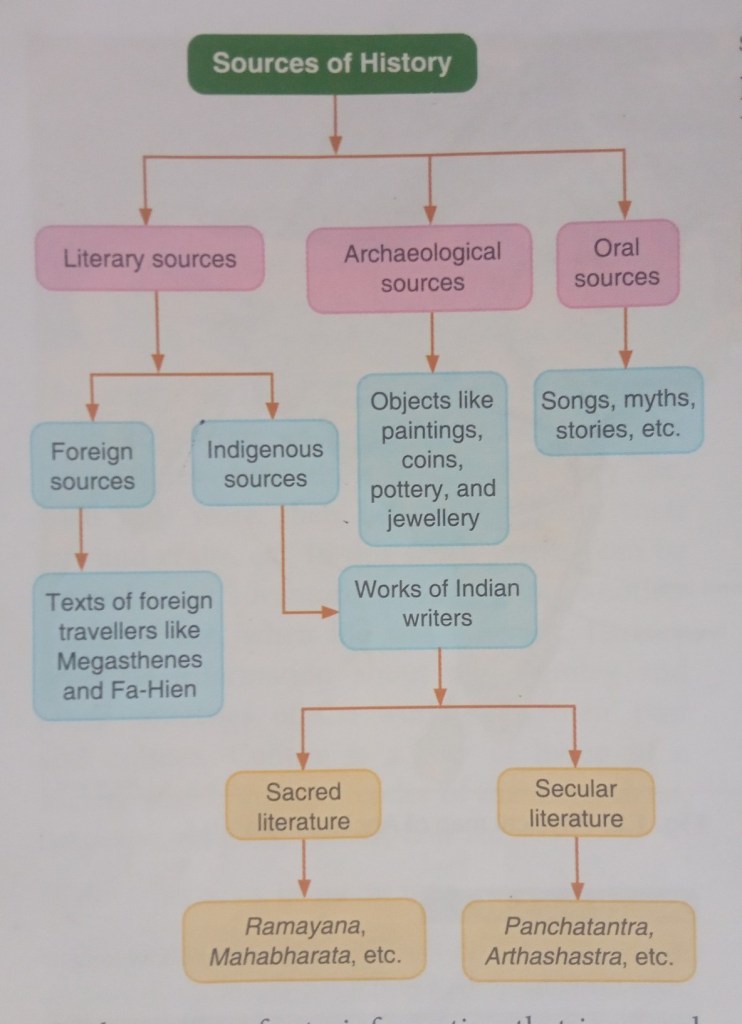
The sources of history are mainly divided into two types—literary sources and archaeological sources. Literary sources include manuscripts, religious books, secular literature and travel accounts. Archaeological sources include inscriptions, coins, monuments, tools, pottery, jewellery and buildings. Historians study these sources carefully to understand the life, culture, economy and administration of people in the past. These sources help us reconstruct history and learn about ancient civilizations.
2. What are the types of literary sources? Discuss them in detail.
Answer:
Literary sources are written records of the past. They are mainly of two types—religious and secular literature. Religious literature includes the Vedas, Ramayana, Mahabharata, Tripitakas and Jain Angas. These books provide information about religion and society. Secular literature includes plays, poems, biographies, travel accounts and books like Arthashastra and Abhijnanasakuntalam. These sources help historians understand politics, economy, culture and daily life of people.
3. What are archaeological sources? Explain how archaeologists use sources to reconstruct the past.
Answer:
Archaeological sources are material remains of the past such as coins, tools, pottery, inscriptions, monuments and jewellery. Archaeologists excavate ancient sites and carefully study these objects. By examining them, they learn about people’s lifestyle, occupation, trade, culture and religion. Coins provide information about rulers and economy, while inscriptions tell about important events. Thus, archaeological sources help reconstruct the history of ancient civilizations.
4. Despite lack of road and transportation, people travelled from one part of the subcontinent to another. Discuss the reasons.
Answer:
People travelled in ancient times for many reasons even though transport facilities were limited. Traders travelled to exchange goods and earn profit. Pilgrims travelled to visit religious places. Scholars and students travelled to gain knowledge. Kings and soldiers travelled for administration and wars. Some people also travelled in search of better opportunities and new settlements. Rivers, mountain passes and sea routes helped them move from one region to another.
G. Differentiate between the following
1. Prehistory and History
Prehistory. . History
Period without Period with writen
written records. . Records
Information is obtained. Information is
from archaeological obtained from
sources. Written and
archaeological sources
2. Manuscripts and Inscriptions
Manuscripts. Inscriptions
Handwritten documents Writings carved on Written on palm leaves, stone,matel,pillars.
bark or paper. Permanent and
long lasting.
3. Archaeological and Literary Sources of History
Archaeological Sources. Literary Sources
Material remains of the Written records
past. of the past.
Examples: coins, pottery, examples:
tools. manuscripts,
religious books.
 Site 𝓝𝓲𝓻𝓾'𝓼𝓫𝓵𝓸𝓰