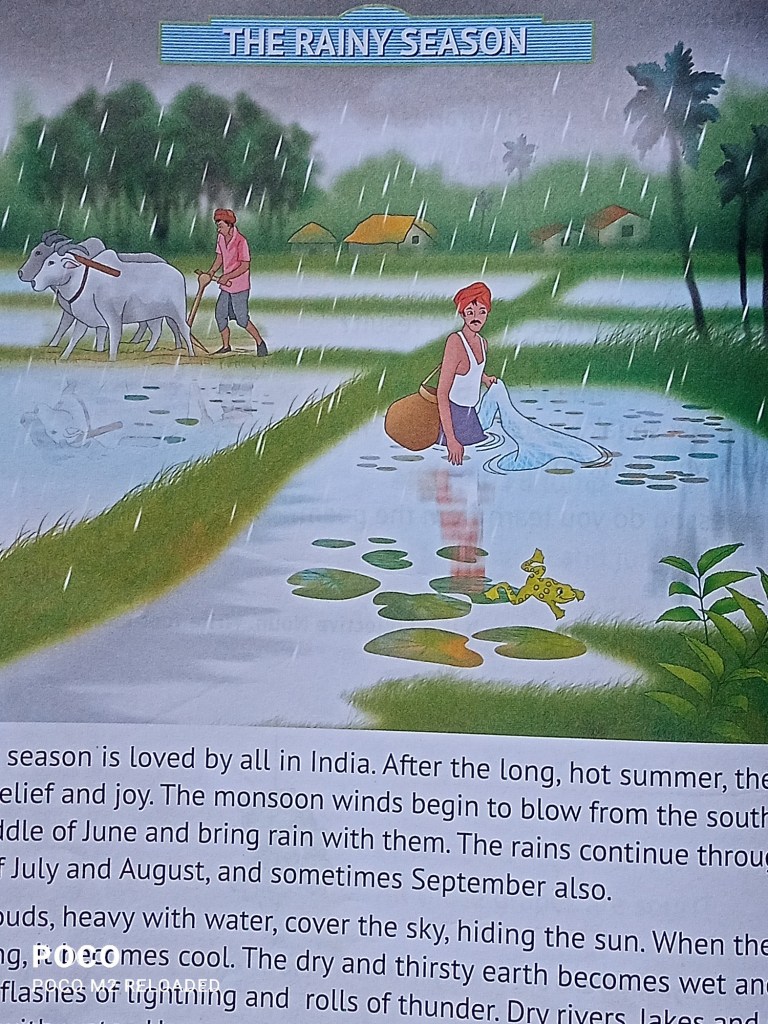
Answer: The South-west monsoon winds bring rain to India.
2. Name the months when it rains.
Answer: The months continue through the month of July, August and sometimes September too.
3. What changes can we see and feel in nature at the start of the rainy season?
Answer: When the rain starts falling, it becomes cool.The dry and thirsty Earth becomes wet and soft. Dry rivers, lakes, and ponds are filled with water.
4. Why are peasants happy when it rains?
Answer: Peasants are happy when it rains, because they can cultivate their fields and it give life to crops and vegetation .
Rain in a city
5. What problems does heavy rains couse in a city?
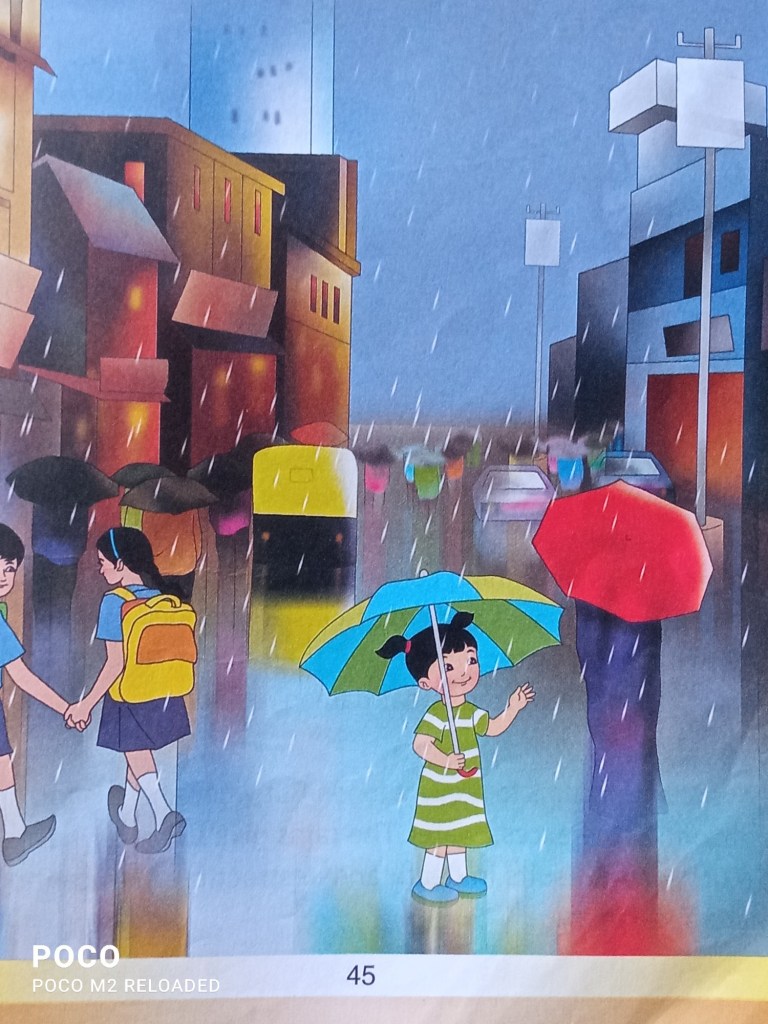
Answer:Heavy rains bring problems for city people,the streets become muddy and slippery. Often the roads become water logged, car and buses cannot move and people have to wolk through dirty knee- deep water slowly.
6.Which vendors are happy during the rains? Why are they happy?
Answer: The venders who sells umbrellas and raincoats are happy because everyone buy their products to protect themselves from getting wet in the rain.
7. What is a rainy day at school?
Answer: In the rainy days at school the little boys and girls, however are very happy they sail paper boats in the water, the streets look like small rivers to the children.
Flood in rainy season
8.What causes floods?
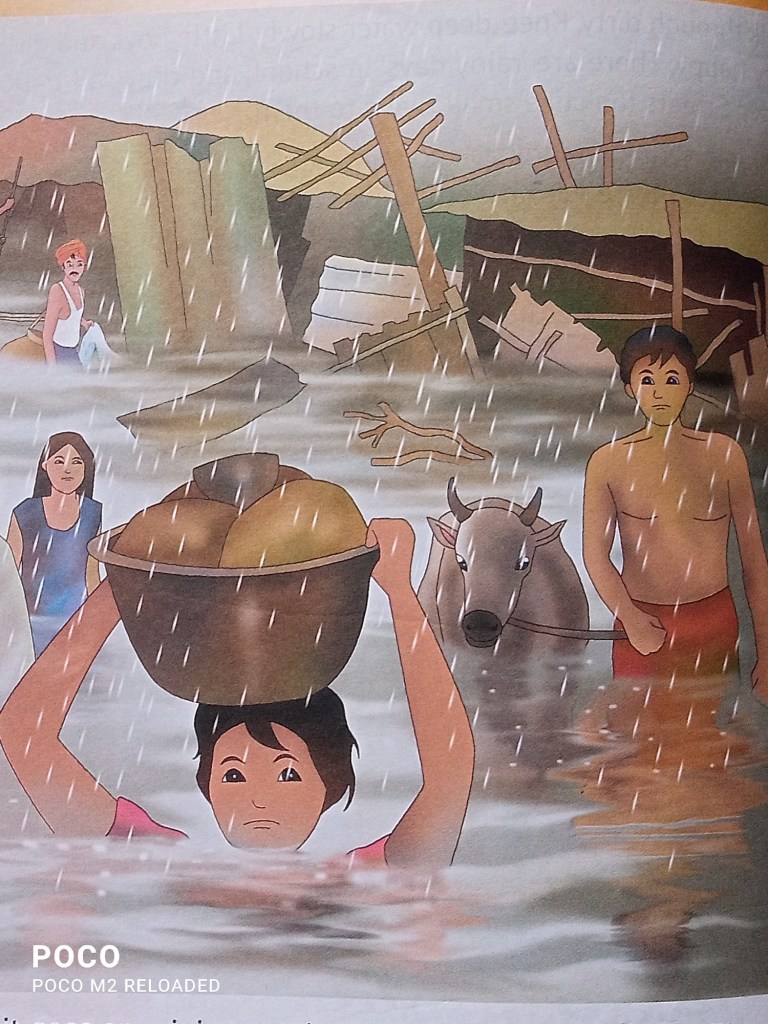
Answer: Heavy rains for days causes floods.
9. What happens when there is a flood?
Answer:The impact of flooding causes loss of human life, distruction of crops, loss of livestock and deterioration of health conditions going to water Borne diseases.
10.How do we try to control flowers?
Answer: We try to control floods by building high dams.
Geography, Lesson- 2, Class- VII,Question and answers. A. Very short answer type questions:
1. What is the age of the earth?
Answer : The earth is approximately 4.5 billion years old.
2. Into how many layers can the earth be divided?
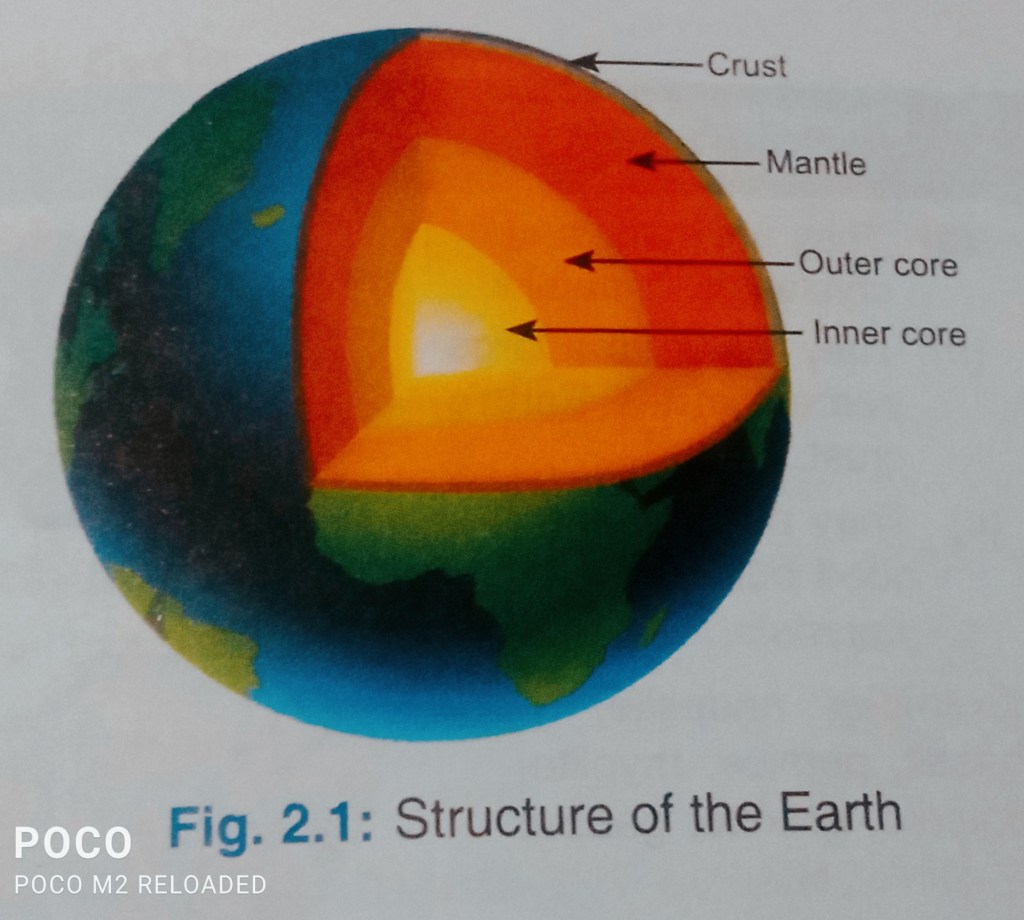
Answer: The earth can be divided into three main layers : the crust , the mantle and the core.
3. What is the continental crust made of?
Answer: The continental crust is mainly composed of granite and other light silicate minerals. 4. Describe the matle of the earth.
Answer: The mantle is the layer of the earth between the crust and the core and is about 2900 kilometre thick, composed of silicate rocks rich in Magnesium and iron.
5. What is the core made up of?
Answer: The core is made up of iron ( Fe)and Nickel (Ni)with a solid inner core and a liquid outer core.
B. Short answer type questions:
1. Compare the inner and the outer core of the earth.
Answer: The inner core is solid composed mainly of iron and Nickel and is extremely hot.
The outer core is liquid also composed of iron and nickel and generates earth’s magnetic field through its flowing currents.
2. What are rocks and Minerals?
Answer: Rocks are solid aggregates of minerals. Minerals are naturally occurring inorganic substances with a definite chemical composition and crystalline structure.
3. Explain the formation of extrusive igneous rocks.
Answer: Extrusive igneous rocks form when magma riches the earth’s surface and cools quickly, resulting in fine grained textures. Examples include basalt and pumice.
4. Describe the formation of sedimentary rocks
Answer: Sedimentary rocks formed from sediments at the surface of the earth, either in water or on land. They are also called stratified rocks as deposition takes place in layers.
5. Write three uses of rocks and Minerals.
Answer: Rocks and Minerals are used in construction (granite for buildings) in manufacturing (limestone for cement) and in technology (silicon in electronics)
C. Long answer type questions : 1. The the structure of the earth is divided into concentric layers.Explain with the help of a diagram.
Answer: The earth is composed of three main concentric layers: the crust (outermost layer) the mental (middle layer) and the core (innermost layer) divided into a solid inner Core.
2. What is meant by The crust? Highlight the difference between the continental crust and Oceanic crust.
Answer: The crust is the Earth’s outermost layer. The continental crust is thicker,less dense,and composed mainly of granite. The oceanic crust is thinner, denser, and composed mainly of basalt
3. Trace the formation of metamorphic rocks.
Answer: Metamorphic rocks form from the alteration of existing rocks due to high temperature,pressure, and chemically active fluids.This process called metamorphism, changes the mineral composition and texture of the rocks (e.g limestone transforms into marble).
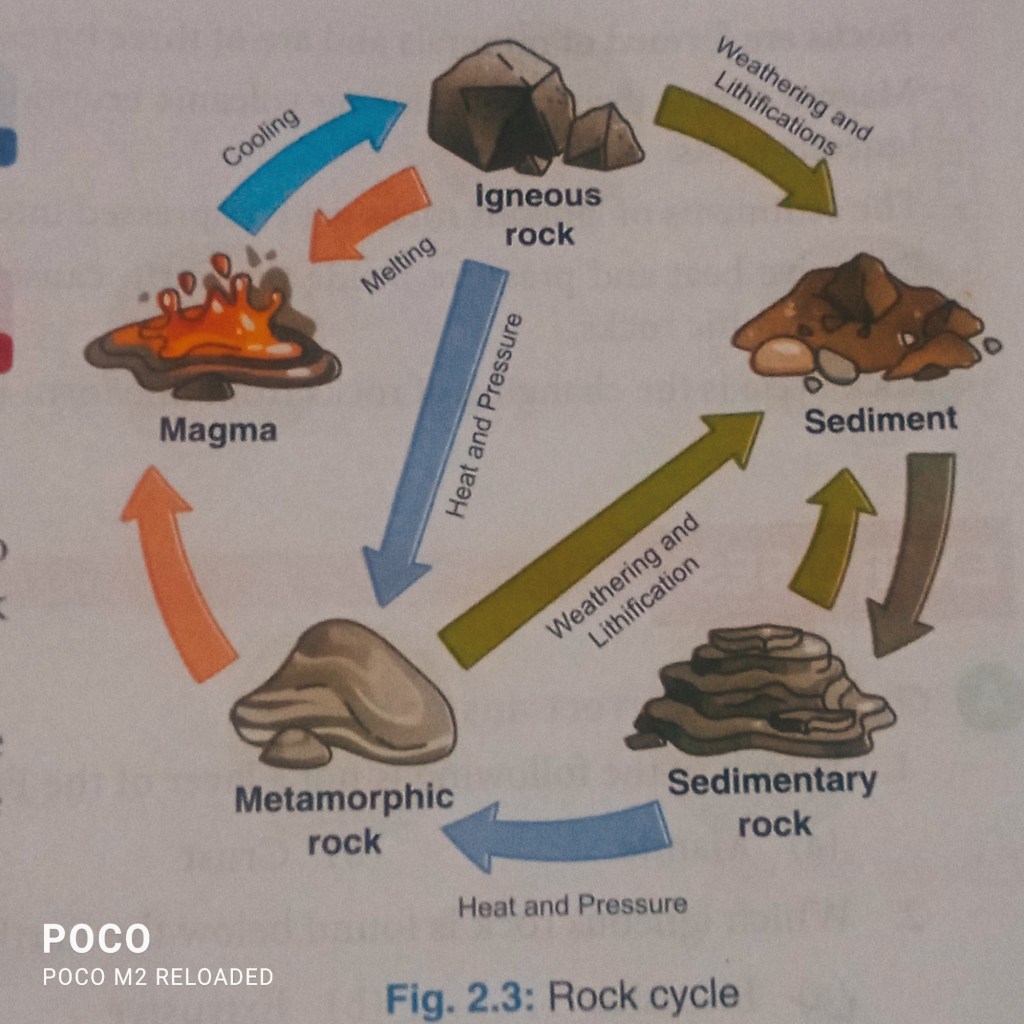
4.What is a Rock cycle? Explain the process of formation of rocks with the help of a diagram.
Answer: The Rock cycle is the continuous process of transformation of rocks from one type to another. Igneous rocks can breakdown into sediments and form sedimentary rocks, which can then be buried and transformed into metamorphic rocks. This can melt into Megma, which upon cooling, forms igneous rocks again.
APJ Abdul Kalam the Missile man of India, was a distinguished Indian scientist and the 11th President of India. Born on October 15, 1931 in Rameshwaram Tamil Nadu, he overcame modest beginnings to become a leading figure in science and Technology.
Kalam studied Aerospace engineering at the Madras Institute of Technology and began his career at DRDO (Defence Research and Development Organisation, later joining ISRO (Indian Space Research Organisation, where he let the development of India’s first satellite launch vehicle. His significant contributions to missile technology, particularly the Agni and Prithvi missiles, earned him his nickname and established India’s prowess in defence technology.
As President from 2002 to 2007, Kalam was beloved for his approachable nature and his advocacy for education and technology. He inspired Millions through his books,such as “Wings of Fire”and ” Ignited Minds”, and initiatives like PURA (Providing Urban Amenities in Rural Areas), aimed at rural development.
A.P.J. Abdul kalam’s legacy endures through his visionary contributions to science, his commitment to education, and his inspirational life story, continuing to motivate people worldwide. He passed away on July 27, 2015, but remains a symbol of dedication, simplicity, and the power of dreams.
Ans: The Samantas were warrior chiefs who were expected to provide military support to the king during during time of wars.
2. What do you mean by the word Rajput?
Ans: The word Rajput comes from the Sanskrit word rajpatra which means ” son of a king”. The term is applied to a group of Warriors who claimed to belong to the Kshetriya caste.
3. Who is University was established by Dharampala?
Ans: The famous Vikramshila University was established by dharampala.
4. What was the tripartite struggle
Answer they fight between the Palas, Gurjara Pratiharas ,and the Rashtrakutas over the control of Kanauj is referred to as the Tripartite Struggle.
5. What was brahmdaya
Ans: Brahmdaya was land granted to Brahmins usually exempt from taxes and meant to support them economically.
B. Short answer type questions.
1. Describe the political changes that took place after the death of Harshavardhana.
Ans: After the death of Harshavardhana, his empire desintegrated as he left no hairs. This led to a period of political fragmentation and the rise of regional kingdoms such as the Pratihara,Palas and Rashtrakutas, who completed for Supremacy in North India.
2. Why was kanauj seen as the symbol of Supremacy? which three kingdoms were involved in fights to control it
Ans: Kanauj was seen as the symbol of Supremacy due to its strategic location and economic importance. The three Kingdoms in the Tripartite Struggle for control over Kanauj were the Pratiharas, the palas and the Rashtrakutas.
3. Write a short note on Mehmud Ghazni.
Ans: Mehmud of Ghazni was a Turkish ruler who invaded India 17 times between 1000 and 1027 AD.He is known for his military campaigns the looting of wealthy temples, and destruction of Indian cities, which established his control over Punjab and parts of northwestern India.
4. Explain the reasons for Rajendra Chola adopting the title of GangaiKonda.
Ans: Rajendra Chola adopted the title of Gangai Kanda after his successful campaign to the Ganges river in North India. This title symbolised his military prowess and the extension of the Chola Empires influence up to the northern regions of India.
C. Long answer type questions
1. Discuss the battle of Tarain?What were the reasons for the defeat of Prithviraj Chauhan?
Ans: The Battles of Tarain were fought in 1191 and 1192 between Prithviraj Chauhan and Muhammad Ghori. Prithviraj won the first battle but was defeated in the second. Reasons for his defeat include internal dissension, and underestimation of Gauri’s tactical skills, and lake of adequate reinforcement.
2. Write a not on Chola inscriptions.
Ans: Chola inscriptions predominantly in Tamil provide valuable historical records about the dynasty. They document details about land grants endowments to temples, administrative decisions and royal degrees.This inscriptions were typically engraved on temple walls, copper plates and stone pillars.
D. Difference between the following
1 Suryavanshi and Chandravanshi
Ans: Suryavanshi refers to the Solar dynasty believed to descent from the sun got Surya, while
Chandravanshi refers to the lunar dynasty believed to descent from the moon got Chandra
2. Kadamai and Vetti
Ans: Kadamai refers to land revenue or taxes leviet on agricultural produce, while Vetty refers to the forced labor or services that where required from the common people.
3.Valanadu and Nadu
Ans: Valanadu was a larger administrative division within the Chola Empire composed of multiple Nadus, while Nadu was a smaller administrative unit or district.
1. The Ganga is considered a holy river because………
Ans: it is believed to purify sins and is worshipped in Hinduism.
2. People release the ashes of the dead in the River Ganga so that………….
Ans: their souls may find salvation.
3. King Sagara performed the ashwamedha yagya because……………
Ans: he wanted to assert his dominance and expand his kingdom.
4. In the ashwagandha yagya a horse…………
Ans: a horse is released to roam freely, and the regions it traverses must accept the king’s sovereignty or challenge his authority.
5. Th difference between the sixty thousand sons of King Sagara and the grandson Anshuman was…………….
Ans: their intentions and actions. The sons were arrogant and disrespectful, while Anshuman was humble and devoted.
6. All the sons of King Sagara were disliked by the people because………..
Ans: of their arrogance and disrespectful behaviour towards others and the sacred rituals.
B2. Answer these questions.
1. Why were the Gods not happy with the sons of King Sagara?
Ans: The Gods were unhappy because the sons of King Sagara were arrogant and disrespectful causing disturbances in the sacred rituals and showing disregard for devine laws.
2.What solutions did the Gods find to their problem with the sons of Sagara?
Ans: The Gods punished the sons of Sagara by turning them into ashes cursing their souls to wander without peace until the Ganga descended to purify them.
3. Why did King Bhagiratha choose to do penance?
Ans: King Bhagiratha chose to do penance to bring the Ganga down to earth and purify the ashes of his ancestors, thus providing them with salvation and peace.
4. Why and how did Shiva stop the Ganga from flowing down to the earth?
Ans: Shiva stopped the Ganga from flowing down to the earth with its full force to prevent it from destroying the world. He caught the river in his hair allowing it to flow gently down to earth in controlled streams.
1. How did the cow and the horse want to make use of their tails?
Ans: The cow and the horse wanted to use their tails to keep away flies.
2. How did the cat show that she did not agree with the dog?
Ans: The dog said that he would wag his tail to express his pleasure and the cat did not agree with him as he wanted to wag his tail to express his anger.
3. Why did the peacock strut about?
Ans: The peacock strutted about by saying that he would spread out his tail to display it’s bright colours.
4. What does the rabbit do to show that danger is near?
Ans: To show that danger is near, the rabbit bobs his tail up like a little white flag.
5. When does the kangaroo make use of it’s tail?
Ans: The kangaroo uses his tail as an extra leg to help him to jump.
6. Why is the tadpole described as ‘poor little tadpole’? What does he do with its tail?
Ass: As he was the only animal who did not know what to do with its tiny tail,he described as a little tadpole.
He swims with the help of his tail and when he grows up he get rid of it.
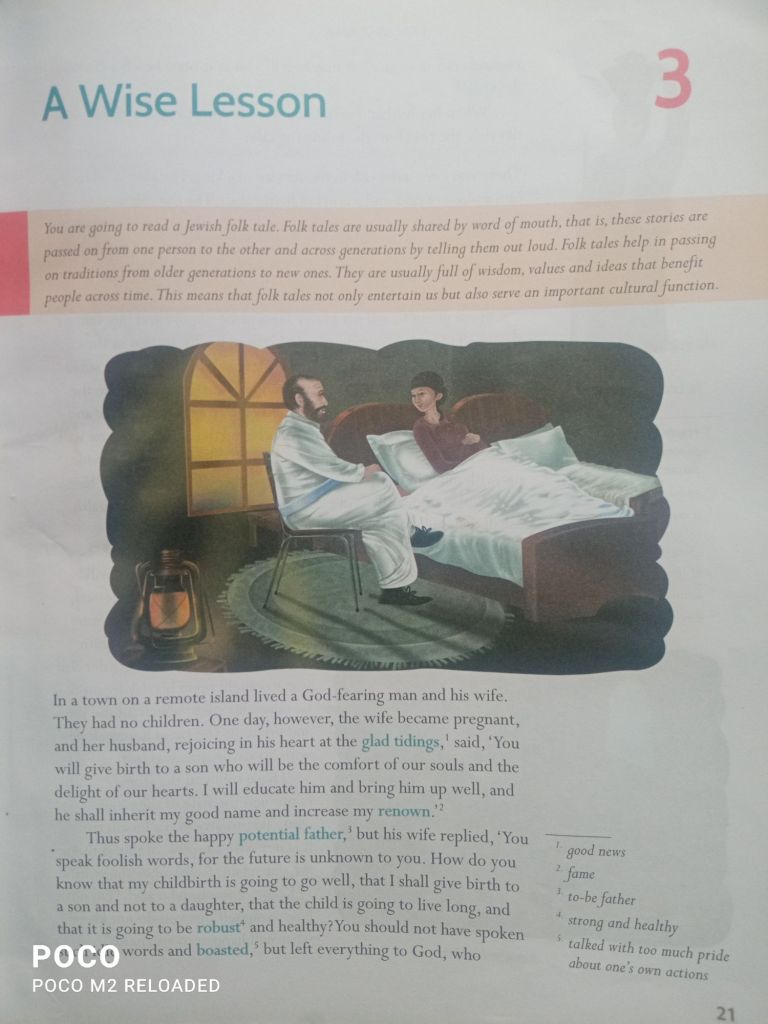
1. What hopes did the man have for his son who was yet to be born?
Ans – The man hoped that his wife would give birth to a son who would be the comfort of their hearts. He planned to educate the son well, and he expected the son to inherit his good name and increase his renown.
2. What was the reaction of the wife when she heard her husband’s plans for their to-be son?
Ans – The wife reacted by telling her husband that he was speaking foolishly because the future is unknown.She pointed out the uncertainties regarding her child, the child’s health, and longevity, and cautioned him against boasting.
3. Why did the wife caution her husband about boasting?
Ans – The wife cautioned her husband about boasting because the future is uncertain, and et is unwise to speak of things that are not quarantced.
4. What was the similarity between the husband and the dervish?
Ans – The similarily between the husband and the dervish is that both made elaborate and confident plans for the future based on uncertain events.
B2. Complete the following sentences.
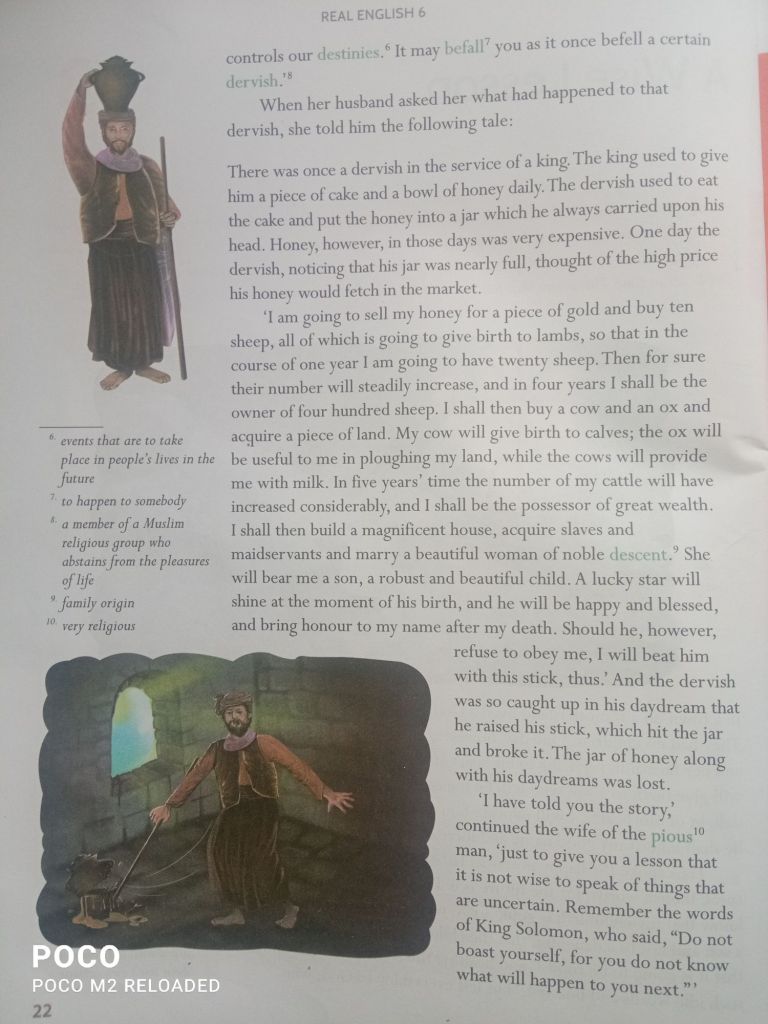
1. The dervish began making plans of……….
……selling his honey for a piece of gold, buying sheep, and eventually becoming wealthy through the multiplication of his livestock.
2. The dervish broke his jar because…………
……. he got carried away in his daydreams about his future wealth and success, and while imagining disciplining his future son, he raised his stick and accidentally broke the jar of honey.
3. The plans of the dervish and the husband were similar because………..
…….. both involved making detailed and optimistic plans about the future based on current hopes and expectations, without considering the uncertainties and potential setbacks.
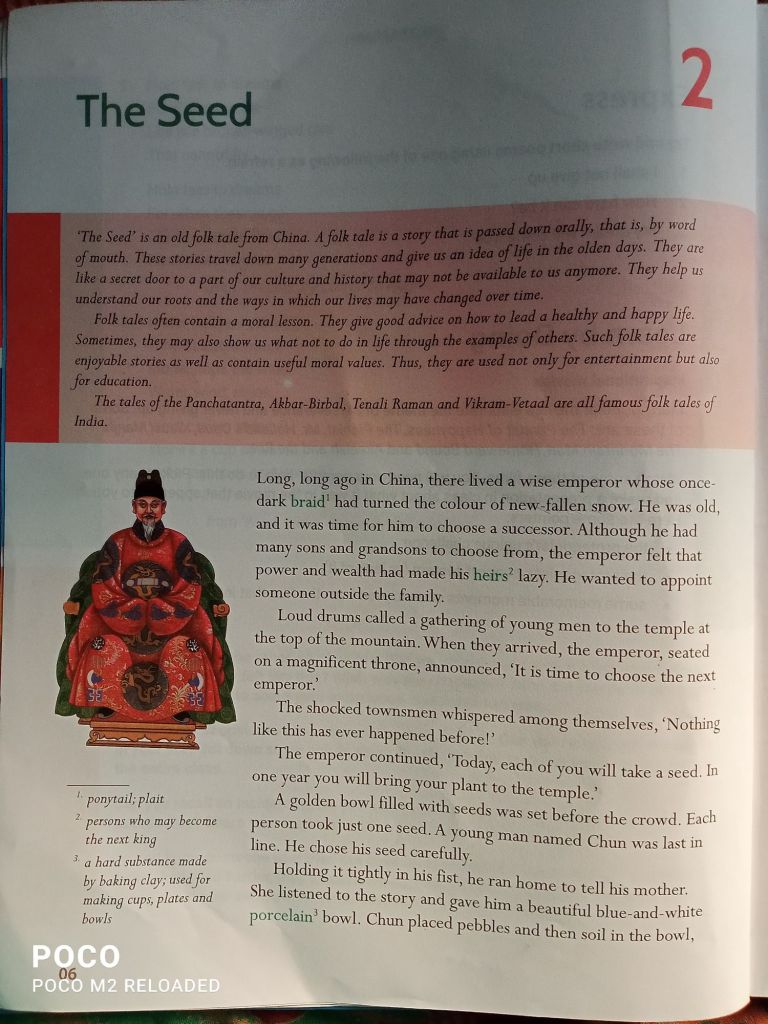
Ans : The emperor’s dark braid had turned into white colour. So we knew that the emperor had grown old.
2. What did the emperor decide to do when he felt that his heirs were lazy?
Ans : The emperor decided to choose his successor from outside the family, when he realised that his heirs were lazy.
3 . The townsmen were shocked by the emperor’s words. What shocked them.
Ans : The townsmen were shocked by the emperor’s announcement that the next emperor would be one of the townsmen.
4 . What did the emperor give the townsmen? What did he want them to do?
Ans : The emperor gave each of the townsmen a seed to plant and asked them to bring back grown plants to the temple after a year.
5 . What did Chun’s mother give him?
Ans : She gave him a beautiful blue-and-white porcelain bowl.
6 . Why was Chun worried about his seed?
Ans : Chun was worried about his seed because, it did not sprout.
7 . Chun said, I failed; Had he really failed? Give reasons for your answer.
Ans : No, he did not fail. It was the seed that was boiled and boiled seed could not grow. He was successful and selected as the next emperor by the king.
8 . Do you think the emperor really was a wise man? Give reasons for your answer.
Ans : Yes, the emperor was really a wise man because he gave boiled seed to everyone and wanted to see that who is honest in his town, so that he could choose a successor for his throne.
 Site 𝓝𝓲𝓻𝓾'𝓼𝓫𝓵𝓸𝓰