India — Location and Features, Class-VI, Subject-Social Science


A. Choose the correct answer

1. Which of these is located in the southern part of India?
โ†’ (d) Kerala


2. The Outer Himalayas are also known as:
โ†’ (d) Shivalik


3. Which river is also called Tsangpo?
โ†’ (b) Brahmaputra


4. Where will you find the lagoons?
โ†’ (c) Kerala


5. Which of these crops is grown in the Brahmaputra Valley?
โ†’ (c) Rice


B. Fill in the blanks

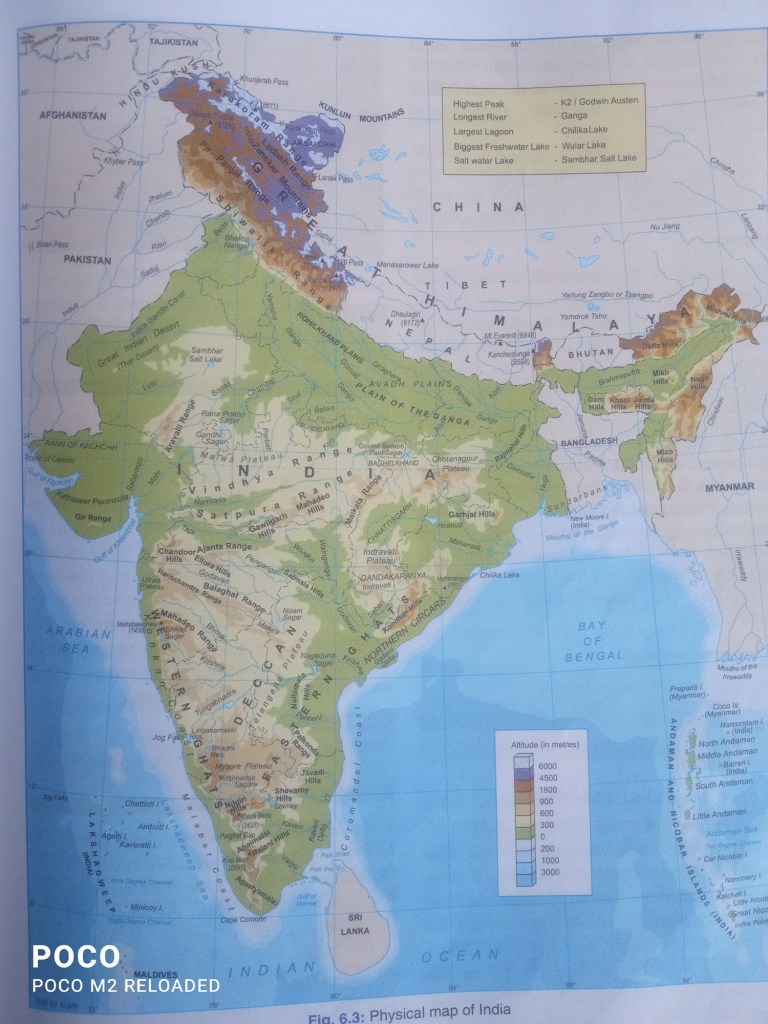
1. The northern part of the eastern coastal plain is known asย Northern Circar.


2. The Barren Island is situated in the Andaman and Nicobar Islands.


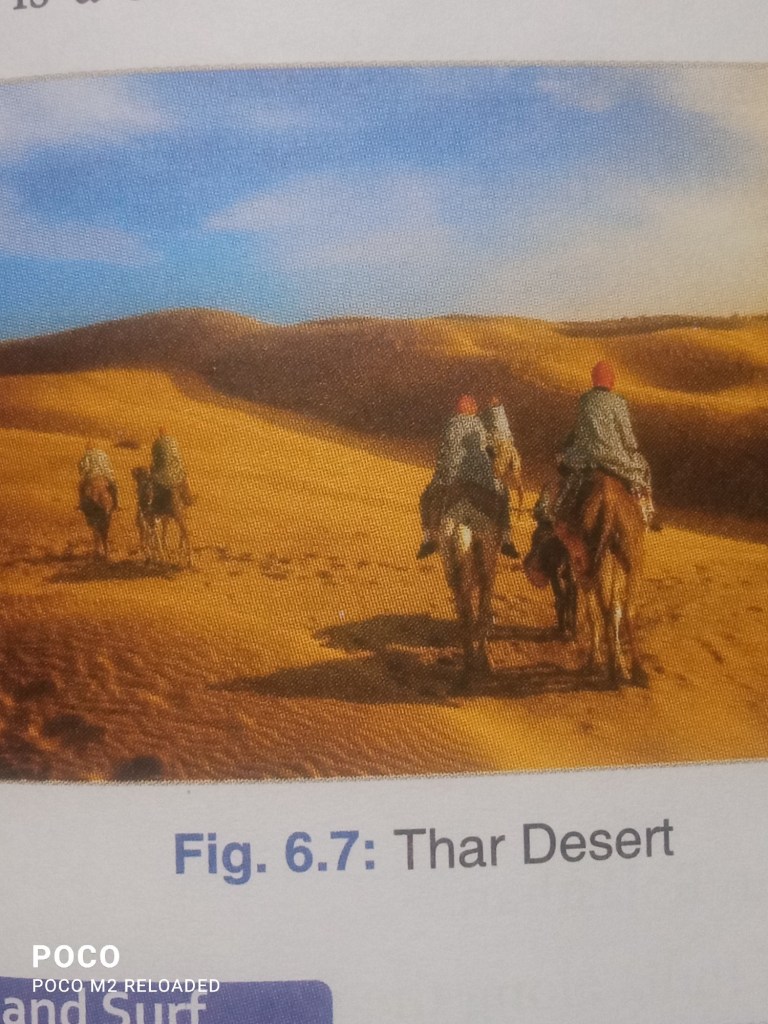
3. The Thar Desert is also known as the Great Indian Desert.


4. ย Sundarbans is the worldโ€™s largest delta.


5. India has 28 states and 8 union territories.


6. Mining is the main occupation of the people living in the Chota Nagpur plateau region.

C. Write T for True and F for False statements

1. F – The Deccan Plateau is also known as Chota Nagpur Plateau in Bihar.

2. T – The Palk Strait lies between India and Sri Lanka.

3. F – West Bengal has a common  boundary with China.

4. F – The Eastern Ghats are  also known as Sahyadri .

5. T – River Narmada divides the peninsular plateau into two halves.

6. F – The highest mountain range in the world is the Himachal.

D. Very Short Answer Type Questions

1. State the location of India.
Ans: India is located in South Asia and is bordered by the Himalayas in the north, the Arabian Sea in the west, and the Bay of Bengal in the east.

2. Mention the major physical divisions of India.
Ans: The major physical divisions of India are: a) The Himalayas                                                        b) The northern Plains                                            c) The Peninsular Plateau                                        c) The Indian Desert                                                 d) The Coastal Plains                                                e) The Islands.

3. List the two major rivers that drain into the Arabian Sea.
Ans: The Narmada and the Tapti rivers drain into the Arabian Sea.

4. Describe the location and extent of the Deccan Plateau.
Ans: The Deccan Plateau is located in southern India. It extends from the Satpura range in the north to the southern tip of the Indian peninsula.

5. Which delta is formed by the Ganga and the Brahmaputra?
Ans: The Ganga and the Brahmaputra form the Sundarbans Delta.

E. Short Answer Type Questions

1. Write a short note on the political divisions of India.
Ans: India is divided into 28 states and 8 Union Territories. Each state has its own government, while Union Territories are governed by the central government. These divisions are based on historical, cultural, and linguistic factors.

2. Compare the Ganga Plain and the Brahmaputra Plain.

Ans: The Ganga Plain is extensive, fertile, and supports a dense population.

The Brahmaputra Plain is narrower and known for its frequent flooding due to heavy rainfall.

3. Write a note on the Malwa Plateau.
Ans: The Malwa Plateau is located in central India, bordered by the Aravalli range in the northwest and the Vindhya range in the south. It is rich in black soil and supports agriculture, especially cotton and wheat.

4. Compare the Western Coastal Plain and the Eastern Coastal Plain.

Ans: The Western Coastal Plain is narrow and lies between the Western Ghats and the Arabian Sea.

The Eastern Coastal Plain is broader and lies between the Eastern Ghats and the Bay of Bengal.

5. Briefly describe the two groups of islands.

Ans: The Andaman and Nicobar Islands lie in the Bay of Bengal and are volcanic in origin.

The Lakshadweep Islands lie in the Arabian Sea and are coral-based.


F. Long Answer Type Questions

1. Explain the geographical extent of India.
Ans: India lies entirely in the Northern Hemisphere. It extends from 8ยฐ4′ N to 37ยฐ6′ N latitude and from 68ยฐ7′ E to 97ยฐ25′ E longitude. The Tropic of Cancer (23ยฐ30′ N) divides India into two halves. The country has a total area of 3.28 million square kilometers.

2. Write about the mountain ranges of India.
Ans: India is home to several mountain ranges, including the Himalayas in the north, which are the highest and youngest ranges in the world. The Western Ghats and Eastern Ghats are located in the southern peninsula. Other ranges include the Aravalli and the Vindhya.

3. Discuss the features of the Deccan Plateau.
Ans: The Deccan Plateau is a large triangular landmass in southern India. It is bounded by the Western Ghats, the Eastern Ghats, and the Satpura hills. The plateau is rich in minerals and has black soil suitable for agriculture. It slopes gently towards the east.

4. Write a note on the Great Indian Desert with reference to its drainage.                                         
Ans: The Great Indian Desert, also known as the Thar Desert, is located in Rajasthan. It is an arid region with scanty rainfall and extreme temperatures. Rivers in the desert, like the Luni, are seasonal and often disappear into the sand.

5. What are the divisions of the Northern Plains?
Ans: The Northern Plains are divided into three parts:

i) Punjab Plains (formed by the Indus and its tributaries).

ii)Ganga Plains (formed by the Ganga and its tributaries).

iii)Brahmaputra Plains (formed by the Brahmaputra and its tributaries)

G. Higher-Order Thinking Skills

1. Why is India called a peninsula?
Ans: India is called a peninsula because it is surrounded by water on three sides: the Arabian Sea to the west, the Bay of Bengal to the east, and the Indian Ocean to the south.

2. Why is the Ganga Plain suitable for agriculture?
Ans: The Ganga Plain is suitable for agriculture due to its fertile alluvial soil, adequate water supply from the Ganga and its tributaries, and favorable climatic conditions.

The Red Room, lesson– 10, Class — VI, Subject — English,

By H.G. Well

H.G. Well (the writer Or narrator for this story)

A. Understand

Complete the following sentences

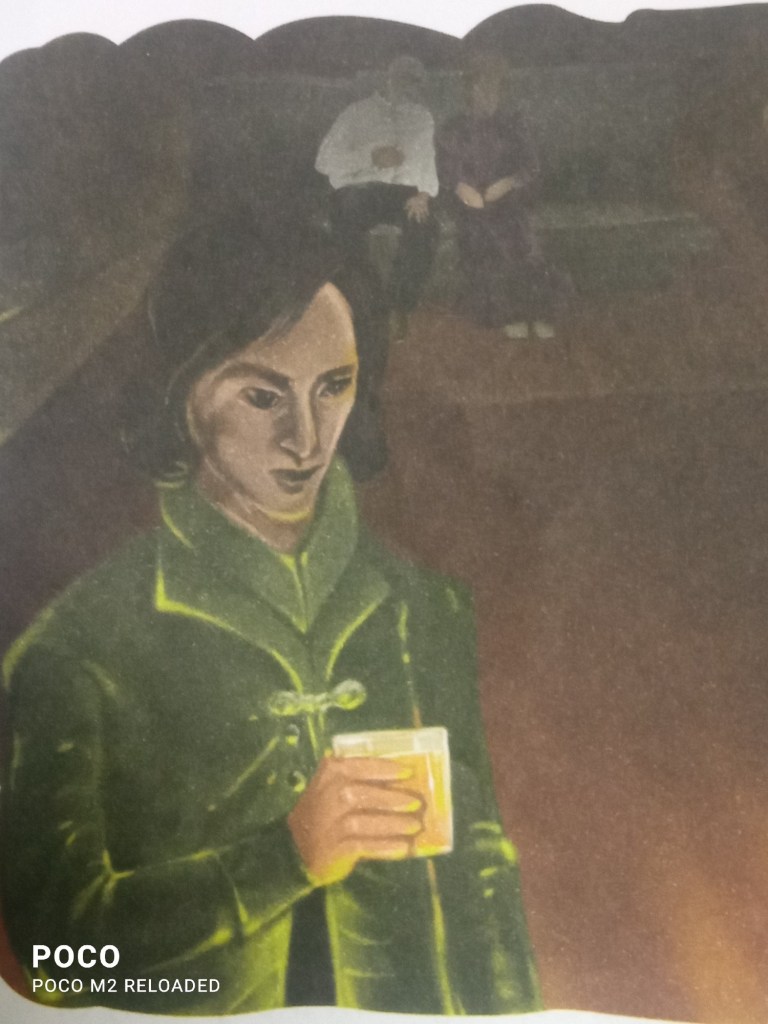
1. The young man seemed overconfident because……. he believed there was no ghost in the red room and thought it was just a superstition.

2. The three caretakers had never visited the Red Room because…… they were to afraid of the ghost say to hount the ghost.

3. The red room of the Lorraine Castle was  infamous because……. it was believed to be haunted and had a reputation for being mysterious and dangerous.

4. The young man told himself to be steady because……… he was feeling nervous and wanted to control his fear.

5. The young man did not remember where he was because …….. he had been  knocked unconscious in the Red Room.

B. Think carefully and answer in detail

  1. Why did the castle look so Haunted give three reasons

Ans: (i) The castle was old and decaying.

(ii) The passages were dark and filled with eerie silence.

(iii) The environment gave a sense of isolation and gloom.

2. How did the stories about the red room work on the narrator’s imagination?

Ans: His imagination magnified every sound and shadow making him Dilip something Supernatural was present.

3. Do you think that there really was Supernatural activity in the room?

Ans: No I don’t think so, it is the fear that follows the narrator through the corridor so that the his dare not turn. It faught against him in the room. There is fear that room. Plain black fear.

4. How do you think our imagination and fear contribute to what we she or perceive?

Ans: Our minds tend to create scenarios based on fear, turning ordinary events into terrifying experience. Fear heightens  our sences and distart reality.

5. Why do people fear ghosts?

Ans: People fear ghosts due to the unknown, cultural stories, and their link to death, amplified by imagination and survival instincts.

6. What techniques do the writers of horror fiction use to create fear in the minds of leaders? Explain with an analysis of ‘ The Red Room’.

Ans: The Red Room illustrates how fear can over power reason. The narrator enters with confidence but succumbs to fear due to the oppressive atmosphere. The real ‘ghosts’ in the story is the fear itself, amplified by isolation and darkness.

The Indus Valley Civilization

Class — VI, Subject – Social Science,

A. Choose the correct answer.

  1. Day in the valley civilization is also called:

(a) Mohenjodaro civilization                                (b) Harappan civilization                                 (c)Lothal civilization                                              (d) none of these                                                    Ans: Harappan Civilization

2. The Great bath is located at:

(a) Dholavira      (b) Lothal       (c)Harappa         (d) Mohenjodaro                                                      Ans: Mohenjodaro

3. The in the seals we are made of:

(a) Steatite       (b)   Faience     (c)  Terracotta       (d)  Bronze                                                               Ans: Terracotta

4. The side of kalibangan is in:

(a) Gujarat    (b)    Punjab     (c)  Haryana            (c)  Rajasthan                                                          Ans: Rajasthan

5. The figure of Pashupati found on the Indus seals is identified with:

( a)   God Vishnu      (b)     God Brahma                (c)    God Shiva          (d)     God  Indra       

Ans: God Shiva

B. Write T  for true and F for false statements

1. Most of the Indus cities were divided into two parts.        T

2. Fire alters have been excavated at Harappa and Mohenjodaro.     T

3. The Harappan script has not been deciphered yet.          T

4. The Indus people did not know how to use the potters wheel.      F

5. A dockyard has been discovered Dholavira.

T

C. Fill in the blanks:

  1. Harappan and Mohenjodaro were the earliest Indus site to be excavated.
  2. Grains were stored in granaries.

   3. Lothal and Dholavira are located in Gujarat.

   4. Oval- shape structures containing ash have been found at  kalibangan  and Lothal.

ย  5.Mesopotamian Civilization is called the cradle of Civilization.

D. Very short answer type questions

  1. List three Civilization that flourished at the same time as the Indus valley civilization.

Ans:  (i) Mesopotamian Civilization

           (ii) Egyptian civilization

           (iii) Chinese civilization

2. What was the extent of the Indus valley civilization?

Ans: It extended from Afghanistan to Gujarat and from Balochistan to Uttar Pradesh.

3. List some important Indus sides.

Ans: Some important Indus sites are Harappa, Mohenjodaro, kalibangan ,Lothal, and Dholavira.

4. What do you understand by the term  “citadel”?

Ans: A Citadel was a raised area in an Indus City that housed public buildings and served  administrative and religious purposes.

5. Why is the Indus valley civilization also called the Harappan civilization

Ans: It is called the Harappan Civilization because Harappa was the first site to be excavated.

E. Short answer type questions

1. Describe the great bath of Mohenjodaro.

Ans: The great bath was a large triangular thank used for ritual bathing. It was surrounded by corridors had steps leading into it, and was made of baked bricks, with a layer of bitumen for waterproofing.

2. Write a short note on Indus seals.

Ans: Indus seals were usually made of steatite and bore inscription and animal notifs. They wear likely used for trade, identification, and religious purposes.

3. Lothal was a port city. Elaborate.

Ans:  Lothal had a dockyard which indicates, it was an important trade Centre. Goods were transported via waterways, linking Lothal with other reasons.

4. Write a note on Dholavira.

Ans: Dholavira located in Gujarat, is known for its unique water conservation system, including reservoirs. It had a well planned city layout with a citadel and a lower town.

5. Examine the religious beliefs of the people of the Indus Valley Civilization.

Ans:  They worshiped nature, animals, and possibly a mother goddess. Seals depicting the figure of Pashupati suggest reverence for a proto-Shiva deity.

F. Long answer type questions

1. Illustrate that the Harappans were great town planners.

Ans: The Harappans excelled in town planning. There cities were laid out in a grid pattern, with well defined streets and drainage system. Houses were made of baked bricks and had multiple rooms. Public buildings like the granaries and the great bath showcased advanced urban designs

2. The drainage system of the Indus valley civilization was unique. Explain.

Ans: The drainage system was well plant with covered drain running along the streets. Each house had a private bathroom and a drain connected to the main sewer line showcasing their advanced knowledge of sanitation and hygiene.

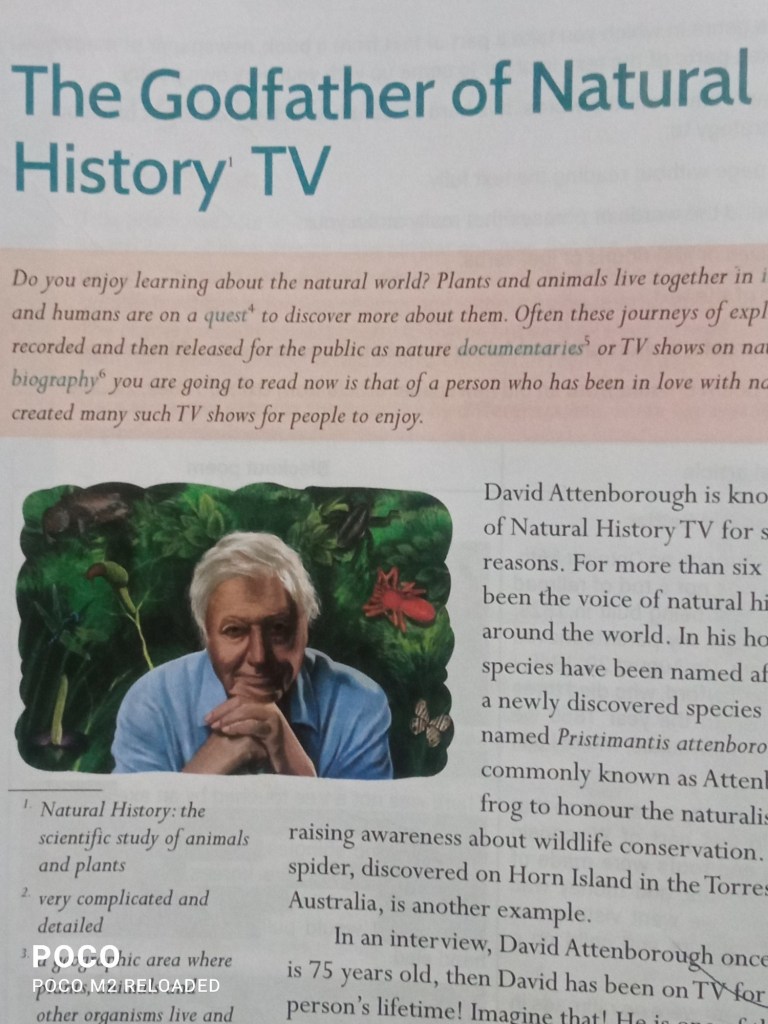
The Godfather of Natural History TV

David Attenborough

B1. Answer this questions

1. Television and social media are good source of information and entertainment what are the importance of the BBC series of David Attenborough for the viewers?

Ans:  The BBC series by David Attenborough provided viewers with deep insights into the natural world. It educated them about the beauty and diversity of wildlife raising awareness about the importance of conserving nature.

2. What does a naturalist do? What is the importance of a naturalist as a profession?

Ans : A naturalist studies and conserves ecosystems, playing a key role in protecting biodiversity and rasing environmental awareness.

3. What are the qualities a person who works in conserving nature – wildlife and environment- need? Give reasons to support your answer.

Ans: Such a person need patience, resilience,  and a deep passion for nature. They must have strong observation skills, a scientific mindset, and ability to work in challenging environment.

4. What kind of risk are faced by a person working for conserving wildlife and nature?

Ans : Conservationists  face encounters with dangerous wildlife,  harsh weather, and health risks from remote areas or diseases.

B2.Think carefully and answer in detail.

1. How are the following professions important? Give two reasons for each.

a)  a naturalist

b) a conservation

c) an environmental advocate

d) an environment minister

Ans:  a naturalist

i) They help conjured and protect species and ecosystem.

ii) They educate the public about the natural world.

b) a conservationist

i) They help protect endangered species.

ii) They work to conserve natural habitats and ecosystems.

c)  an environmental advocate

i)They raise awareness about environment issues.

ii) They influence policies and promote sustainable practices.

d) an environmental minister

i) They develop and implement policies to protect natural resources.

ii) Establishing regulations for industries to reduce their environmental impact is a key part of this.

2. Identify at least three steps that you can take to help or protect animals or birds in the place where you live.

Ans.  a) Avoid using plastic products to prevent pollution.

b) Plant trees or create a small garden to attract wildlife.

c) Support local wildlife organisation or santuaries.

Bonku Babu’s Friend    14

Class — V, Subject — English, Lesson — 14 , Real English

Meeting of Ang and Bonku Babu

A. Questions and answers

1.Who was Ang?

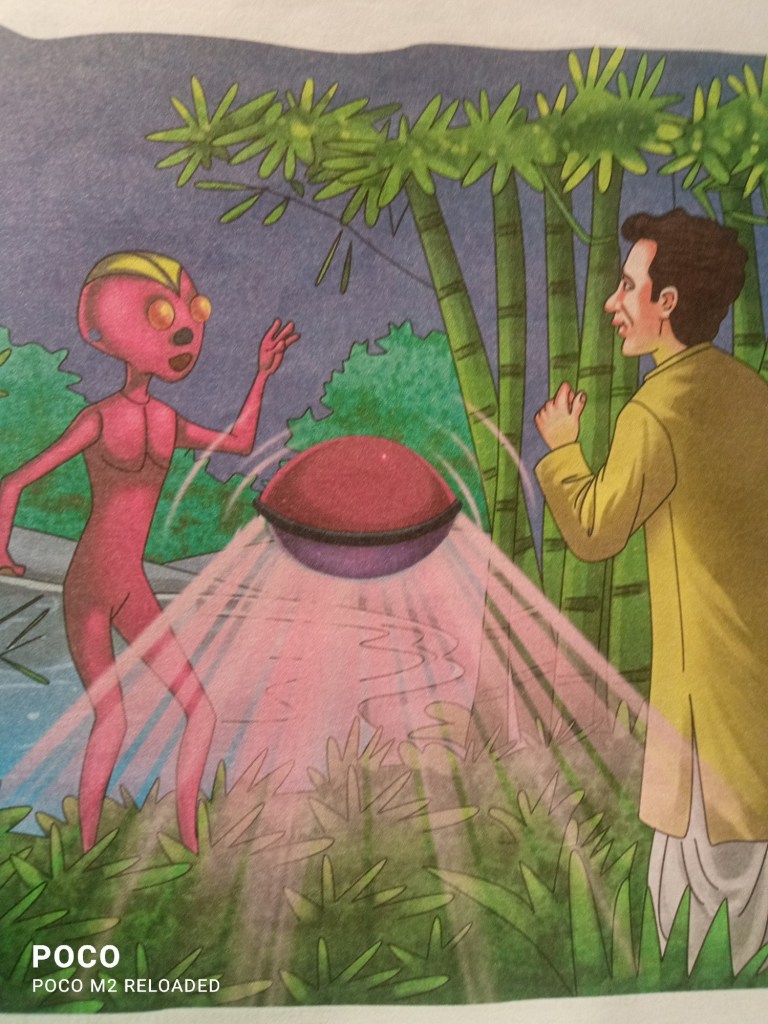
Ans : Ang was an Alien from the planet Craneus.

2. How did Ang come to earth?

Ans : Ang accidentally landed on earth when he intended to go to Pluto.

3. What did he tell Bonku Babu about his planet and about himself?

Ans : Ang felt, proud describing himself as a superior being who knew 14000 languages.

4. What impression did Ang create in Bonku Babu’s mind?

Ans : Ang’s pride and confidence left Bonku Babu feeling that Ang was a powerful and intelligent being.

5. Why did Pancha Ghosh so excited at the Sunday meeting?

Ans:  Pancha Ghosh excited at the Sunday meeting because he was going to tell everyone about bamboo grove ,where all the bamboo around the pond had shed all their leaves.

6. What was the first thing that Bonku Babu did on entering Sripati Babu’s house?

Ans : Bonku Babu burst into a gaffow and laughed  loudly for a whole minute as soon as he entered Sripati Babu’s house.

7. Did the meeting with Ang change Bonku Babu in any way? Give reasons for your answer.

Ans:  Yes, Bonku Babu got the courage to stand up for himself after meeting Ang, because he was the only person to not make fun of him. Often people get the courage to stand up for what is right when they have get support from others.

8. Banku Babu had something to say to the people in Sripati Babu’s house. Write against each of their names what he told them.

Ans :   Chandi Babu: at your age, hiding other people’s shoes and umbrellas is not just childish, but totally wrong. Kindly bring my umbrella and brown Canvas shoes to my house tomorrow.

Nidhi Babu :ย  if you call me Bu,nkum ‘ I will call you Nitwit and you must learn to live with that.

Shripati Babu : you are an important men and must have hangers- on, but please count me out from today.

Pancha Babu:  you are here as well! l Let me inform you that last night, an Ang arrived from the planet Craneus and landed on the pond in your bamboo grove. We had a long chat. The Ang was most amiable.

B2  Ang has been described as a strange creature very different from humans complete the following table with details of his appearance.

Head : Round and Shiny with no hair.

Eyes : Large, bright yellow ,growing

Ears : Tiny holes on each side of the head

Nose :  no visible nose, only two holes

Mouth : A large gaping hole

Arms and legs : Long, thin arms and legs

Hair : No hair

Body : Covered with a shiny pink outfit

B3.

C1.

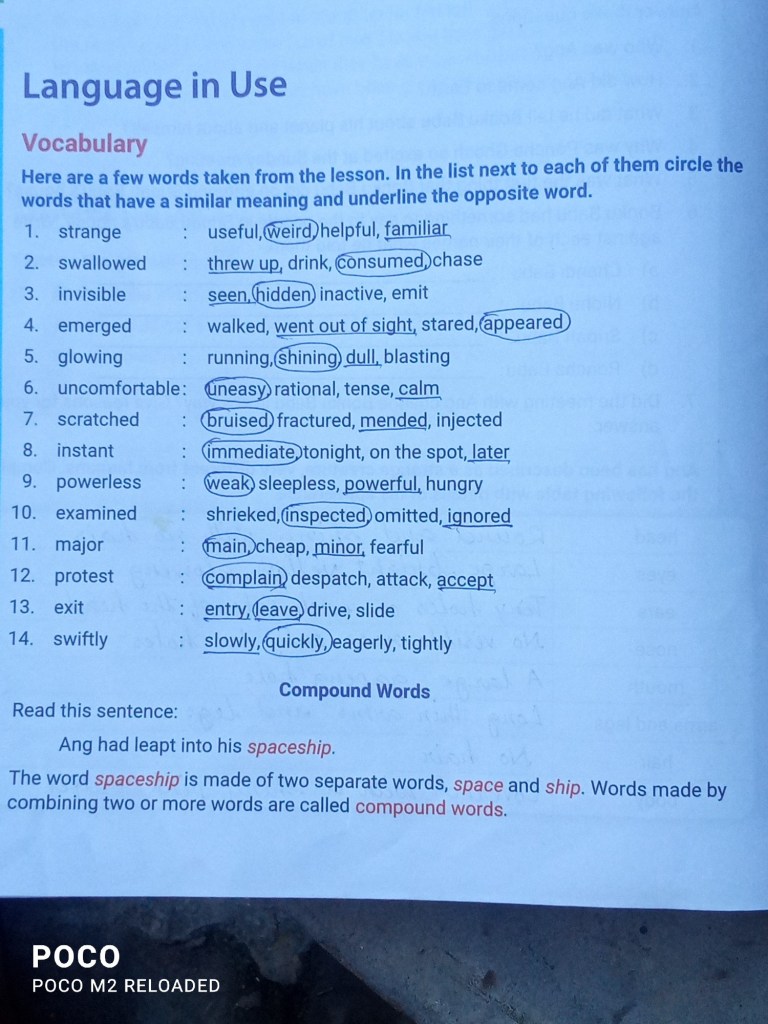
Match the words in Column A with those in Column B to get some commonly used compound words.

               A                                      B

           arm                                  cycle

           atom                                 friend

            foot                                   chair

            lamp                                 dream

            black                                 bomb

            dark                                   worm

             glow                                   ball

              day                                    room

              pen                                    friend

              motor                                board

Ans :   arm — chair

             atom — bomb

              foot — ball

              lamp — post

              black — board

              dark — room

              glow — worm

              day — dream

              pen — friend

              motor — cycle

C2. Complete the following sentences with the compound words that you got by solving C1

1. My uncle has broad a beautiful red motorcycle which can go very fast.

2. We love playing football in the rain.

3. The teacher drew the figure of a human heart on the blackboard.

4. Divya’s grandmother had a pen friend who lived in Switzerland.

5. The lamp post outside my house broke yesterday.

6. You can see the glow worm shining in the dark forest.

7.Photographs are developed in a dark room.

8. The world will not survive if people start fighting with the atom bomb.

9. My grandfather was sleeping in his day dream.

The Mughal Empire

( 16th — 17th Century)

The Taj Mahal is made by Shah Jahan for his beautiful queen Mamtaj Mahal

Question and answers for the chapter “The Mughal Empire” , Class — vii, subject — Social Science.

A. Very short answer type questions:

  1. Name the autobiography of Babu in which language it is written?                 Ans: the autobiography of Babur is called the Baburnama and it was written in chagatai turkic.
  2. Who defeated Humayun twice? Mention the places and years.                                 Ans: Humayun was defeated twice by Sher ShahSuri.The first defeat was at the battle of Chausa in 1539, and the second was at the battle of Kanauj in 1540.
  3. Between whom and when was the battle of Haldighati caught?                                Ans: the Battle of Haldighati was fought between Maharana Pratap of Mewar and the forces of Akbar led by Mansingh I of Amber in 1576.

4. What is the meaning of Noor Jahan who was she

Ans: “Noor Jahan” means ” Light of the world” She was the wife of the Mughal emperor Jahangir originally named mehr-un-nisha.

5. The Mughals were descendants of Two Famous rulers

Ans: The Mughals were descendants of Genghis Khan from the maternal side and Tamerlane ( Taimur) from there paternal site.

B. Short answer type questions:

1. Write a short note on the raign of Sher Shah Suri.

Ans: Sher Shah Suri was an Afghan ruler who established the Sur Empire in North India after defeating the Mughal Emperor Humayun. Sher Shah Suri was known for administrative reforms, including a new tax system, building roads and enhancing trade. Hi policies influenced later Mughal rulers.

2. Describe the administrative changes introduced by Akbar

Ans: Akbar introduced several administrative reforms to strengthen his Empire. He implemented the mansabdari system to organise his army and bureaucracy established a centralized administration, and promoted religious tolerance called sulh-i-kul. His reforms laid the foundation a stable and prosperous Empire.

3. Write a short note on Noor Jahan.

Ans:  Noor Jahan was the influential wife of Emperor Jahangir and one of the most powerful women in Mughal history, She effectively handled the administration and made important decisions on behalf of Jahangir. Known for her intelligence and political acumen, she influence the Mughal court and supported architecture poetry and art.

4. Describe the cultural contribution of Shah Jahan.

Ans: Shah Jahan is known for his significant contributions to Mughal architecture. His reign  saw the construction of iconic structure like the Taj Mahal, The Red Fort, The Jama Masjid. His architectural achievements symbolised the Zenith of Mughal Art and culture.

5. Write a not on Aurangzeb in the battle in Deccan

Ans:  Aurangzeb expanded the Mughal Empire into the Deccan region, defeating the Maratha ruler Shivaji’s successor and other southern kingdoms. Although he achieved military success, the prolonged campaigns drained the Empires resources and eventually contributed to is decline. His  policies led to increased resistance in the Deccan.

C. Long answer type questions

1. Assess the fact that it was Akbar who expanded and consolidated the Mughal Empire.

Ans: Akbar played a crucial role in expanding the Mughal Empire. He extended Mughal territories through conquest in Gujarat, Bangle, Rajasthan and the Deccan. Beyond military success, Akbar’s policy of Sulh-i-kul fostered religious tolerance  which  helped integrate diverse communities. His administrative reforms like the Mansabdari system and land revenue system, established a stable governance model. Akbar’s vision and policies made the empire one of the most powerful in the world during his reign.

2. Describe Akbar’s Rajput policy.

Ans:  Akbar’s policy was a mix of diplomacy, alliances, and military actions. He married Rajput princesses recruited Rajput nobles into his court , and granted them high ranks. This approach fostered loyalty among the Rajputs who became vital allies and  administrators  within the empire by winning their trust, Akbar was able to secure the Northwest Frontier and strengthen his rule.

3. Write about the mansabdari system under the Mughals.

Ans:  The mansabdari system was military and administrative system introduced by Akbar. Officials known as mansabdars, were assigned ranks that determined their status salary  and number of soldiers  they maintained. This system helped centralize control and ensured loyalty to the emperor, as appointments and promotions depended on merit and the rulers favour.

4. Justify the fact that land was the main source of revenue for the  Mughals.

Ans:  Land revenue was the Mughal Empire’s primary source of income as agriculture was the main economic activity, as agriculture dominated. Taxes collected financed the army and administration.

5. Discuss Aurangzeb religious policies.

Ans:  Aurangzeb’s religious policies were more orthodox compared to his predecessors. He introduced the jizya tax on non-Muslims banned certain cultural practices, and destroyed some Hindu temples. His policies led to discontent among non-Muslims and weaked alliances that previous had cultivated. This approach eventually contributed to internal dissent and the decline of the empire.

Teachers Day speech

Good morning respected principal sir, teachers, elders brothers and sisters , friends and all the Guardians.

Today we gather to celebrate the remarkable role teachers play in shaping our lives. A teacher is more than just someone who just someone who imports knowledge; they are mentors, guides, and often, our greatest supporters. Their influence extends far beyond the classroom helping us grow not only academically but also as individuals.

Teachers inspire us to dream big, work hard and believe in ourselves. They have the power to unlock potential we never knew we had pushing us to achieve greatness.

On this Teachers Day, let’s take a moment to express our deepest gratitude for their dedication, patience, and endless encouragement. To all teachers: thank you for your unwavering commitment to shaping a brighter feature.

Happy Teachers Day

Thank you

                    ooooooooooooooooooo

Bonku Babu, Lesson – 13

B1 Choose the correct answer.

  1. We know that Bonku  Babu was a mild- manners man because                    

a) he never laughed.

b) he never reacted even when the students teased him.

c) he was afraid of the aliens.

Ans : (b)

2. Sripati Majumdar liked inviting  people to his house because

a) he liked feeding them.

b) he could talk to them.

c) it made him feel important.

Ans : (c)

3.Chandi Babu was not interested to talk about rockets because

a) he had not seen them take off.

b) he was afraid of them.

c) he would get burnt  if  he went near them.

Ans: (a)              

4. Nidhi Babu, Chandi Babu and others laughed

at Bonku Babu because                                                  (a) he was so quit

b) they thought he was stupid.

c) he wanted to know  what would happen if aliens landed on earth.

Ans : (b)

5.Bonku Babu left Sripati Majumdar’s house early because

a) he was tired of  being made fun of.

b) he wanted to rest home.

c) he wanted to meet the alien.                               Ans : (a)

6. The pink light shining all around in the bamboo grove was coming from

a) a giant football in the field.

b) a bowl of water with coloured fish in it.

c) an upturned giant glass bowl.

Ans : (c)

B2. Answer this questions

1. Why did everyone tease Bonku Babu?

Answer Bonku Babu is a meek and timid village school teacher. The villagers particularly his students and others tease him because of his shy, introverted nature and lack of assertiveness.

2.Whose house did Bonku Babu go to on weekends?

Answer: Bonku Babu went to the lawyer Sripati Majumdar’s house on weekends

3.How was Bonku Babu usually treated by Sripati Majumdar and his friends?

Answer :  Bonku Babu was treated with ridicule and  disrespect by Sripati and his friends, who mocked him for his timid and awkward nature.

4. What did Bonku Babu see in the bamboo grove?

Answer: He saw a pink light shining all around and an upturned joint glass bowl.

5. Why did Bonku Babu feel there was something strange about the night?

Answer :  He likely felt strange because of the unusual humming sound and the pink light in the bamboo grove, which suggested something otherworldly  or  alien to him.

6. What happened after humming sound stopped?

Answer : After the humming sound stopped, the pink light likely disappeared, and Bonku Babu might have realised something extraordinary was happening, possibly related to the alien encounter he imagined.

D1. Fill in the blanks with the correct words from those given in brackets

1. The school is closed on __________ . (weekends/ wekends).

Answer:  weekends

2. I love to__________ seashells from the seashore. (collect / colect)

Answer: collect

3. She borrowed my__________ when it started raining ( umbrella / umbrela)

Answer :  umbrella

4. The moon is a________ of the earth.(satellite/satelite)a

Answer:  satellite

5. Our science room has a glass Case full of  __________ of plants and animals.( specimens/speecimens)

Answer: specimens

6. I saw a small mummy preserved in the _________ (musum/ museum)

7. The child felt an ________ current on touching the wire.(ellectrec/ electric).

8. We suddenly heard loud noise followed by the __________ of glass.( shattering/shattring)

Answer: shattering

9. The old man walked ________ because he had painful joints.(stiffly/steefly)

Answer: stiffly

10. My friend Sonal__________ that I go to her house on her birthday.(insested/insisted)

Answer: insisted

D2. Complete the words by reading there meanings

1 . p_zz_ _d        —   confused                                      Ans : puzzled

2.  in_ _s_ble     —     cannot be seen                          Ans : invisible

3. tr_d_t_ _n       —     a belief or practice               Ans : tradition                         

4.wr_nk_ _d       —     crumpled or Christ                Ans :wrinkled

5. r_p_ _ _ted     —     said something again and                                              again                                                                               Ans :repeated                                                               

6. im_ _rt_ _t      —      central or main                 Ans :important     

7.n_rm_ _lly          —      usually                               Ans :normally                                                           

8. m_s_ _m            —      a place where valuable things are stored                                                        Ans :museam

9. r_ _k_t                —       a space vehicle                Ans :rocket

10. sp_c_m_n        —         a sample                             Ans :specimen

Self-contained, Class-VI, Poem by Walt Whitman, question and answers.

Summary for the poem Self-contained:

The poem Self- Contained written by Walt Whitman, highlights the importance of independence and self reliance. It encourages individuals to believe in themselves, face challenges confidently and manage without always relying on others. The poem promotes inner strength and self confidence.

New Words:

Self-contained– not depending on other people

Placid — calm

Whine — complain all the time about e                  everything

Demented — crazy

Mania — uncontrolled desire to do something

Kneels to another — shows obedience to somebody

Answer this questions

1. What does Whitman mean by ‘ They do not lie awake in the dark and weep for their sins’?

Ans : This line suggest that animals don’t feel guilt or regret like humans do. They live naturally without dwelling on  their actions or feeling remorse for things done in the past.

2. What does this line mean: ‘Not one kneels to another, nor to his kind that lived thousands of years ago’? Choose the correct answer.

a) Animals  unlike humans, believe in hierarchy.

b) Animals cannot kneel.

c) Animals, unlike humans, don’t try to impress others of their species and don’t worship their ancestors either.                                                           Ans : c      

3. What does ‘Not one is respectable and unhappy over the whole earth’ mean ?

Ans : This line means that animals are not concerned with ideas of respect and status as humans are. They are content and not weighed down by concerns about being respected or unhappy with their place in the world.

                     ๐Ÿ˜Š๐Ÿ˜Š๐Ÿ˜Š๐Ÿ˜Š๐Ÿ˜Š๐Ÿ˜Š๐Ÿ˜Š๐Ÿ˜Š

Role of Government in Healthcare, Class-7, Subject- SST,

A. Choose the correct answer

1. Absence of illness and injury means:

(a) Wealth (b) Sanity  (c) Health  (d)  Public Health system                                                         Ans: ( c)

2. The manpower of a country is its

(a) Human resources  (b) Power stations           (c)    Electricity     (d) Political leaders                 Ans:  (a)

3. 21% of all the communicable diseases are:

ย  (a) Waterborneย ย  (b) Terminalย ย ย  (c) Mentalย ย ย ย ย ย  (d) Psychological                                                   Ans : (a)

4. A foreigner can stay in India for medical reasons for:

(a) 15 daysย ย  (b) 3 monthsย ย  (C) 20 daysย ย ย ย ย ย ย ย ย ย ย ย  (d)30 days                                                                Ans : (b)

B. Fill in the blanks.

1. Health of the citizens affects development of a nation.

2.Niti Aayog replace the planning commission in 2015

3. The full form of WHO is World Health Organisation.

4. Private Healthcare facilities are very expensive.

C. Match the columns.

  1. International organisation that provides assistance to Public Health Care programs— WHO

2. Private Healthcare —  Healthcare and medicine provided by entities other than the government.

3. The Ministry of Health and Family Welfare —A central government body responsible for forming health policies.

4. Waterborne diseases —- Dysentery jaundice hepatitis diarrhoea.

5. Niti Aayog — Set up on January 1, 2015.

D. Write T for through and F for false statements

1. A person with no illness and injury is considered healthy.     (True)

2. India has only government-run dispensaries and hospitals.     (False)

3. Kerala has the poorest health service facilities in India.      (False)

4. Medical tourism is a growing sector in India.

(True)

E. Very short answer type questions

1. What do you mean by health?

Answer– Health is a state of complete physical mental and social well-being, not marely the absence of disease or Infinity.

2. What are the factors on which the health of a person depends?

Answer– The health of a person depends on factors such as genetics, lifestyle, environment, access to health care, and socio- economic conditions.

3. How does the government private organisations and NGOs try to prevent or treat illness

Answer –they implement health policies, run awareness campaigns, provide vaccinations, offer healthcare services, and promote sanitation and hygiene.

4. List the reasons why large sections of the population do not have access to medical care.

Answer— Reasons include poverty, lake of healthcare, infrastructure, geographical barriers, and insufficient healthcare professionals in remote areas.

5. How does the government use the money paid by citizens is Texas

Answer—The government uses tax money to fund public services like healthcare, education, infrastructure, and social welfare programs.

F. Short answer type questions

1. What is Niti Aayog why was it formed

Answer— Niti Aayog is a policy think tank of the Indian government, formed in 2015 to replace the planning commission. It was created to provide strategic and technical advice on economic and social issues.

2. Explain the working of the public health care system

Answer— The public health care system in India is run by the government, providing affordable healthcare services to citizens through a network of hospitals, dispensaries, and healthcare centres. It focuses on preventive care, treatment, and health Promotion.

3. Write a not on Private Health Care system.

Answer — The private healthcare system consist of privately-owned hospitals clinics and healthcare providers. It offers high quality services but is often expensive and primarily accessible to those who can effort it or have insurance coverage.

4. India has become a destination for medical tourism. Elaborate.

Answer— India has emerged as a leading destination for medical tourism due to its advanced healthcare facilities, skilled medical professionals, and affordable treatment cost. Patients from around the world come to India for treatment such as surgeries, organ transplants and specialized medical care.

G. Long answer type question

1. What guidelines have been mentioned in the Directive Principles of State Policy related to healthcare? How do they ensure access of all the resources to all community.

Answer— In the field of healthcare, the Directive Principles of State Policy ensure that:

. Citizens get required means of livelihood.

. Equal pay for equal work is given.

. Sick, aged, unemployed and disabled get works, education, and public assistance.

. Maternity relief is given to working women.

. The level of nutrition and standard of living condition is raised and public health is improved.

To ensure available of resources, public health expenditure in a state is shared by the Central and State the government. NGOs and international organisation like WHO also provide assistant to public health care programmes.

Design a site like this with WordPress.com
Get started