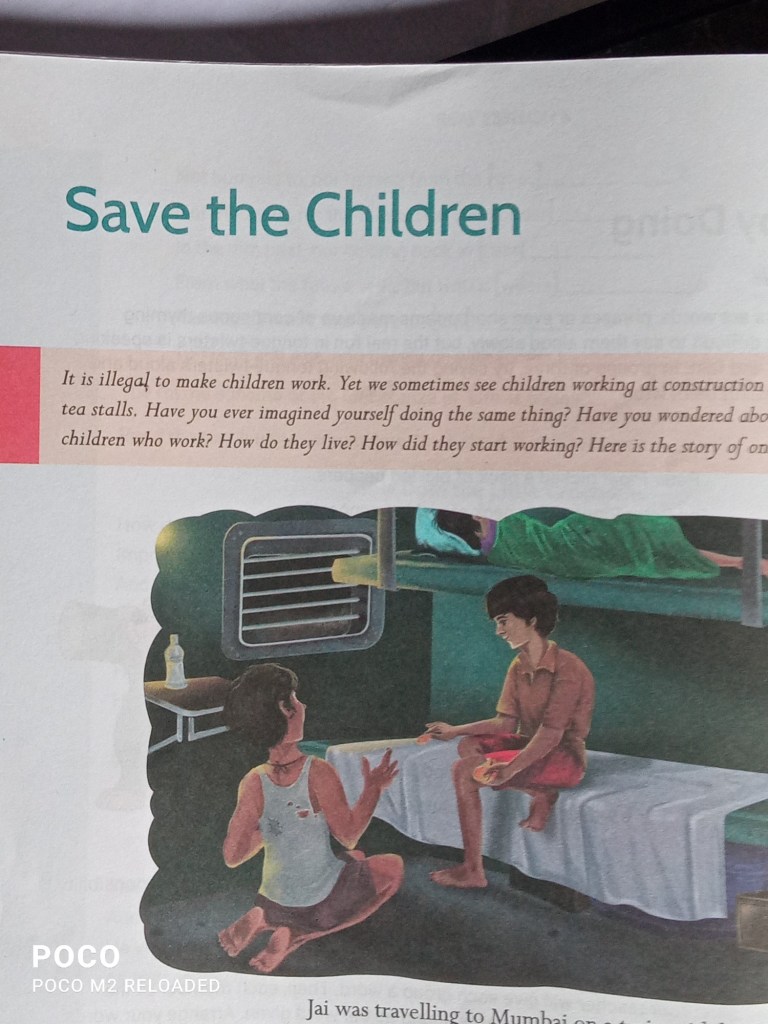
Save the Children,Class- VI,Exercises or questions and answers, Lesson- 12.

B 1. Choose the correct answer.

  1. What were jai’s plans for the holidays?

a) He was going to make new friends.

b) He was going to sleep a lot.

C) He was looking forward to being pampered by his grandmother.

Ans — c

2. Who was Shantu?

a) He was an abandoned boy of ten years.

B) He was a friend of Jai

c) He was a boy travelling to Mumbai with his family on the same train as Jai.

Ans– a

3. What are children like Santu known as?

a)  criminals         b)homeless children     c)whizzkids

Ans — b

4. Why was Shantu left behind by his own father?

a) Shantu was a naughty boy and he was left behind as a punishment.

b) He was not loved by his family.

c) His family was so poor that they could no longer look after him, his three brothers and two sisters.

Ans — c

5. What is the practice of making children work called

a) exploited labour   b) children labour    c)young labour

Ans– b                                                                             B 2. nswer these questions.

1. What do you think would have happened to Shantu’s other brothers and sisters?

Ans – Shantu’s other brothers and sisters likely fates. They may have been abandoned or sent to work in hazardous conditions.

2. How are parents into sending their own children of to work

Ans–Parents are often tricked by promises of a better life for their children, which is a lie.

3. What kind of do working children late

Ans– The life of working children is difficult and dangerous. They are forced to work long hours, sometimes up to 16 hours a day in unsafe conditions.

4.In what kind of work/ factories are small children employed?

Ans — Small children are employed in various hazardous industries such as making crackers, working in construction sites, and Silk factories.

5. In what kind of conditions do such abandoned children live?

Ans — Abandoned children live in terrible conditions. They are often homeless, hungry, and have to fend for themselves. They might sleep on the streets, in small corners, or even in dangerous places like railway stations.

6.Why do you think Jai’s life changed forever after meeting Shantu?

Ans —  Jai’s life changed because meeting Shantu opened his eyes to the harsh reality  of  child labour and poverty. It made him realise how fortunate he was and likely  instilled in him a sense of empathy and a desire to help those less fortunate.

C 1. Think and answer

  1. How is Shantu’s life different from Jai’s?

Ans —  Shantu’s life is filled with hardship and survival struggles. He is an abandoned child, forced to work, faced to work in dangerous conditions to survive. On the other hand, Jai lives a comfortable life with his family.                2. Suggest a few ways to end child labour and exploitation

Ans — Following are few ways to end child labour and exploitation.

a) Enforce lawsย ย ย  b) Provide educationย ย ย ย ย ย ย ย ย ย  ย ย  C) Rate awarenessย ย  d) Support poor families.

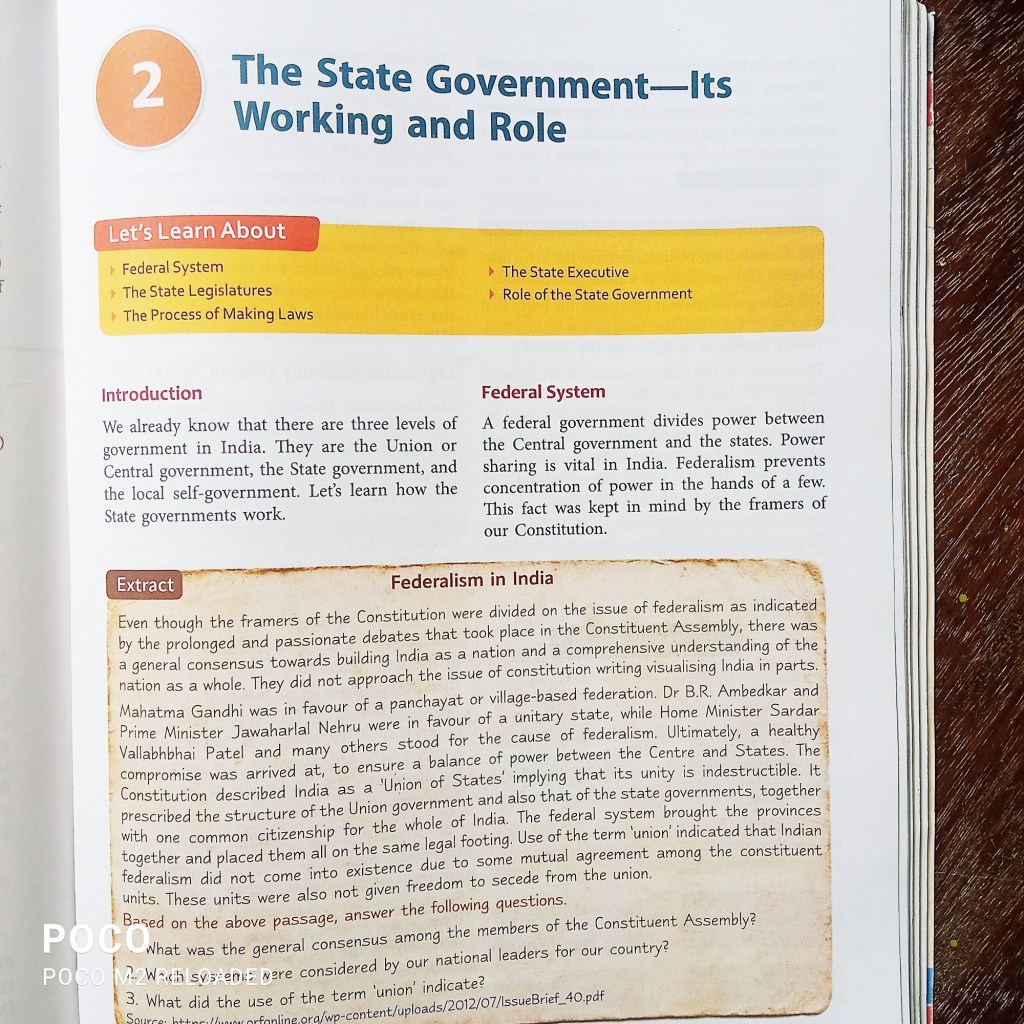
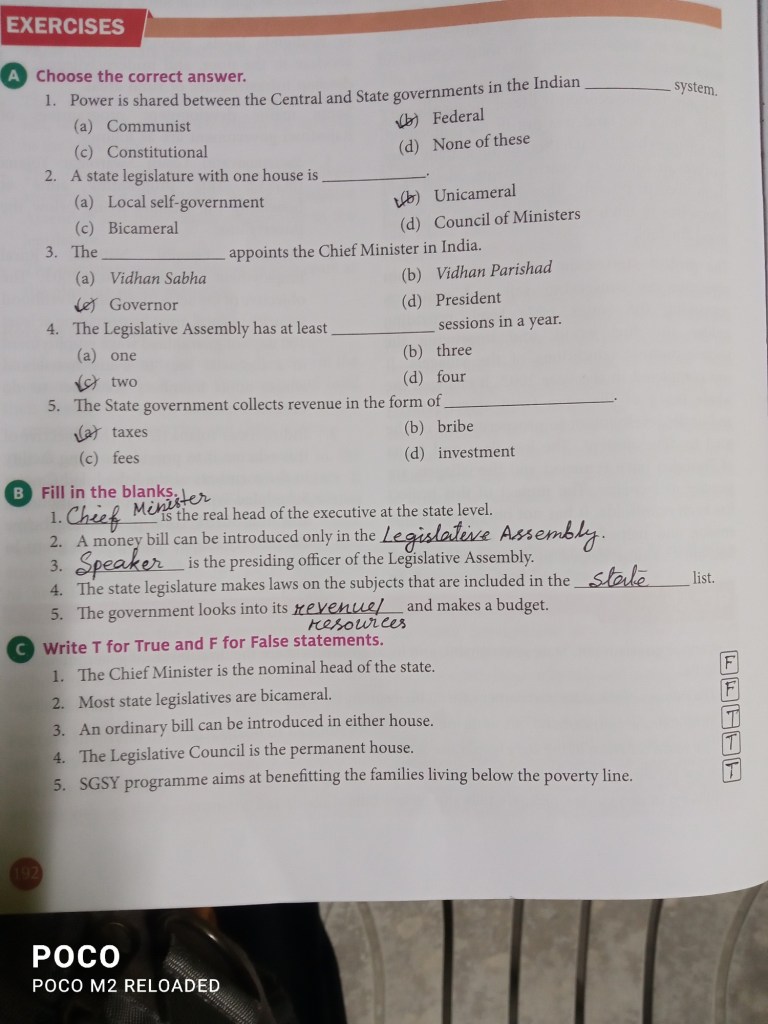
The State government-its working and rules

D. Define the following terms.

  1. Council of Ministers     

  Answer: The council of Ministers is headed by the Chief Minister and includes cabinet ministers and other ministers.

2. Deadlock

Answer: A situation where no progress can be made or no advancement is possible due to disagreement among parties or within a legislature.

3. Proportional representation

Answer : An electoral system in which seats in a legislature are allocated to political parties in proportion to the number of votes each party receives in an election.

4. Simple majority system

Answer: An election system in which the candidate or party that recieves more votes, than any other wins. It does not require an absolute majority.

E. Very short answer questions.

  1. What is federalism?

Answer: Federalism is s system of government in which power is divided between a central authority and constituent political units (like states and provinces.

2. How are the powers of a state government divided?

Answer: The powers of a state government are divided into three branches : the executive, the legislature, and the judiciary.

3. Write about the term of the Legislative Assembly.

Answer: The term of the Legislative Assembly is typically five years, unless dissolved sooner.

4. When are the sessions of the Legislative Assembly held?

Answer: Sessions are held at regular intervals, usually including Budget, Monsoon and Winter session.

5. Explain the composition of the state Legislative Council.

Answer:It’s composition includes members elected by the Legislative Assembly, graduates, teachers, and local authority members as well as members nominated by the Governor.

F. Short answer type questions

1. Describe the main functions of the state legislature

Answer: Making law,s approving the budget, debating policies, representing public interest, and holding the executive accountable.

2. Difference between the Legislative Assembly and legislative council

Answer: The Legislative Assembly is the directly elected lower house; The Legislative Council is the indirectly elected Upper house.

3. How is a Legislative Assembly constituted

Answer A Legislative Assembly is constituted through direct elections where representatives are elected by the voters in their respective constituencies. The number seats is determined based on the population of the state.

4. Mention Qualifications necessary to become an MLA

Answer:  To become a member of the Legislative Assembly (MLA) a person must be the citizen of the country, at least 25 years old, and meet other qualifications as specified by the electoral laws,such as not holding any office of profit under the government.

5. They Chief Minister is the real hat of the state executive elaborate

Answer: The Chief Minister is the head of the state government and leads the executive branch. They are responsible for implementing policies, overseeing the functioning of various departments, and representing the state both internally and externally.

G. Long answer type questions.

1. Describe the process by which a bill becomes a law.

Answer: A bill goes through several stages before becoming a law:

(i) Introduction: The bill is introduced in either house of the legislature.

(ii)First reading: The bill is read out and members discuss its general principles.

(iii)Committee stage: The bill is examined in detail by a committee.

(iv) Second reading: The bill is debated and may be amended.

(v) Third Reading: The final version of the bill is debated and voted on.

(vi) Approval by the other house: The bill is sent to the other house for similar consideration.

(vii) Presidential assent: If both houses pass  the bill, it is sent to the president (or governor in case of state bill) for assent.

(viii)Becoming law:  Once the president (or governor) signs the bill, it becomes law.

2. Write a short note on Council of Ministers.

Answer: The Council of Ministers composed of various ministers including Cabinet Ministers, Ministers of states and Deputy Ministers. They are responsible for different portfolios such as defense, finance, health etc. The Council of Ministers aids and advises the President (or Governor) and is collectively responsible to the legislature.

3. Explain the powers and functions of the Governor.

Answer: The Governor is the constitutional head of a state and performs various functions including:

(i) Summoning and Proroguing sessions of the state legislature.

(ii) Giving assent to bills passed by the state legislature.

(iii) Appointing the Chief Minister and other ministers.

The Cruel King of the Jungle-II,Exercises,

The Cruel King of the Jungle

Exercises

  1. Which of this statement are true and which are false                                       (a)The Lion listened quietly to what the jackal had to say.ย ย ย ย ย  (False)

(b)The Lion liked the vulture’s plan because he was getting old.       (True)

(c) One animal was brought by the jackal to the lion everyday.       (False)

(d) The poor rabbit trembling with fear ran to the lion’s den.       (False)

(e) The rabbit was chased by another lion.  (False)

(f) All the animals were happy when the lion was drowned.      (True)

2.Who said the following and in what situation.

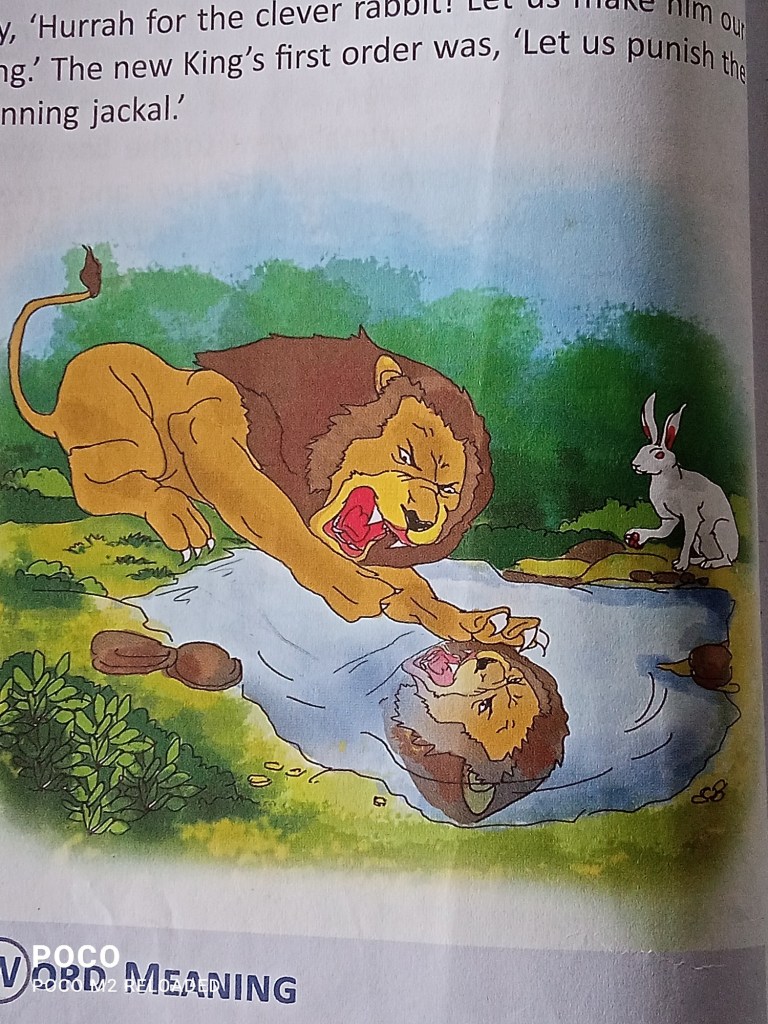
(a)That is the other lion, sir!

Answer: The rabbit said this to the lion when the image of the lion snarled into the cliff.

(b) Am I not the king of all the beasts?

Answer: It is said by the lion when the jackal informed that all the animals were planning to kill him.

(c) Hurrah for the clever rabbit!

Answer:All the beast of the Jungle said this for the rabbit as he cleverly  killed the lion.

(d)Each day one of us one of us will come to you to become your meal.

Answer: The vulture said this line, when he brought a plan from all the animals in front of the lion.

(e) Let us punish the cunning jackal.

Answer: The clever rabbit said this line, when he became the king of the Jungle.

(f) I’will kill him first and then have my dinner.

Answer:This was said by the lion when the rabbit told him about another lion.

Word Practice

Select the correct meaning of the word bold in each sentence:

(a) I came late because another lionย chased me.

(caught, ran after, attacked)

Ans: ran after

(b)The vulture perched himself on the tree.

(restart, searched,set on a branch)

Ans:  sat on a branch

(c) The Lion in the image also snarled.

(barked, showed his teeth fiercely, roared)

Ans: showed his teeth fiercely

(d) There wasย gloom all over the rabit’s house.

ย  (sadness, darkness, deep sorrow)

Ans: darkness

Bhaloo, The Bear– I

Class- IV,Subject- English, Lesson- 13,Exercises.

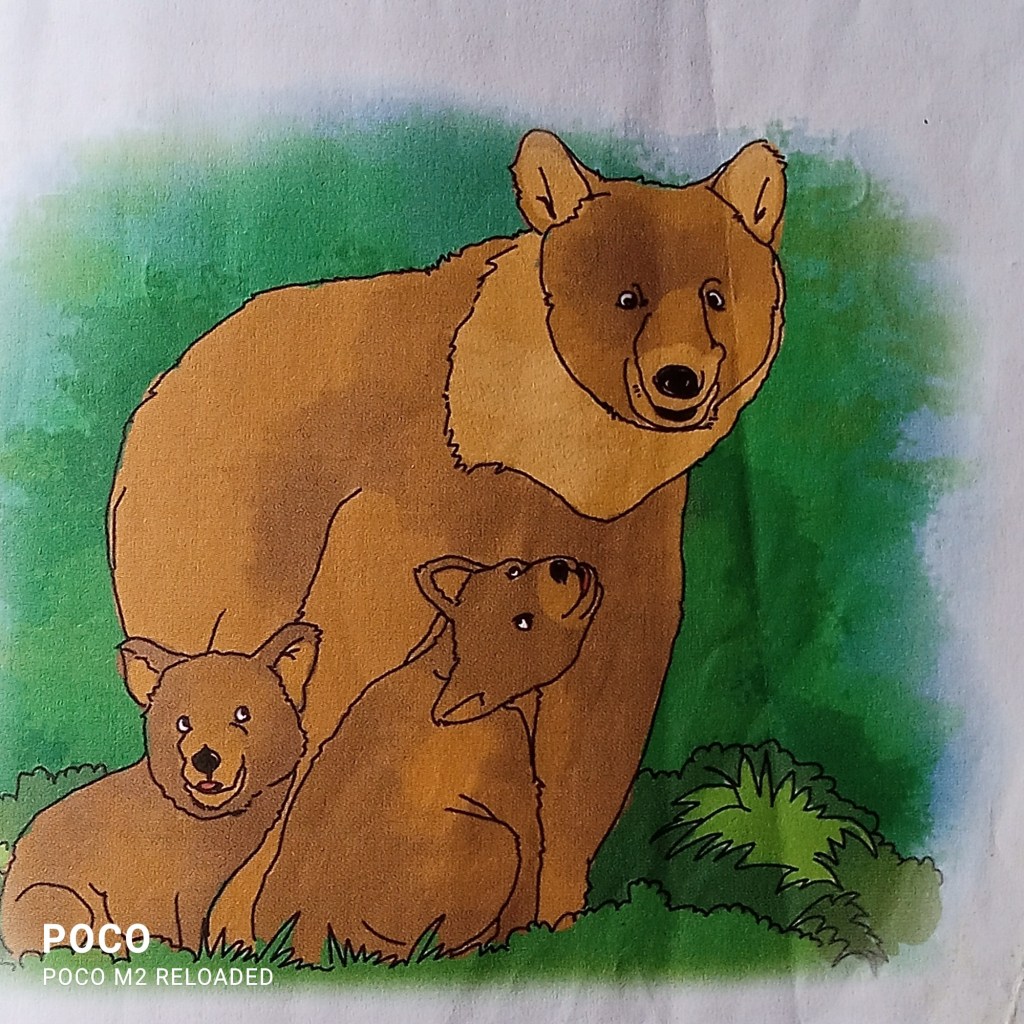
Mother Bear and her cubs

A. Answer the following questions

1. Why did Mother Bear often punish Bhaloo when he was a little bear?

Answer: When he was a little bear, Mother Bear often punish Bhaloo for his mischief.

2.Why did Baloo and his sister whimper and squeal when there mother wanted to go out hunting at night

Answer Bhaloo and his sister whimper and Squeal when there mother wanted to go out for hunting at night, because she told them to go inside the cave.

3. What stories did Mother Bear sometimes tell the two children during the day?

Answer: Mother Bear sometimes tell them stories about the forest and the great world outside.

4. Who was the greatest enemy of Mother Bear and her family?What advice did she give to the children about him?

Answer: The tiger was the greatest enemy of Mother Bear and her family. Mother Bear warned the cups against sher.She told them that he was not to be trusted and so, they must never go near him or speak to him.

5. Why did Mother Bear want to go the orchard when the cubs were about three months old?

Answer:When the cubs were about three months old, Mother Bear wanted to go to the orchard, because the apples in the orchard on the hill are ripe and she wanted to bring some fruit for her cups.

6. What did she tell the cups before she left the cave?

Answer: Before she left the cave Mother Bear told her cups to be very careful for she heard that sher prowling about that afternoon and sound  angry.

B. Complete the following sentences.

(a) Bhaloo’s small black nose was always sniffing because………….

Answer: he was in  search of food.

(b) Mother bear often slept in the daytime because…………….

Answer: she was tired after being out all night.

(c) Bhaloo liked best to hear about sher because…………

Answer:he was there greatest enemy.

(d) Mother Bear had to push Bhaloo back into the cave because………..

Answer: it was dangerous outside.

(e) The two cups cried out with delight because………

Answer: they loved the red apples their mother brought home.

The Ghost of the Greasy Spoon, Question and answers Class- VI, English

A. Answer these questions

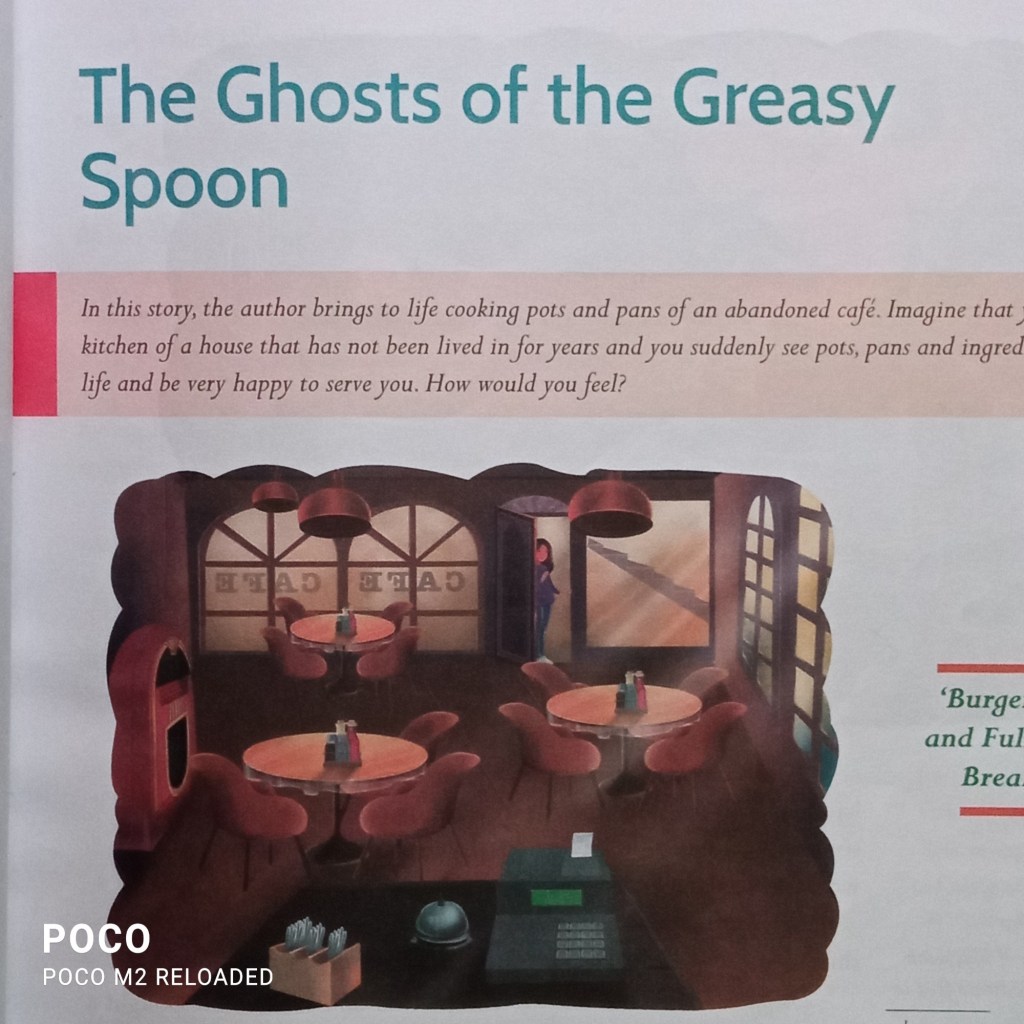
1. Why did Deepa and Bengi go to the cafe even though it had been closed?

Answer: Deepa was too curious to wonder what it was, so she went to the cafe that had been abandoned.

2. Why was the cafe closed?

Answer: The cafe was closed because it had been abandoned for years.

3. Why was Bengi scared of entering the cafe?

Answer: Because, he might have remembered that dogs weren’t allowed in cafes or perhaps something else bothering him.

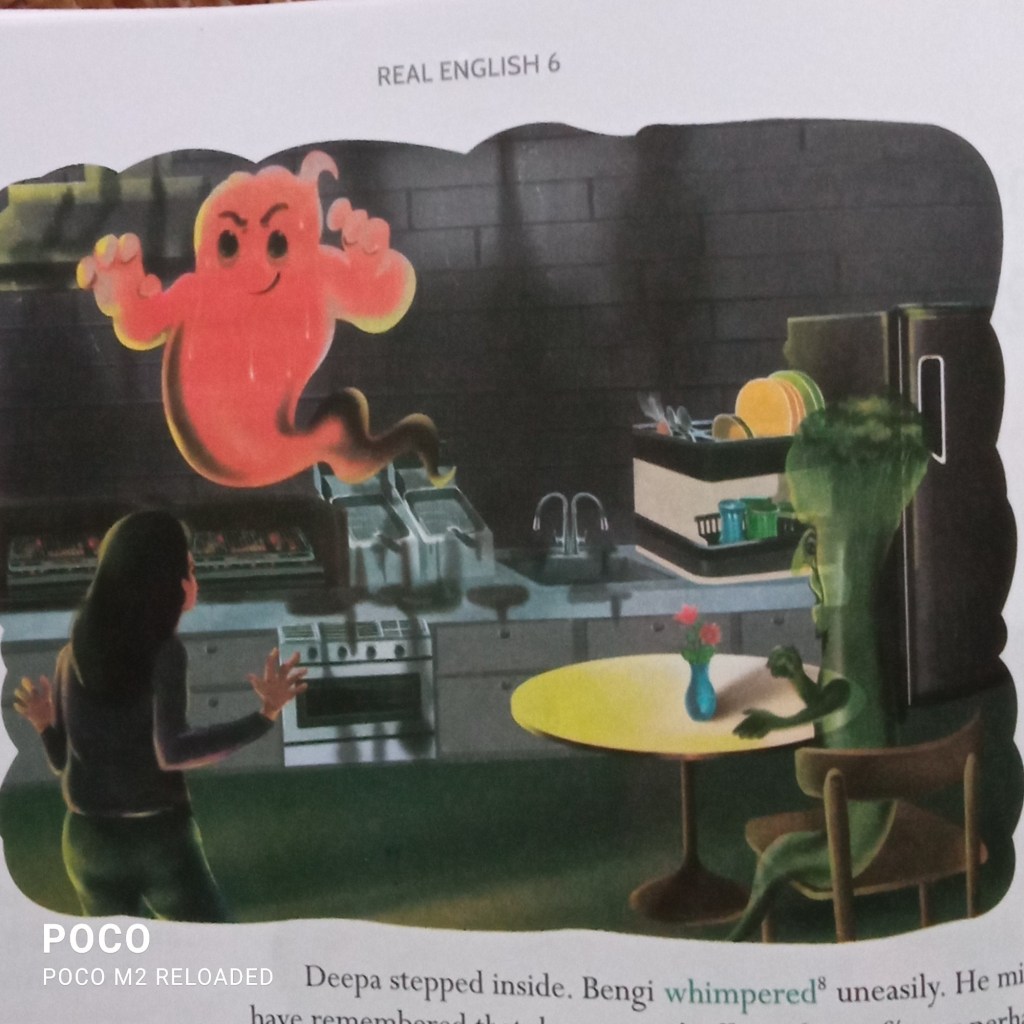
4. Why had the inhabitants of the cafe become  unhappy ghosts?

Answer: The inhabitants became unhappy ghost likely due to their  unresolved attachment to the cafe  and their previous lives as kitchen entities (like burnt burgers and site salads).

B. Complete the following sentences.

1. The ghosts suddenly became excited because………..

Ans: Deepa entered the cafe, and she was the first customer they had seen in years.

2. The deep fryer slipped from the hands of the smudge because………….

Ans: the smudge was reminiscing about the fires, it used to have all the time, and it lost control of the deep fryer.

3. The cafe caught fire because……….

Ans: the contents of the deep fryer fell into the red-hot element of the cooker, causing a ball of frame to hit the ceiling.

4. Not many people questioned how and why the cafe burnt down because………….

Ans: the cafe was already due to be demolished, so not many questions were asked about the cause of the fire.

A Bottle of Dew, Questions and answers, Lesson- 9, Class- V,English.

Sage Mahipati

1. Why did Ramanatha go to meet the sage?

Answer: Ramanatha went to meet the sage to seek his advice to and guidance, possibly to find a solution to his problems or to gain some sort of wisdom and or maagical help.

2. Was this meeting useful to him give reasons for your answer?

Answer:  Yes, the meeting was useful to Ramanatha although the sage’s instructions did not result in a real magic potion, the process led Ramanatha to work diligently, which eventually helped him improve his life and accumulate wealth through hardwork and dedication.

Ramanatha and Madhumati

3. While Ramanatha was collecting the due, what did his wife do?

Answer: While Ramanatha was collecting the due, his wife Madhumati supported him by taking care of their home and possibly managing other responsibilities,which allowed him to focus to forecast on his task.

4.The sage asked Ramanatha to bring him five litres of due. What did Ramanatha decide to do so that he could collect  this within the shortest period of time?

Answer: Ramanatha decided to plant banana trees as suggested by the sage and collect the due that settled on the leaves of these trees to gather the five litres of due.

5 ”This is cheating”why did ramanatha say this?

Answer:  “This is cheating”Ramanatha said this when he realized that there was no magic portion and that the sage had tricked him into working hard and learning the value of patience.

6. There was no mugic portion, yet Ramanatha made a lot of money. What was the real magic?

Answer:  The lesson in hard work and persistence that Ramanatha learned was the real magic,which eventually let him to success and wealth.

The Rainy Season,Lesson- V, Subject- English, Questions and answers.

Peasants feels happy when it rains

A. Answer the following questions:

1. Which monsoon winds bring rain to India?

Answer: The South-west monsoon winds bring rain to India.

2. Name the months when it rains.

Answer: The months continue through the month of July, August and sometimes September too.

3. What changes can we see and feel in nature at the start of the rainy season?

Answer: When the rain starts falling, it becomes cool.The dry and thirsty Earth becomes wet and soft. Dry rivers, lakes,  and ponds are filled with water.

4. Why are peasants happy when it rains?

Answer:  Peasants are happy when it rains, because they can cultivate their fields and it give life to crops and vegetation .        

Rain in a city

5. What problems does heavy rains couse in a city?

Answer:Heavy rains bring problems for city people,the streets become muddy and slippery. Often the roads become water logged, car and buses cannot move and people have to wolk through dirty knee- deep water slowly.

6.Which vendors are happy during the rains?  Why are they happy?

Answer: The venders who sells umbrellas and raincoats are happy because everyone buy their products to protect themselves from getting wet in the rain.

7. What is a rainy day at school?

Answer: In the rainy days at school the little boys and girls, however are very happy they sail paper boats in the water, the streets look like small rivers to the children.

Flood in rainy season

8.What causes floods?

Answer: Heavy rains for days causes floods.

9. What happens when there is a flood?

Answer:The impact of flooding causes loss of human life, distruction of crops, loss of livestock and deterioration of health conditions going to water Borne diseases.

10.How do we try to control flowers?

Answer:  We try to control floods by building high dams.

Inside Our Earth

Geography, Lesson- 2, Class- VII,Question and answers.                                                               A. Very short answer type questions:

1. What is the age of the  earth?

Answer : The earth is approximately 4.5 billion years old.

2. Into how many layers can the earth be divided?

Answer:  The earth can be divided into three main layers : the crust , the mantle and the core.

3. What is the continental crust made of?

Answer:  The continental crust is mainly composed of granite and other light silicate minerals.                                                                     4. Describe the matle of the earth.

Answer:  The mantle is the layer of the earth between the crust and the core and is about      2900  kilometre thick, composed of silicate rocks rich in Magnesium and iron.

5. What is the core made up of?

Answer:  The core is made up of iron ( Fe)and Nickel (Ni)with a solid inner core and a liquid outer core.

B. Short answer type questions:

1. Compare the inner and the outer core of the earth.

Answer:  The inner core is solid composed mainly of iron and Nickel and is extremely hot.

             The outer core is liquid also composed of iron and nickel and generates earth’s magnetic field through its flowing currents.

2. What are rocks and Minerals?

Answer: Rocks are solid aggregates of minerals. Minerals are naturally occurring inorganic substances with a definite chemical composition and crystalline structure.

3. Explain the formation of extrusive igneous rocks.

Answer: Extrusive igneous rocks form when magma riches the earth’s surface and cools quickly, resulting in fine grained textures. Examples include basalt and pumice.

4. Describe the formation of sedimentary rocks

Answer: Sedimentary rocks formed from sediments at the surface of the earth, either in water or on land. They are also called stratified   rocks as deposition takes place in layers.

5. Write three uses of rocks and Minerals.

Answer: Rocks and Minerals are used in construction (granite for buildings) in manufacturing (limestone for cement) and in technology (silicon in electronics)

C. Long answer type questionsย :ย ย ย ย ย ย ย ย ย ย ย ย ย ย ย ย ย ย ย ย ย ย ย ย ย ย ย ย ย ย  1. The the structure of the earth is divided into concentric layers.Explain with the help of a diagram.ย ย ย ย ย ย ย ย ย ย ย ย 

Answer: The earth is composed of three main concentric layers: the crust (outermost layer) the mental (middle layer) and the core (innermost layer) divided into a solid inner Core.                                                                                                

2. What is meant by The crust? Highlight the difference between the continental crust and Oceanic crust.

Answer: The crust is the Earth’s outermost layer. The continental crust is thicker,less dense,and composed mainly of granite. The oceanic crust is thinner, denser, and composed mainly of basalt

3. Trace the formation of metamorphic rocks.

Answer:  Metamorphic rocks form from the alteration of existing rocks due to high temperature,pressure, and chemically active fluids.This process called metamorphism, changes the mineral composition and texture of the rocks (e.g limestone transforms into marble).

4.What is a Rock cycle? Explain the process of formation of rocks with the help of a diagram.

Answer: The Rock cycle is the continuous process of transformation of rocks from one type to another. Igneous rocks can breakdown into sediments and form sedimentary rocks, which can then be buried and transformed into metamorphic rocks. This can melt into Megma, which upon cooling, forms igneous rocks again.

Essay on Dr.A.P.J. Abdul Kalam

APJ Abdul Kalam the Missile man of India, was a distinguished Indian scientist and the 11th President of India. Born on October 15, 1931 in Rameshwaram Tamil Nadu, he overcame modest beginnings to become a leading figure in science and Technology.

         Kalam studied Aerospace engineering at the Madras Institute of Technology and began his career at DRDO (Defence Research and Development Organisation, later joining ISRO (Indian Space Research Organisation, where he let the development of India’s first satellite launch vehicle. His significant contributions to missile technology, particularly the Agni and Prithvi missiles, earned him his nickname and established India’s prowess in defence technology.

           As President from 2002 to 2007, Kalam was beloved for his approachable nature and his advocacy for education and technology. He inspired Millions through his books,such as “Wings of Fire”and ” Ignited Minds”, and initiatives like PURA (Providing Urban Amenities in Rural Areas), aimed at rural development.

            A.P.J. Abdul kalam’s legacy endures through his visionary contributions to science, his commitment to education, and his inspirational life story, continuing to motivate people worldwide. He passed away on July 27, 2015, but remains a symbol of dedication, simplicity, and the power of dreams.

Kings and Kingdoms

Class – VII, Subject- Social Science, Lesson 2.

Niru educare

A. Very short answer type questions

1. Who were Samantas?

Ans: The Samantas were warrior chiefs who were expected to provide military support to the king during during time of wars.

2. What do you mean by the word Rajput?

Ans: The word Rajput comes from the Sanskrit word rajpatra which means ” son of a king”. The term is applied to a group of Warriors  who claimed to belong to the Kshetriya caste.

3. Who is University was established by Dharampala?

Ans: The famous Vikramshila University was established by dharampala.

4. What was the tripartite struggle

Answer they fight between the Palas, Gurjara Pratiharas ,and the Rashtrakutas over the control of Kanauj is referred to as the Tripartite Struggle.

5. What was brahmdaya

Ans: Brahmdaya was land granted to Brahmins usually exempt from taxes and meant to support them economically.

B. Short answer type questions.

1. Describe the political changes that took place after the death of Harshavardhana.

Ans: After the death of Harshavardhana, his empire desintegrated as he left no hairs. This led to a period of  political fragmentation and the rise of regional kingdoms such as the Pratihara,Palas and Rashtrakutas, who completed for Supremacy in North India.

2. Why was kanauj seen as the symbol of Supremacy? which three kingdoms were involved in fights to control it

Ans: Kanauj was seen as the symbol of Supremacy due to its strategicย  location and economic importance. The three Kingdoms in the Tripartite Struggle for control over Kanauj were the Pratiharas, the palas and the Rashtrakutas.

3. Write a short note on Mehmud Ghazni.

Ans: Mehmud of Ghazni was a Turkish ruler who invaded India 17 times between 1000 and 1027 AD.He is known for his military campaigns the looting of wealthy temples, and destruction of Indian cities, which established his control over Punjab and parts of northwestern India.

4. Explain the reasons for Rajendra Chola adopting the title of GangaiKonda.

Ans: Rajendra Chola adopted the title of Gangai Kanda after his successful campaign to the Ganges river in North India. This title symbolised his military prowess and the extension of the Chola Empires influence up to the northern regions of India.

C. Long answer type questions

1. Discuss the battle of Tarain?What were the reasons for the defeat of Prithviraj Chauhan?

Ans: The Battles of Tarain were fought in 1191 and 1192 between Prithviraj Chauhan and Muhammad Ghori. Prithviraj won the first battle but was defeated in the second. Reasons for his defeat include internal dissension, and underestimation of Gauri’s tactical skills, and lake ofย  adequate reinforcement.

2. Write a not on Chola inscriptions.

Ans: Chola inscriptions predominantly in Tamil provide valuable historical records about the dynasty. They document details about land grants endowments to temples, administrative decisions and royal degrees.This inscriptions were typically engraved on temple walls, copper plates and stone pillars.

D. Difference between the following

1 Suryavanshi and Chandravanshi

Ans: Suryavanshi  refers to the Solar dynasty believed to descent from the sun got Surya, while

Chandravanshi refers to the lunar dynasty believed to descent from the moon got Chandra

2. Kadamai and Vetti

Ans: Kadamai refers to land revenue or taxes leviet on agricultural produce, while Vetty refers to the forced labor or services that where required from the common people.

3.Valanadu and Nadu

Ans:  Valanadu was a larger administrative division within the Chola Empire composed of multiple Nadus, while Nadu was a smaller administrative unit or district.

Design a site like this with WordPress.com
Get started