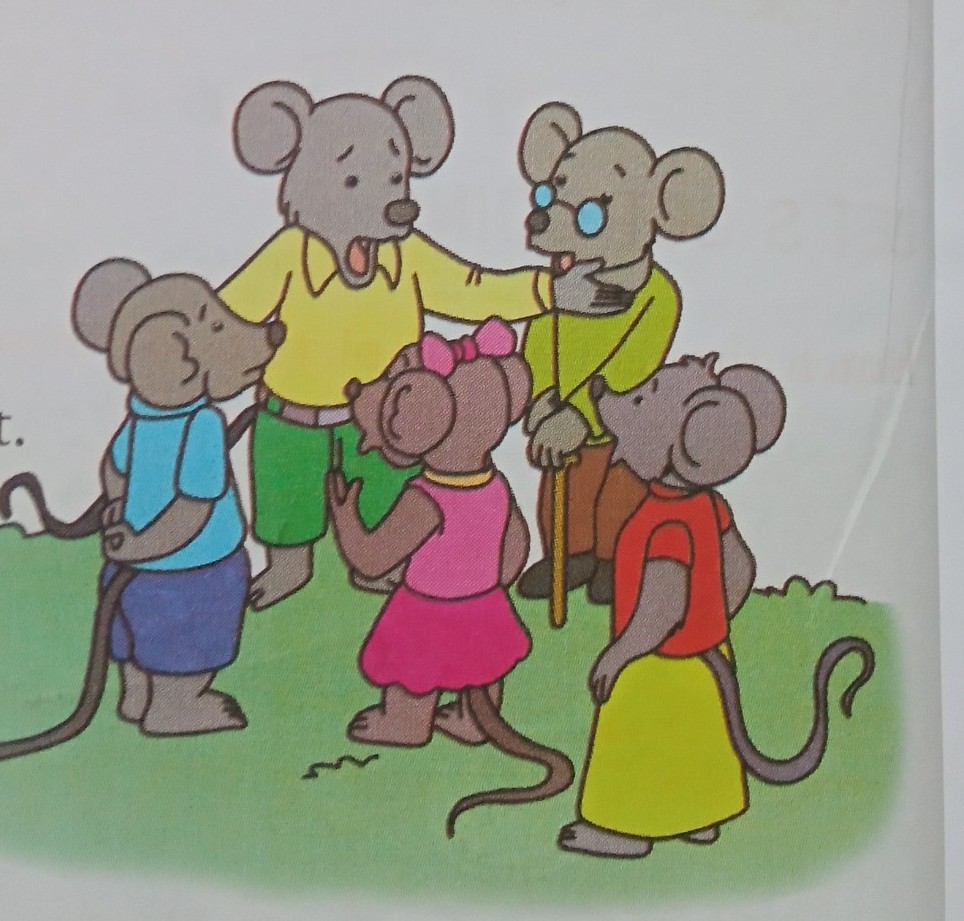
4. The mice decided to hang a small bell around the cat’s neck so the mice could not hear her come.
5. The cat walks softly, so the mice could not hear her come.
—
🟣 Vocabulary
A. Match the words which mean the same.
A (Words) B (Meanings)
1. small e. little 2. right t. correct 3. heavy a. light 4. softly b. quietly 5. sad c. unhappy 6. large f. big
—
B. Answer these questions
1. Name the rooms where the mice lived. → They lived in the kitchen, drawing room, and bedrooms.
2. Describe the cat. → The cat was big and fat. She always chased the mice.
3. Who gave the new idea? → The little mouse gave the new idea.
4. Did the mice carry out the idea in the end? Why? → No, they did not carry out the idea because no one was ready to hang the bell around the cat’s neck.
—
🟢 Grammar – Position Words
Fill in the blanks with appropriate position words (in, on, under, behind, between, over).
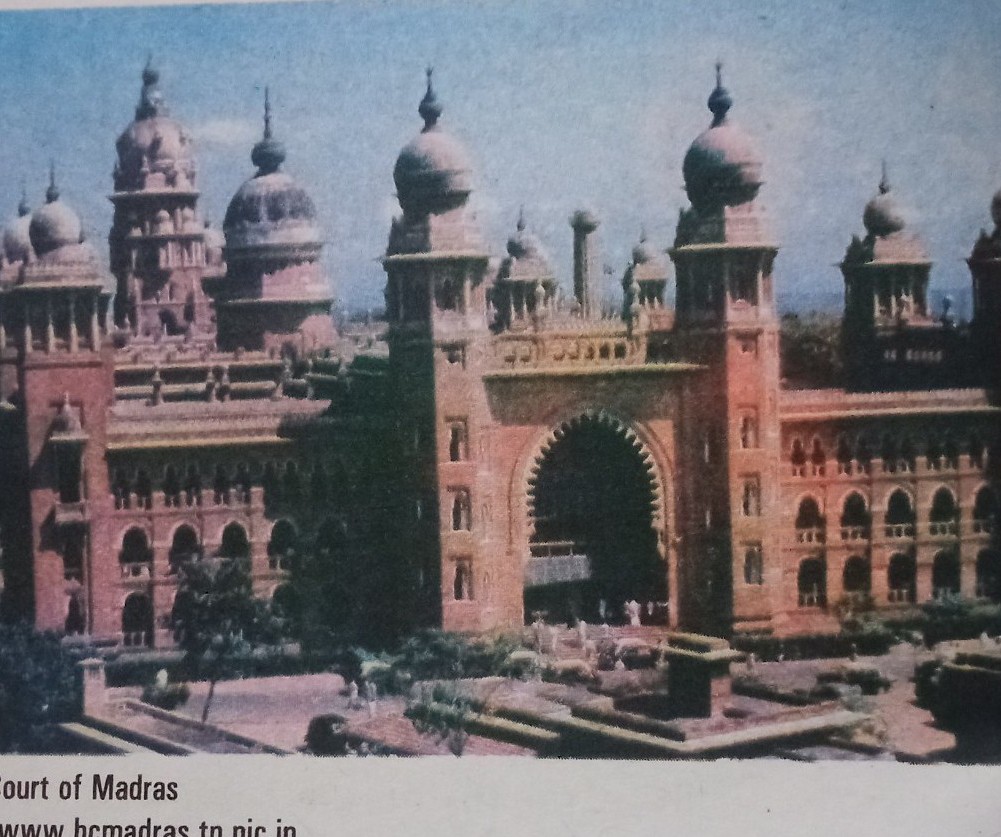
Question: Why do you think an independent judiciary is necessary to carry out this important function? Answer: An independent judiciary is necessary to ensure that judges can make decisions free from the influence of the executive or legislature. This helps protect the Fundamental Rights of citizens and ensures justice is delivered fairly and without bias.
—
2.
Question: How does the Right to Constitutional Remedies connect to the idea of judicial review? Answer: The Right to Constitutional Remedies allows citizens to approach the courts if their Fundamental Rights are violated. Judicial review enables the courts to examine whether laws or actions of the government violate the Constitution, thus protecting those rights.
—
3.
Illustration: Sudha Goel Case
Court Judgment
Lower Court — Found Sudha Goel’s husband and in- laws and sentenced them to imprisonment.
High Court — Acquitted the accused, saying there was not enough evidence.
Supreme Court — Reversed the High Court’s decision and held the accused guilty again.
— 4. Keeping the Sudha Goel case in mind, tick the sentences that are true and correct the ones that are false.
(a) ✅ The accused took the case to the High Court because they were unhappy with the decision of the Trial Court. → True
(b) ❌ They went to the High Court after the Supreme Court had given its decision. → Correction: They went to the High Court after the Trial Court had given its decision.
(c) ❌ If they do not like the Supreme Court verdict, the accused can go back again to the Trial Court. → Correction: The accused cannot go back to the Trial Court after the Supreme Court’s verdict, as the Supreme Court’s decision is final.
5.
Question: Why is the introduction of Public Interest Litigation (PIL) a significant step? Answer: PIL allows any citizen or group to approach the court in the interest of the public, even if they are not directly affected. It helps ensure justice for disadvantaged people and makes access to justice easier and quicker for all.
—
6.
Question: What did the judges mean by the Right to Livelihood as part of the Right to Life (Olga Tellis case)? Answer: The judges meant that the Right to Life is meaningless without the Right to Livelihood, because without work or income, a person cannot live with dignity or meet basic needs.
—
7.
Question: Write a story around the theme ‘Justice delayed is justice denied.’ Answer (example): A poor farmer lost his land due to a false document filed by a rich landlord. The case went on in court for 20 years. By the time the farmer won, he had lost his livelihood and family. The delay in justice had destroyed his life—showing that justice delayed is indeed justice denied.
—
8.
Question: Make sentences with each glossary word (given on the next page).
Answer:
1. Acquit – The court decided to acquit the accused as there was no proof of the crime.
2. To Appeal – The lawyer will appeal to the High Court against the decision of the lower court.
3. Compensation – The company paid compensation to the worker who was injured during work.
4. Eviction – The families protested against their eviction from the land they had lived on for years.
5. Violation – Not allowing children to attend school is a violation of their Fundamental Rights.
1. Where can cats sleep? Answer:- Cats can sleep anywhere — on a chair, table, piano, or in a box.
2. Do you think cats can really sleep anywhere? Answer:- Yes, cats can sleep almost anywhere they find comfortable.
3. If you had a pet cat, would you let it sleep anywhere? Answer:- No, I would give it a cozy place to sleep.
4. How would you feel if your pet slept in your cupboard with your clothes? Answer:- I would be surprised or might not like it because it could make my clothes dirty.
B. Circle the different letters that make a common sound
1. sale — sail → Circle a in sale and ai in sail
2. seen — scene → Circle ee in seen and sce in scene
3. made — maid → Circle a in made and ai in maid
4. blew — blue → Circle ew in blew and ue in blue
5. ate — eight → Circle a in ate and eigh in eight
—
C. Match the given letters to the words where they appear
1. What is the natural world in which people, animals and plants live called? ✅ Environment
2. Clean surrounding is necessary for us to stay — ✅ Healthy
3. What are the materials that decompose naturally called? ✅ Biodegradable
4. What is the process of reusing a product or producing new products from waste materials known as? ✅ Recycling
—
B. Write (T) for true and (F) for false sentences
1. Compost pits cannot be made at home. — ❌ False
2. We should use cloth bags. — ✅ True
3. Open dumping is an eco-friendly way of waste disposal. — ❌ False
4. Clean surroundings are necessary for us to stay healthy. — ✅ True
—
C. Answer the following questions
1. What do you understand by the term ‘environment’? Answer:- The environment is everything that surrounds us, including air, water, land, plants, animals, and humans.
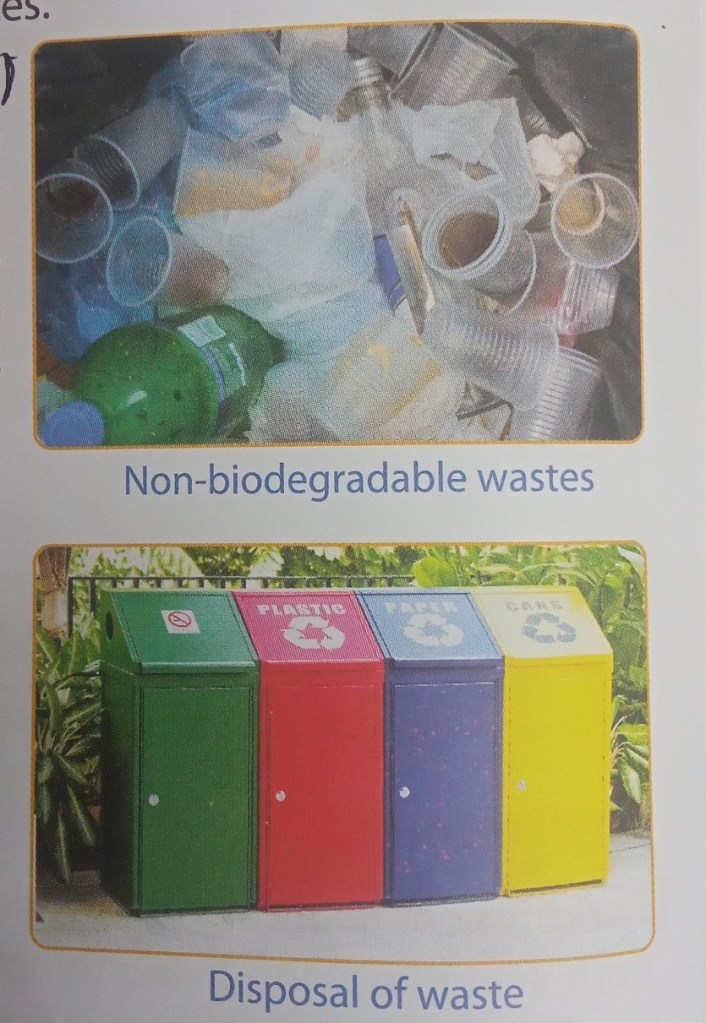
2. What is the difference between biodegradable and non-biodegradable waste? Answer:- Biodegradable waste decomposes naturally (like food waste and paper), while non-biodegradable waste does not decompose easily (like plastic and glass).
3. Explain open dumping. Answer:- Open dumping is the careless throwing of waste in open areas, which causes pollution and harms the environment.
4. Write a note on compost pits. Answer:- Compost pits are pits where biodegradable waste is collected and allowed to decompose naturally to form compost, which can be used as manure.
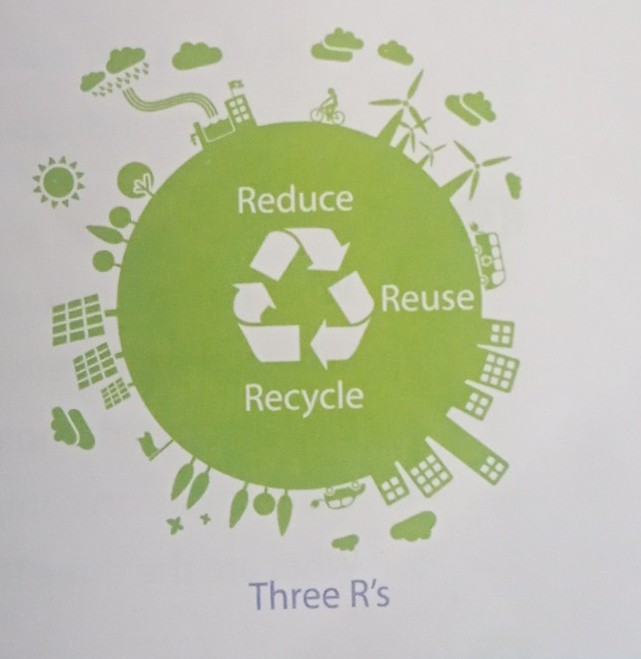
5. What are the three R’s? What are their uses? Answer:- The three R’s are Reduce, Reuse, and Recycle. They help in minimizing waste, conserving resources, and protecting the environment.
—
D. Give reasons
1. We should not throw waste in a water body. → Because it pollutes the water, harms aquatic life, and makes water unsafe for use.
2. Plastics, bottles and cans are a major threat to the environment. → Because they are non-biodegradable and cause land and water pollution.
—
Observe and Answer
1. What does the picture represent? Answer:- The picture represents the three R’s — Reduce, Reuse, and Recycle.
2. Why is it important? Answer:- It helps to reduce waste, save resources, and keep the environment clean and healthy.
a. Why does the southern part of India enjoy an equable climate? Answer:- Because it is surrounded by the sea on three sides, which keeps the temperature moderate throughout the year.
b. What are monsoons? How are they useful? Answer:- Monsoons are seasonal winds that bring rain to India. They are useful because they help in farming and provide water for drinking and irrigation.
c. Which part of India receives rainfall in the winter season? Answer:- The coastal areas of Tamil Nadu and Andhra Pradesh (southeastern India).
d. Why is there winter in some parts of India? Answer:- Because during this time, the northern hemisphere tilts away from the sun, reducing heat and making the weather cold.
e. Which factors affect the climate of a place? Answer:- Latitude, altitude, distance from the sea, and wind direction.
—
2. Fill in the blanks:
a. A hot, dry wind which blows in summer is called loo. b. Mawsynram is the place which receives the highest rainfall in the world. c. December and January are the coldest months of the year. d. Shimla and Darjeeling are two popular hill stations of India. e. Places near the sea enjoy equable type of climate.
—
3. Write ‘T’ for ‘true’ or ‘F’ for ‘false’:
a. All parts of India have the same type of climate throughout the year. — F b. The days are longer in summers than in winters. — T c. Gujarat and Rajasthan receive very little rainfall in the rainy season. — T d. The winter season starts in August. — F e. The winter season brings rainfall to all parts of India. — F
1. ______ was the founder of the Khalji Dynasty. ➤ Jalal-ud-din Khalji was the founder of the Khalji Dynasty.
2. Dagh and chehra were introduced by ______. ➤ Alauddin Khalji introduced dagh and chehra.
3. ______ and ______ were two rituals introduced by Balban in his court. ➤ Sijda and Paibos were two rituals introduced by Balban in his court.
4. The ______ was the master of ceremonies at the sultan’s court. ➤ The Amir-i-dad was the master of ceremonies at the sultan’s court.
5. The ______ was the head of the pargana. ➤ The Shiqdar (or Mukaddam) was the head of the pargana.
B. Match the Columns
Column A Column B
1. Mamluk (c) Slave 2. Raziya Sultan (d) 1236–1240 3. Alauddin Khalji (a) Hauz Khas 4. Iqta (e) Division of the empire 5. Muhammad bin (b) transfer of capital
Tughlaq
—
E. Short Answer Type Questions (50–60 words)
1. Who can be considered the real founder of the Delhi Sultanate? And:-Iltutmish is considered the real founder of the Delhi Sultanate. He consolidated the kingdom after Qutb-ud-din Aibak’s death, established a strong administrative system, introduced the silver tanka and copper jital, and made Delhi the capital. His efforts gave the Sultanate a stable foundation.
—
2. Describe the challenges faced by Raziya Sultan. Ans:- Raziya Sultan faced strong opposition from the nobles who did not accept a woman ruler. They constantly plotted against her. She also faced revolts from provincial governors and was betrayed by her own supporters. Eventually, she lost her throne and life due to these conspiracies.
—
3. Discuss the Slave Dynasty. Write a note on any two rulers. Ans:- The Slave Dynasty (1206–1290) was the first dynasty of the Delhi Sultanate, founded by Qutb-ud-din Aibak.
Qutb-ud-din Aibak began construction of the Qutub Minar and built mosques in Delhi and Ajmer.
Iltutmish expanded the empire, improved administration, and introduced coins called tanka and jital.
—
4. Identify the public works done by Firoz Shah Tughluq. Ans:- Firoz Shah Tughluq built many canals for irrigation, repaired old buildings, and constructed new cities like Firozabad. He built mosques, madrasas, hospitals, and the famous Firoz Shah Kotla in Delhi. His reign is known for welfare and development works.
—
5. What happened to the powerful samantas? Ans:- The samantas (feudal lords) lost their power when the Delhi Sultans centralized administration. Their lands were taken over and turned into iqtas under government officials. The sultans kept strict control to prevent rebellion and strengthen the central authority.
—
F. Long Answer Type Questions (80–100 words)
1. The nobility was a powerful influence on the Delhi sultans. Examine. Ans:- The nobles played an important role in the Delhi Sultanate as administrators and military officers. However, their power often created problems for the sultans. They formed powerful groups like the Chalisa (group of forty nobles) that tried to control the throne. Sultans like Balban had to take strict steps to curb their power by introducing rituals such as sijda and paibos and emphasizing royal authority.
—
2. Discuss the administration under the Delhi sultans. Ans:- The Delhi Sultanate had a well-organized central and provincial administration. The sultan was the supreme ruler assisted by ministers such as the wazir (finance), ariz-i-mamalik (army), and diwan-i-insha (correspondence). The empire was divided into iqtas governed by iqtadars. Law and order were maintained through a strong army and efficient judicial system.
—
3. What were the consequences of Muhammad bin Tughluq’s experiments? Explain in detail. Ans:- Muhammad bin Tughluq’s experiments, like shifting the capital from Delhi to Daulatabad, introducing token currency, and increasing taxes, all failed. The capital transfer caused hardship, the token coins led to counterfeit money, and heavy taxes angered peasants. These failures weakened his rule and reduced the people’s trust in his administration.
—
4. Discuss the reforms made by Alauddin Khalji. Ans:- Alauddin Khalji introduced many reforms to strengthen his empire. He fixed prices of goods and set up markets to control inflation. He introduced dagh (branding of horses) and chehra (descriptive rolls of soldiers) to maintain an efficient army. He also controlled nobles to prevent rebellion and built the Hauz Khas reservoir for Delhi’s water supply.
—
5. Write about Timur’s invasion and the beginning of the Sayyid Dynasty. Ans:- Timur invaded India in 1398 during the rule of Nasir-ud-din Tughluq. He defeated the Sultan’s army, plundered Delhi, and killed thousands. After his return to Central Asia, the Tughluq dynasty collapsed. In 1414, Khizr Khan, Timur’s governor in India, established the Sayyid Dynasty, marking a new phase in the Delhi Sultanate’s history.
Q1. What is the advantage of the use of Electronic Voting Machines (EVMs)? Ans. Cutting of trees has been stopped.
Q2. Name the two Houses of the Parliament. Ans. The Rajya Sabha and the Lok Sabha.
Q3. What is the term or tenure of the Lok Sabha? Ans. The tenure of the Lok Sabha is 5 years.
Q4. What makes the Indian Parliament powerful? Ans. It is the representative of the people.
Q5. What do you mean by the executive? Ans. The executive is a group of persons who work together to implement the laws made by the Parliament.
Q6. Who is the leader of the ruling party in the Lok Sabha? Ans. The Prime Minister.
Q7. Name the ministries which are housed in the North Block. Ans. The Minister of Finance and the Ministry of Home Affairs.
Q8. Who nominates the 12 members of the Rajya Sabha? Ans. The President of India.
Q9. How is the question hour an important mechanism? Ans. It is through this mechanism that MPs can elicit information about the working of the government.
Q10. What has been done to give adequate representation to the communities that have been historically marginalised? Ans. Some seats are reserved in the Parliament for people belonging to SC and ST category.
Q11. Give one reason why you think there should be universal adult franchise.
Ans: There should be universal adult franchise in order to establish equality in the country.
B. Short answer type questions:
Q1. Do you think there would be any difference if the class monitor was selected by the teacher or elected by the students? Discuss.
Ans:
Selection of class monitor by the teacher is not a democratic process because the monitor is not the representative of the students.
If the class monitor is elected by the students, he will represent the entire class.
This is democratic in nature and represents fairness.
—
Q2. Use the terms ‘constituency’ and ‘represent’ to explain who an MLA is and how the person gets elected.
Ans:
Example: Mr. Manohar Lal Khattar represents Karnal (Haryana) constituency as an MLA of the Haryana Vidhan Sabha.
Procedure of election of an MLA:
1. Parties give tickets to their workers (one party = one candidate per constituency).
2. Candidates file nomination forms with the Returning Officer.
3. They campaign by announcing their policies and programmes.
4. Voting is conducted on a fixed day.
5. Candidate with the highest number of votes becomes the MLA from that constituency.
—
Q3. Discuss with your teacher the difference between a State Legislative Assembly (Vidhan Sabha) and the Parliament (Lok Sabha).
Vidhan Sabha Lok Sabha
1. State Legislative Assembly is the lower house of a particular state’s Vidhan Sabha consisting of MLAs. 1. Parliament is the highest law-making body of the whole country consisting of Lok Sabha and Rajya Sabha. Their members are called MPs. 2. State legislature can make laws on the subjects given in State List and only for its own state. 2. Parliament can make laws on subjects given in Central List, Concurrent List and Residuary List for the whole country.
—Q4. Why do you think nationalist movement supported the idea that all adults have a right to vote?
Answer: The nationalist movement became successful because people from various backgrounds joined it. With independence, it was felt that all persons in independent India should participate in making decisions. The government must be sensitive to people’s needs and demands. Therefore, the Constitution of independent India laid down the principle of universal adult franchise, i.e., all adult citizens of India have the right to vote. By exercising this right, people can participate in the functioning of the government through their representatives. This is the essence of a democratic government.
Q5. How is the national government formed? Ans. After the Lok Sabha elections are declared, a list is prepared showing how many MPs belong to each political party. For a political party to form the government, they must have a majority of elected MPs. The total membership of the Lok Sabha is 545, in which 543 are elected members while 2 are nominated. Thus, a party should have at least half the number i.e., 272 members or more to have a majority in order to form the national government.
—
Q6. What is the role of Prime Minister in India? Ans. The Prime Minister of India is the leader of the ruling party in the Lok Sabha. From the MPs who belong to his/her party, the Prime Minister selects ministers to work with him to implement decisions. These ministers then take charge of different areas of government functioning such as health, education, foreign, tourism, etc.
C. Long answer type question:
Q1. Discuss the role and functions of the Parliament.
Answer:
The Parliament is the most important institution in a democracy. It performs the following role and functions:
1. Two Houses – It consists of two houses: the Lok Sabha (lower house) and the Rajya Sabha (upper house).
2. Controls the Government – The Parliament controls, guides, and informs the government. The Question Hour is an important mechanism through which MPs elicit information about the working of the government. This helps the Parliament control the executive and hold it accountable.
3. Financial Approval – In all financial matters, the government requires the Parliament’s approval. This ensures proper control, guidance, and information flow.
4. Law-making – The Parliament makes new laws for the entire country and amends or repeals old ones when necessary.
5. Passing the Budget – It passes the budget of the Union Government. Parliament can also reduce or even reject the budget.
6. Power of Impeachment – The Parliament can remove the President of India through impeachment. It can also impeach judges of the Supreme Court or High Courts if they are found violating the Constitution or misusing their position.
1. Which is the most preferred mode of transportation? → Roadways ✅
2. Indian Railways is the ______ largest in the world. → Fourth ✅
3. Which was the first city in India to have a metro? → Kolkata ✅
4. Around when was the printing press invented? → 1440 ✅
—
B. Fill in the blanks
1. In developed countries, there is a network of highways known as Expressways which connects the major cities.
2. Air transport is the fastest mode of transport.
3. Satellites are electronic devices that are sent to space.
4. The idea of mass communication came with the invention of the printing press.
—
C. Write (T) for true and (F) for false sentences
1. Television is known as the Information Superhighway. → F
2. Kolkata doesn’t have a metro rail project. → F
3. The first television was made in 1926. → T
4. Air Deccan is India’s leading airline. → F
—
D. Answer the following questions
1. Explain the two types of land transport. Answer: Land transport is of two types:
Roadways: Includes cars, buses, trucks, and other vehicles that run on roads.
Railways: Trains that run on tracks and are useful for carrying heavy goods and passengers over long distances.
2. Write a short note on water transport. Answer: Water transport is the oldest means of transport. It includes ships, boats, and steamers that move on rivers, seas, and oceans. It is mainly used for carrying bulky goods and is cheaper than air transport.
3. What do you mean by communication? Answer: Communication means the exchange of ideas, messages, or information between people. It can be done through speaking, writing, or using electronic media.
4. The idea of mass communication came with the invention of the printing press. How? Answer: The printing press made it possible to produce books, newspapers, and magazines in large numbers. This helped in spreading information and knowledge to many people at the same time, which is called mass communication.
E. Give reasons
1. Invention of wheel was a revolutionary step in transport. 👉 Because the wheel made the movement of goods and people much easier and faster. It allowed the invention of carts, carriages, and later modern vehicles, which greatly improved transport.
2. Artificial satellites are very useful in communication. 👉 Because satellites help in sending signals for television, radio, telephones, and the internet across long distances quickly. They make global communication possible.
Tech Corner
Using the Internet, find out and make a list of the major airports of India.
✅ Major airports of India are:
1. Indira Gandhi International Airport, New Delhi
2. Chhatrapati Shivaji Maharaj International Airport, Mumbai
3. Kempegowda International Airport, Bengaluru
4. Netaji Subhas Chandra Bose International Airport, Kolkata
5. Rajiv Gandhi International Airport, Hyderabad
6. Chennai International Airport, Chennai
7. Cochin International Airport, Kochi
—
Values and Life Skills
What are some good manners that you must follow while communicating with others?
✅ Good manners while communicating:
1. Listen carefully without interrupting.
2. Speak politely and respectfully.
3. Maintain eye contact and a friendly tone.
4. Use “please” and “thank you.”
5. Respect others’ opinions, even if you disagree.
2. Who raised the slogan ‘Swaraj is my birth right’? ✅ Bal Gangadhar Tilak
3. When was the Rowlatt Act executed by the British? ✅ 1919
4. What were the freedom fighters who believed in achieving freedom through peaceful methods known as? ✅ Moderates
B. Match the columns
1. Moderate → (e) W.C. Bonnerjee
2. Radical → (d) Lala Lajpat Rai
3. A.O. Hume → (a) Started the Indian National Congress
4. Swaraj → (b) Self-rule
5. Lord Curzon → (c) Division of Bengal
C. Write short notes on the following Answer:– Rowlatt Act – Passed in 1919 by the British, it allowed the government to arrest and imprison people without trial, leading to widespread protests.
2. Dandi March – In 1930, Gandhiji marched from Sabarmati Ashram to Dandi to break the salt law, starting the Civil Disobedience Movement.
3. Simon Commission – A British committee set up in 1927 to suggest constitutional reforms in India, but it had no Indian members, leading to protests.
—
D. Answer the following questions
1. Write a note on the Indian National Congress.-
Answer: The Indian National Congress was Founded in 1885 by A.O. Hume, it was a political party that led the struggle for India’s independence.
2. Write down the differences between the moderates and the radicals. Name any two leaders from each category.
Answer: Moderates believed in peaceful methods (e.g., Dadabhai Naoroji, Gopal Krishna Gokhale). Radicals believed in aggressive methods (e.g., Bal Gangadhar Tilak, Lala Lajpat Rai).
3. Why was Bengal divided by the British? What were the results of this partition?
Answer: Bengal was divided in 1905 to weaken the nationalist movement. It led to strong protests and the Swadeshi Movement.
4. Name a few movements launched by Gandhiji to achieve freedom for India.
Answer: Non-Cooperation Movement, Civil Disobedience Movement, Quit India Movement.
—
E. Give reasons
1. Gandhiji withdrew the Non-Cooperation Movement. – Because of the Chauri Chaura incident in 1922, where violent clashes led to the death of policemen.
2. Rowlatt Act was called the ‘Black Act’. – Because it took away basic rights like trial by jury and allowed arrest without reason.
Observe and Answer
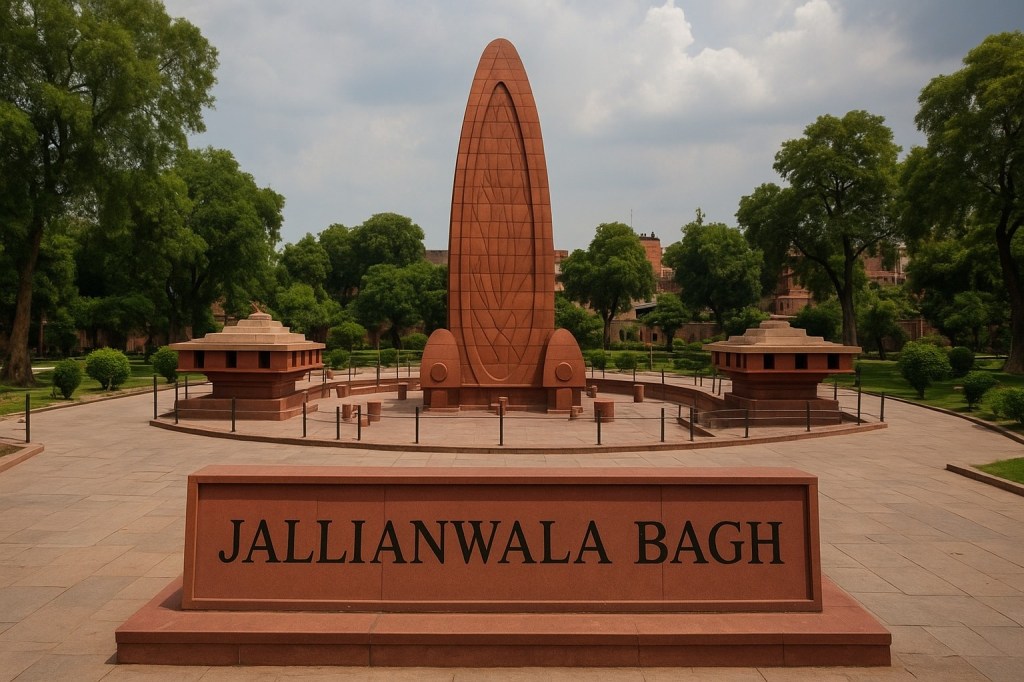
Answer: This is the Jallianwala Bagh Memorial in Amritsar. It commemorates the tragic massacre of hundreds of innocent Indians by British troops on 13 April 1919. The place reminds us of the sacrifices made for India’s freedom.
Web Chart – Major Events of the Freedom Struggle of India
Respected Principal, Teachers, and My Dear Friends,
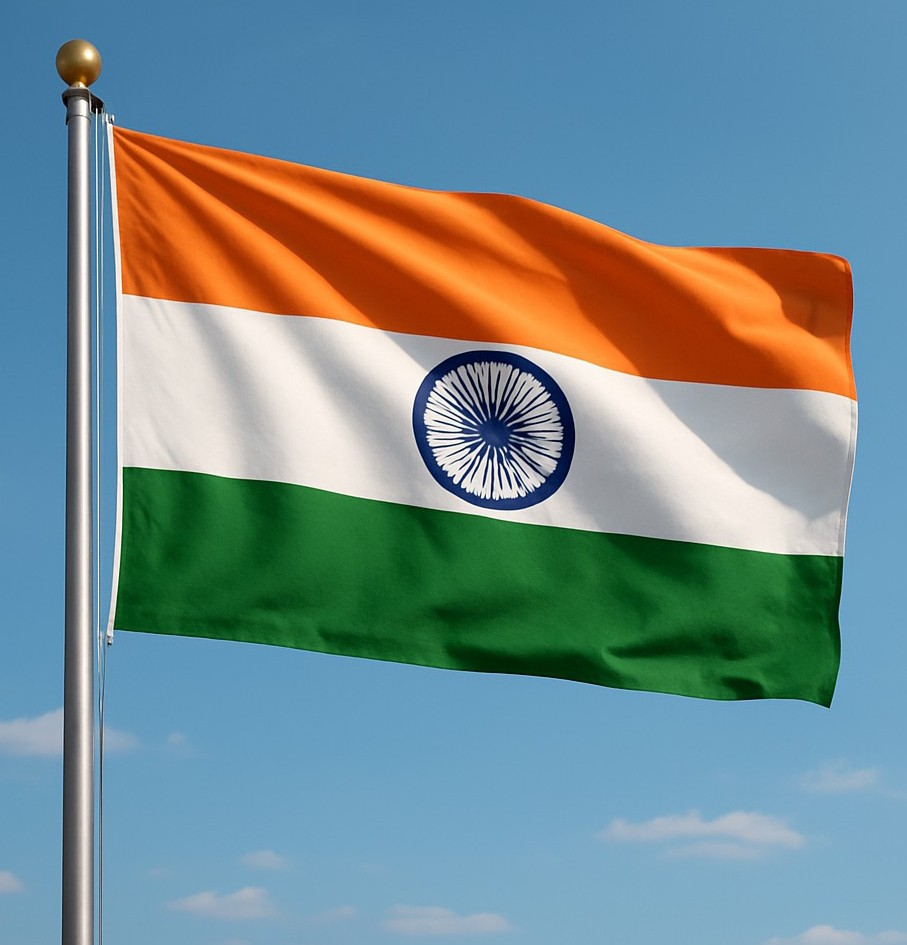
A very good morning to all of you. Today, we are gathered here to celebrate our Independence Day, the day our beloved India got freedom from British rule in 1947. This day is not just a holiday—it is a reminder of the sacrifices and struggles made by our freedom fighters like Mahatma Gandhi, Netaji Subhas Chandra Bose, Bhagat Singh, and many others.
Because of their courage and determination, we are able to live in a free nation where we can dream and achieve without fear.
But friends, true independence is not only about freedom from foreign rule. It is also about freedom from poverty, illiteracy, and inequality. It is our duty, as the youth of this great nation, to protect our unity, respect our diversity, and work hard for a better future.
Let us remember the words, “Sare Jahan Se Achha, Hindustan Hamara” and promise to be responsible citizens who make our country proud.
 Site 𝓝𝓲𝓻𝓾'𝓼𝓫𝓵𝓸𝓰