A. Choose the correct answer
1. Awadh emerged as an independent state under:
(a) Saadat Khan
2. The Battle of Plassey was fought in the year:
(b) 1757
3. Chin Qilich Khan was given the title:
(b) Nizam‑ul‑Mulk
4. Hyder Ali and Tipu Sultan were the rulers of:
(c) Mysore
—
B. Write T for True and F for False statements
1. The Mughal emperors after Aurangzeb are referred to as the Later Mughals. – T
2. Suraj Mal was the most famous Jat ruler. – T
3. The Third Battle of Panipat was fought between the Mughals and Ahmad Shah Abdali. – F (It was fought between Marathas and Ahmad Shah Abdali.)
4. Chauth and sardeshmukhi were two taxes levied by the Mughals. – F (These were levied by the Marathas.)
—
C. Fill in the blanks
1. The Battle of Buxar was fought in 1764.
2. The ijaradari system was introduced by Saadat Khan in Awadh.
3. The Bengal became independent from the Mughal rule under Murshid Quli Khan.
4. Under Peshwas, the Marathas emerged as a powerful force.
5. In the Third Battle of Panipat, the Marathas were defeated by Ahmad Shah Abdali in 1761.
D. Very Short Answer Type Questions (20–30 words)
1. Who were the later Mughals?
Answer: The Mughal emperors who ruled after Aurangzeb (1707) are called the Later Mughals. They were weak rulers, and their empire gradually disintegrated.
2. Who were the parties in the Battle of Buxar?
Answer: The Battle of Buxar (1764) was fought between the British East India Company and the combined forces of Mir Qasim (Bengal), Shuja‑ud‑Daulah (Awadh) and Shah Alam II (Mughal).
3. Who was Saadat Khan? What was the title given to him?
Answer: Saadat Khan was the founder of the independent kingdom of Awadh. He was given the title Burhan‑ul‑Mulk by the Mughal emperor.
4. Who was Maharana Pratap?
Answer: Maharana Pratap was the brave Rajput ruler of Mewar who resisted Mughal emperor Akbar’s attempts to capture his kingdom, most notably in the Battle of Haldighati (1576).
5. What was the Ashtapradhan?
Answer: The Ashtapradhan was a council of eight ministers appointed by Shivaji to assist in administration and governance of the Maratha kingdom.
—
E. Short Answer Type Questions (50–60 words)
1. What was the ijaradari system?
Answer: The ijaradari system was introduced by Saadat Khan in Awadh. Under this system, the right to collect revenue from land was auctioned to the highest bidder, called the ijardar. The ijardar paid a fixed sum to the state and kept the remaining revenue, which often led to exploitation of peasants.
2. Write a note on Sawai Raja Jai Singh.
Answer: Sawai Raja Jai Singh was a powerful Rajput ruler of Amber (Jaipur). He was a skilled administrator, diplomat, and astronomer. He built the city of Jaipur and established astronomical observatories called Jantar Mantars in different cities, including Delhi and Jaipur.
—
F. Long Answer Type Questions (80–100 words)
—
1. Analyse the reasons for the decline of the Mughal Empire.
Answer: The Mughal Empire declined after Aurangzeb’s death due to several reasons. The later Mughals were weak and unable to control the vast empire. Continuous wars drained the treasury, and heavy taxes angered the people. Powerful nobles and regional leaders like the Marathas, Sikhs, and Jats became independent. Invasions by Nadir Shah and Ahmad Shah Abdali weakened the empire further. The rise of the British East India Company also led to the empire’s downfall.
—
2. Explain the rise of Bengal as an independent kingdom.
Answer: Bengal became independent under Murshid Quli Khan, who was appointed as governor by the Mughals. After Aurangzeb’s death, he stopped sending revenue to Delhi and started ruling independently. Bengal was rich in trade, agriculture, and resources, which made it powerful. Its strategic location near the sea helped it flourish as a major trading centre. Later rulers like Alivardi Khan continued Bengal’s prosperity until the British conquest.
—
3. Trace the emergence of the Sikhs as an important political power.
Answer: The Sikhs, founded by Guru Nanak, gradually turned into a military power under later Gurus, especially Guru Gobind Singh, who formed the Khalsa in 1699. After Aurangzeb’s death, the Sikh Misls united under Maharaja Ranjit Singh to form a strong kingdom in Punjab. They resisted Mughal and Afghan forces and later built a powerful empire with Lahore as the capital.
—
4. Examine the rise and fall of the Marathas.
Answer: The Marathas rose under Shivaji, who established Swarajya and challenged Mughal power. After his death, the Peshwas controlled the Maratha Confederacy and expanded it across India. They became the most powerful force in the 18th century. However, internal divisions and defeat in the Third Battle of Panipat (1761) against Ahmad Shah Abdali weakened them. Later, the British defeated the Marathas in the Anglo‑Maratha wars.
—
5. Describe the Maratha administration.
Answer: The Maratha administration, founded by Shivaji, was well‑organized. He appointed the Ashtapradhan, an eight‑member council of ministers to help him. Revenue was collected through chauth and sardeshmukhi taxes. The kingdom was divided into provinces called subhas, managed by officers. Forts were built for defence, and a disciplined army was maintained. The system promoted efficiency and loyalty.
—
G. Differentiate between the following
—
1. Chauth and Sardeshmukhi
Chauth: A 25% tax on revenue or produce collected by the Marathas from lands not directly under their control.
Sardeshmukhi: An additional 10% tax claimed as the hereditary right of the Maratha ruler over the region.
—
2. Swarajya and Mughlai
Swarajya: Areas directly controlled by the Marathas under Shivaji’s administration.
Mughlai: Areas controlled by the Mughals or those who paid revenue to them.
—
3. Misl and Dal Khalsa
Misl: Small Sikh military groups led by individual chiefs in Punjab.
Dal Khalsa: The united army of all Sikh Misls formed to defend Punjab and fight against invaders.
—
H. Higher‑Order Thinking Skills
—
1. The Battle of Buxar had more far‑reaching consequences than the Battle of Plassey. Why?
Answer: The Battle of Plassey (1757) gave the British control over Bengal, but the Battle of Buxar (1764) was more important as it gave them control over Bengal, Bihar, and Odisha. The Mughal emperor granted them Diwani rights, making the British the real rulers of Eastern India, which laid the foundation for British rule in India.
Our Human Resources, Chapter- 14, Subject- Social Studies, Solved Exercises .
1. Answer the following questions:
a. Why are people considered the most important resource of a country?
Answer: People are considered the most important resource because they use and develop other resources and help in the progress of the country.
b. What is the biggest hurdle in the path of growth of our country?
Answer: The biggest hurdle in the growth of our country is the growing population.
c. What are the effects of the increasing population?
Answer: Increasing population leads to poverty, unemployment, illiteracy, lack of health and housing facilities.
d. Write five steps which should be taken to improve the quality of our human resources.
Answer: Steps should be taken to improve the quality of our human resources:
1. Provide better education.
2. Improve healthcare facilities.
3. Promote skill development.
4. Create more employment opportunities.
5. Spread awareness about population control.
e. Why is a small family said to be a happy family?
Answer: A small family is a happy family because it can live a better life with proper education, health, and other facilities.
—
2. Tick the right answer:
a. The most intelligent living being of all —
✔️ (i) Man
b. A scheme launched by the Government to increase milk production —
✔️ (iii) White Revolution
c. The biggest problem of our country —
✔️ (i) Growing population
d. The most populated country in the world —
✔️ (i) China
e. It is said to be a happy family —
✔️ (i) Small family
—
3. Write ‘T’ for ‘True’ or ‘F’ for ‘False’:
a. The population of India is 80 crores.
❌ F (It is over 140 crores now.)
b. India is less populated than Australia.
❌ F (India is much more populated.)
c. To improve the quality of the people, education is very important.
✔️ T
d. The Government is not making schemes to create jobs.
❌ F (Government has several job creation schemes.)
e. Illiteracy and poverty are two major problems of our country.
✔️ T
Rural Livelihood, Class- 6,Lesson- Seven, Subject- Social Science, Solved exercises
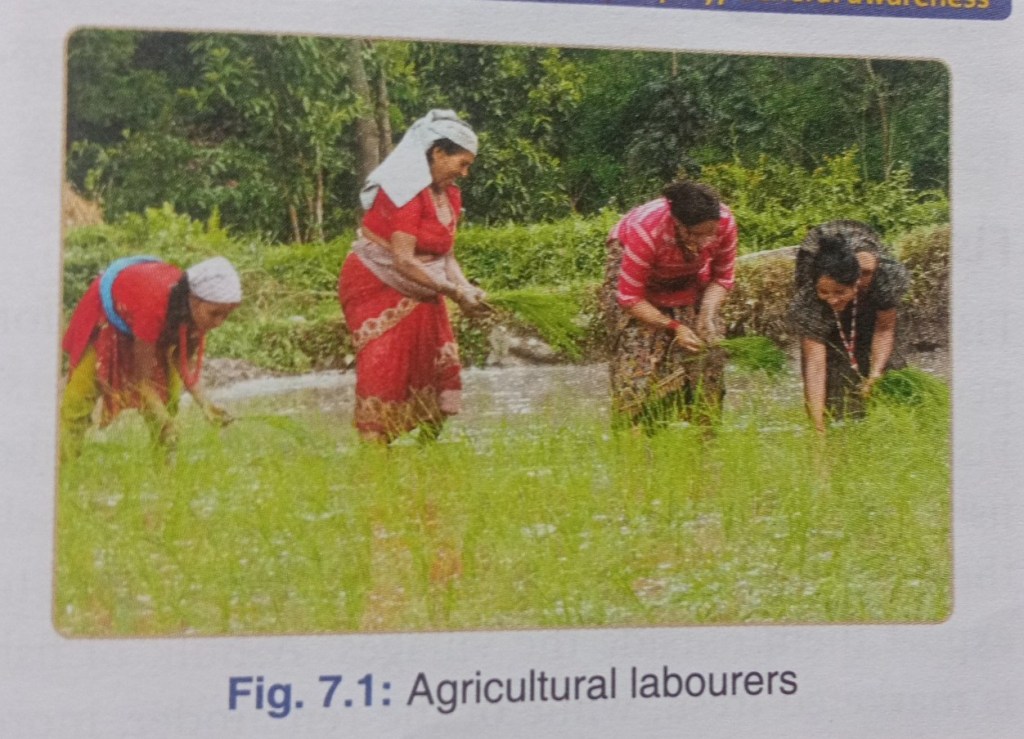
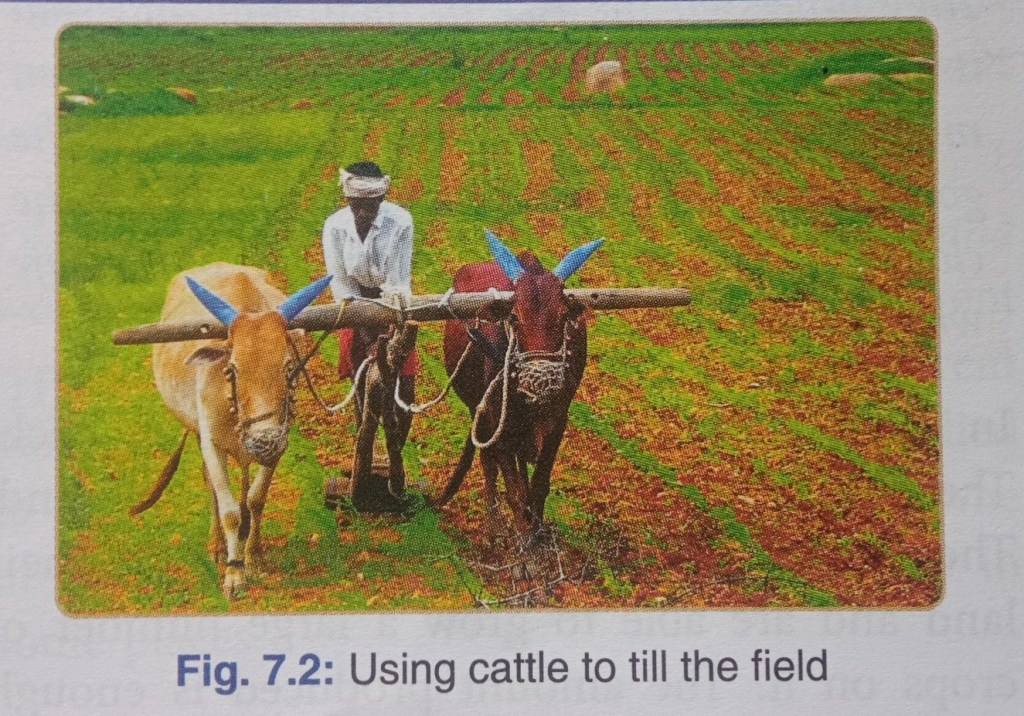
A. Choose the correct answer
1. The main occupation of rural people is:
(b) Agriculture
2. The middle-level farmers own:
(c) Small plots of land
3. Fishermen can’t go fishing during the:
(a) Monsoon season
4. Cattle are used for tilling the fields mostly by:
(b) Small or mid-level farmers
5. Rearing of animals to produce food is referred to as:
(c) Animal husbandry
—
B. True or False
1. The work of landless peasants is seasonal. – True
2. Banking, teaching and trading are secondary occupations. – True
3. Poultry refers to birds such as chickens, ducks and geese. – True
4. The rich farmers have to work in their fields. – False
5. Fishing is a primary occupation. – True
—
C. Fill in the blanks
1.Agricultureis the main occupation of majority of people in rural area.
2. Rich farmers can afford to buy fertilizers, modern machinery and other things.
3. Landless labourers borrow money to buy seeds, fertilizers and insecticides.
4. Animals such as cows, goats and buffaloes are mainly reared for their milk.
5. Many people from rural areas are forced to migrate to urban areas to find jobs.
—
D. Very Short Answer Type Questions
1. Which is the main occupation in rural areas?
Answer: The main occupation in rural areas is agriculture, as most people depend on farming for their livelihood.
2. Who are landless peasants?
Answer: Landless peasants are poor farmers who do not own land and work on others’ fields for daily wages.
3. What is animal husbandry?
Answer: Animal husbandry is the practice of rearing animals like cows, goats and buffaloes for milk, meat and other products.
4. What is poultry?
Answer: Poultry refers to the rearing of birds like chickens, ducks and geese for eggs and meat.
5. Who are rich farmers?
Answer: Rich farmers are those who own large plots of land and can afford modern machinery, fertilizers and good seeds for farming.
—
E. Short Answer Type Questions (50–60 words)
1. Explain the term livelihood.
Answer: Livelihood refers to the means or way by which people earn their living and meet their basic needs like food, clothing and shelter. It includes activities such as farming, fishing, trading, animal husbandry and other work that help them survive and support their families.
—
2. What is animal husbandry?
Answer: Animal husbandry is the practice of breeding and rearing animals like cows, goats, buffaloes and sheep to obtain products such as milk, meat, wool and leather. It is an important occupation in rural areas and supports farmers’ income.
—
3. How do people living near forest areas earn their livelihood?
Answer: People living near forest areas earn their livelihood by collecting forest products like wood, honey, fruits, medicinal plants and leaves. Some of them also hunt animals, fish in rivers, or make handicrafts from bamboo and other materials found in forests.
—
4. How do small farmers incur heavy debts?
Answer: Small farmers incur heavy debts because they do not have enough money to buy seeds, fertilizers, and farming tools. They borrow money from moneylenders at high interest rates, and if the crops fail due to drought or floods, they are unable to repay the loans.
—
5. Why do farm labourers migrate to urban areas?
Answer: Farm labourers migrate to urban areas in search of better employment opportunities, higher wages and improved living conditions. Due to seasonal farming, they do not get regular work in villages and move to cities to work in factories, construction sites or as daily wage labourers.
—
F. Long Answer Type Questions (80–100 words)
1. Who are middle-level farmers? Explain.
Answer: Middle-level farmers are those who own small or medium-sized plots of land. They do not have as much land or wealth as rich farmers but are better off than landless labourers. These farmers generally work on their own fields with the help of family members and sometimes hire labourers during the busy seasons. They grow crops for their own use and sell the surplus in the market. Their income is moderate, and they may use simple farming tools instead of modern machinery.
—
2. Discuss in detail about fishing and cottage industries in rural areas.
Answer: Fishing is an important occupation in coastal and riverine rural areas. Fishermen catch fish using boats and nets and sell them in local markets. It provides food and income to many rural families. Cottage industries are small-scale industries run from homes or small workshops. Examples include weaving, pottery, handicrafts, and basket-making. These industries use locally available raw materials and provide supplementary income to rural households, especially during non-farming seasons.
—
3. Write a note on the three sectors of occupations.
Answer: Occupations are divided into three main sectors:
Primary sector: Includes activities like farming, fishing, mining and forestry that use natural resources.
Secondary sector: Includes industries that process raw materials into finished goods, like textile or food processing.
Tertiary sector: Includes services like banking, teaching, transportation and trade that support the other two sectors.
All three sectors are interdependent and essential for the economy.
—
4. Distinguish between small and middle-level farmers.
Answer: Small farmers: Own very small pieces of land, often less than two hectares. They mostly work themselves and face financial difficulties.
Middle-level farmers: Own slightly larger land, can produce enough for their family and sell surplus. They may hire some labourers during peak seasons.
Small farmers are poorer and more dependent on loans, while middle-level farmers are relatively stable.
—
5. Write a note on different types of farmers living in rural areas.
Answer: Farmers in rural areas can be divided into three types:
Rich farmers: Own large plots of land and modern machinery. They can easily buy fertilizers, seeds and employ labourers.
Middle-level farmers: Own moderate land and use family labour. They manage with simple tools and have limited income.
Small farmers and landless labourers: Either own very little land or none at all. They work on others’ fields for wages and face financial struggles.
—
G. Differentiate between the following
Answer: . Primary livelihoods and secondary livelihoods
Primary livelihoods: Activities that directly use natural resources like farming, fishing and forestry.
Secondary livelihoods: Activities that process raw materials into products like weaving, pottery, or small-scale industries.
—
2. Small farmers and rich farmers
Answer: Small farmers: Have little land, cannot afford modern tools, and rely on manual labour.
Rich farmers: Own large landholdings, use modern machinery, and produce surplus crops for sale.
—
3. Animal husbandry and poultry farming
Answer: Animal husbandry: Rearing of animals like cows, buffaloes and goats for milk, meat and wool.
Poultry farming: Rearing of birds like chickens and ducks for eggs and meat.
*****************
Food We Eat, Class- 1, Subject- EVS, Solved exercises
Food We Eat – Exercises with Answers
A. Fill in the Blanks .
1. We eat food (food/air).
2. Food makes us strong (weak/strong).
3. We cannot live for long without water.(water/milk).
4. Breakfast (Breakfast/Dinner) gives us the energy to start the day.
5. We should (should/should not) wash our hands before meals.
—
B. Write ‘Yes’ or ‘No’ .
1. We eat dinner in the morning. – No
2. We need food and water to live. – Yes
3. We should eat junk food daily. – No
4. The food eaten at a particular time of a day is called a meal. – Yes
5. We should not eat food at fixed times every day. – No
—
D. Guess the Name of the Fruit .
1. I am the king of fruits. You can eat me sliced or drink my juice. I am MANGO.
2. I am red, sweet, and juicy. If you eat me, you stay healthy. I am APPLE.
3. I am green from outside but red from inside. I am a summer delight. I am WATERMELON.
—
E. Match the Pairs .
Food — Eat
Water — Drink
Apple — Red
Banana — Yellow
Spinach — Green
Carrot — Red
—
F. Time for Meals.
(Times may vary; children can write their own daily schedule)
1. Breakfast – 8:00 AM
2. Lunch – 1:00 PM
3. Dinner – 8:00 PM
—
G. List Any Five Food Items You Like in Your Breakfast.
1. Bread
2. Butter
3. Milk
4. Eggs
5. Fruits
—
H. Challenge Questions.
1. What harm can it do if Rohan does not wash his hands before or after meals?
Answer: He may get germs on his hands, which can enter his body and make him sick.
2. What is supper?
Answer: Supper is another word for a light evening meal or dinner.
—
I. Life Skills.
1. Who has better food habits and why?
Answer: Aman has better food habits because home-cooked food is healthier and cleaner.
Government, Class- 6, Subject- Social science, solved exercises

A. Choose the correct answer
1. The central legislature of our country is the:
(a) Supreme Court
(b) High Court
(c) Parliament
(d) None of these
Answer: (c) Parliament
—
2. The branch that ensures that the laws are enforced is the:
(a) Legislature
(b) Executive
(c) Judiciary
(d) State government
Answer: (b) Executive
—
3. In India, women were given the right to vote in:
(a) 1918
(b) 1952
(c) 1930
(d) 1920
Answer: (b) 1952
—
4. ANC is a political party in:
(a) South Africa
(b) India
(c) Egypt
(d) None of these
Answer: (a) South Africa
—
5. Adolf Hitler was the head of a:
(a) Dictatorship
(b) Monarchy
(c) Anarchy
(d) Democracy
Answer: (a) Dictatorship
—
B. Write T for True and F for False statements
1. The Supreme Court is the highest court of India.
Answer: T
—
2. The Parliament consists of the Lok Sabha and the Rajya Sabha.
Answer: T
—
3. The judiciary functions through a system of courts.
Answer: T
—
4. The right to vote is known as the Suffragette Movement.
Answer: F
—
5. Apartheid was officially abolished in 1994 in South Africa.
Answer: T
—
C. Fill in the blanks
1. ________ is the law-making branch of the government.
Answer: Legislature
—
2. The ________ is the government at the national level.
Answer: Parliament
—
3. ________ was imprisoned for 27 years for fighting against apartheid.
Answer: Nelson Mandela
—
4. The right to vote is called ________.
Answer: Franchise (or Suffrage)
—
5. The first elections were held in India in ________.
Answer: 1952
—
D. Very Short Answer Type Questions
1. Define government
Answer: Government is an organization or system through which laws are made, enforced, and justice is administered in a country.
2. Who can vote in an election in India?
Answer: All Indian citizens aged 18 years or above, irrespective of gender, caste, religion, or wealth, can vote.
3. In India, how many levels does the government have?
Answer: India has three levels of government – central, state, and local.
4. Name the three organs of the government.
Answer: Legislature, Executive, and Judiciary.
5. Name the different types of government.
Answer: Democracy, Monarchy, Dictatorship.
—
E. Short Answer Type Questions (50–60 words)
1. Examine the need for government.
Answer: Government is needed to maintain law and order, provide security, and manage resources for the welfare of the people. It ensures justice, protects rights, builds infrastructure, and regulates relations with other countries. Without government, society would lack structure and face chaos.
—
2. What are the functions of the government?
Answer: The government makes laws, enforces them, and ensures justice. It provides public services like education, healthcare, and transport. It collects taxes to fund development and protects citizens from external and internal threats. It also plans economic development and maintains foreign relations.
—
3. Discuss the working of different organs of the government.
Answer: The government has three organs:
i) Legislature: Makes laws.
ii) Executive: Implements and enforces laws.
iii) Judiciary: Interprets laws and delivers justice.
These organs work separately but cooperate to ensure smooth governance and prevent misuse of power.
—
4. Explain the concept of Universal Adult Franchise.
Answer: Universal Adult Franchise means every adult citizen has the right to vote in elections, irrespective of gender, caste, religion, or wealth. In India, every citizen above 18 years can vote. It ensures equality and is an important feature of democracy.
—
5. Differentiate between monarchy and democratic forms of government.
Answer: Monarchy: Power lies with a king or queen; citizens have little role in decision-making.
Democracy: Power lies with elected representatives; citizens participate through voting.
—
F. Long Answer Type Questions (80–100 words)
1. Describe the Suffragette Movement.
Answer: The Suffragette Movement was a campaign for women’s right to vote. It began in the late 19th and early 20th centuries, mainly in the UK and USA. Women protested, organized rallies, and faced imprisonment to gain equal voting rights. This movement spread worldwide and inspired similar campaigns in other countries, including India. It helped achieve women’s suffrage, a crucial step toward gender equality in politics.
—
2. Explain in detail the working of the three types of government.
Answer: There are three main types of government:
i) Democracy: People elect their representatives. Power lies with the citizens.
ii) Monarchy: A king or queen rules, power is inherited. Citizens have limited rights.
iii) Dictatorship: A single leader holds complete power, often gained through force. Citizens have no role in governance.
Each type functions differently, affecting people’s freedom and rights.
—
3. Write a note on the anti-apartheid struggle in South Africa.
Answer: The anti-apartheid struggle in South Africa was a fight against racial segregation and discrimination imposed by the white minority government. Nelson Mandela became a prominent leader of this movement. He spent 27 years in prison for opposing apartheid. After years of protests and international pressure, apartheid was abolished in 1994, and South Africa held its first multiracial elections, making Mandela the first Black president.
—
4. Justify that democracy is the best form of government.
Answer: Democracy is considered the best form of government because it is based on equality and freedom. Citizens elect their representatives and participate in decision-making. It protects fundamental rights, ensures accountability, and promotes welfare. Unlike monarchy or dictatorship, democracy prevents misuse of power and allows peaceful change of leadership through elections.
—
G. Differentiate between the following
—
1. State government and National government
Answer: State Government:
i) It looks after the administration of a specific state.
ii) It makes laws on matters listed in the State List such as police, agriculture, and local trade.
iii) It is headed by the Chief Minister and the Governor.
National Government:
i) It looks after the administration of the entire country.
ii) It makes laws on matters listed in the Union List such as defence, foreign affairs, and currency.
iii) It is headed by the Prime Minister and the President.
—
2. Executive and Legislature
Answer: Executive:
a) The Executive is responsible for implementing and enforcing the laws made by the Legislature.
b) It includes the President, Prime Minister, and the Council of Ministers at the central level.
c) It also manages the day-to-day administration of the country.
Legislature:
a) The Legislature is responsible for making laws for the country.
b) It includes the Parliament at the central level and State Legislative Assemblies at the state level.
c) It represents the will of the people through elected representatives.
—
3. Monarchy and Dictatorship
Answer: Monarchy:
i) In a monarchy, the head of the state is a king or queen, and the position is hereditary.
ii) The ruler may have absolute power or limited power depending on the type of monarchy.
Dictatorship:
i) In a dictatorship, a single person holds complete power, usually gained through force or military control.
ii) Citizens do not have freedom to elect their leader or criticize the government.
*****************
Natural Resources, Class- 5, Subject- Social Studies, Solved exercises.


1. Which of the following resources is used in producing electricity by making dams?
Answer: Water
2. Which of the following is not a gift of nature?
Answer: Highways
3. Which of the following resources is non-renewable?
Answer: Coal
4. Which of the following resources cannot be used directly?
Answer: Petroleum
—
B. Fill in the blanks
1. Natural resources are the gifts of nature.
Answer: nature
2. Sunlight, water and air are resources that can be used directly.
Answer: directly
3. Petroleum taken out from the Earth is in a crude form.
Answer: crude
4. Wind energy can be used for producing electricity.
Answer: electricity
—
C. True or False
1. Natural resources are man-made things. → False
2. All natural resources have to be processed before they can be used. → False
3. Renewable resources can be used again and again. → True
4. We must conserve our natural resources. → True
—
D. Answer the following questions
1. What are natural resources? How are they important for all living beings?
Answer: Natural resources are things we get from nature like air, water, soil, plants and animals. They are important because they give us food, water, shelter and energy needed to live.
—
2. What are renewable resources? Give examples.
Answer: Renewable resources are resources that can be used again and again because they can naturally replenish. Examples: sunlight, wind, water.
—
3. What are non-renewable resources? Give examples.
Answer: Non-renewable resources are resources that get exhausted after use and cannot be replaced quickly. Examples: coal, petroleum, natural gas.
—
4. How do human activities affect natural resources?
Answer: Human activities like cutting trees, pollution and overuse of resources reduce the availability and quality of natural resources.
—
E. Give reasons
1. Some natural resources cannot be used in their natural form.
Answer: Because they need to be processed before use. For example, crude petroleum must be refined to get petrol, diesel and kerosene.
—
2. It is important to conserve natural resources.
Answer: Because they are limited and all living beings depend on them for survival. Conserving them ensures they are available for future generations.
Flowering of Regional Cultures, Class – 7, Subject- Social Science, Solved Questions and answers
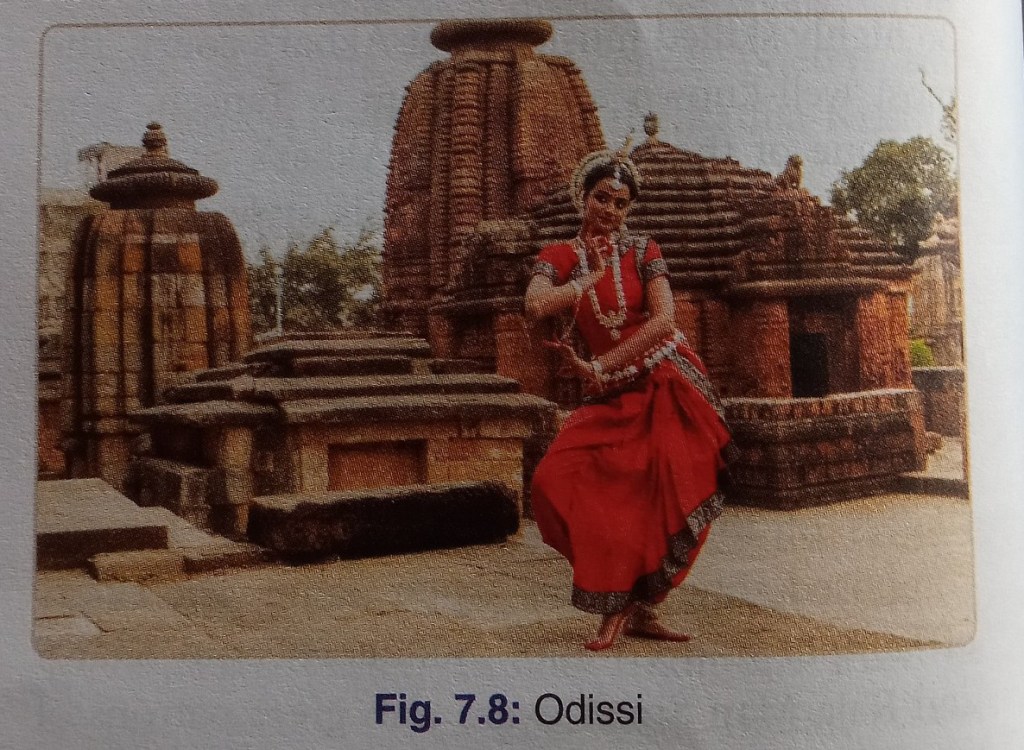
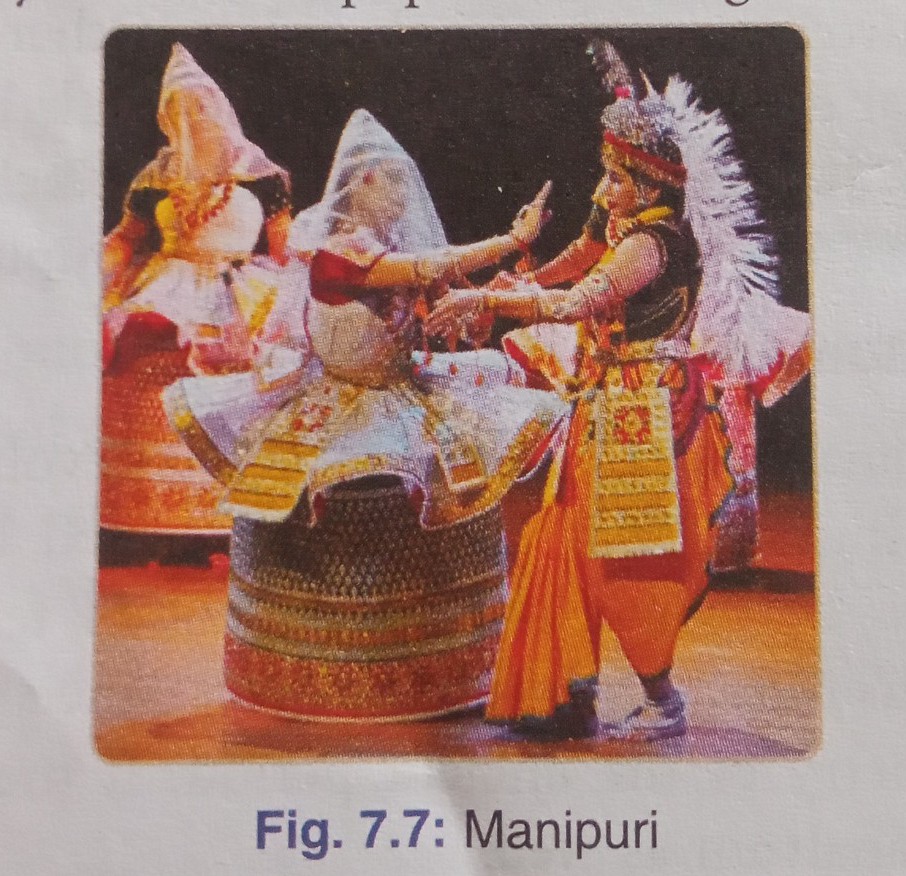
A. Choose the correct answer
1. The fusion of Persian and Hindi led to the development of:
(c) Urdu
2. The Janmasakhis are stories on the life of:
(b) Guru Nanak
3. The text Ragadarapan was translated during the reign of:
(b) Akbar
4. Rajasthani, Pahari, and Deccani were:
(a) Schools of painting
5. Kuchipudi is a dance form of:
(d) Andhra Pradesh
—
B. Write T for True and F for False statements
1. The Gita Govinda is written in Hindi. — F
2. Amir Khusrau was a disciple of the Sufi saint Salim Chishti. — F (He was a disciple of Nizamuddin Auliya)
3. Mewar, Kota, Kishangarh, Bundi, Bikaner and Jodhpur were Pahari school of painting. — F (They were Rajasthani school of painting)
4. Chaitanya introduced kirtanas. — T
5. Nawab Wajid Ali Shah patronized Kuchipudi. — F (He patronized Kathak, not Kuchipudi)
—
C. Fill in the blanks
1. Somadeva is the author of Kathasaritsagar.
2. Amir Khusrau was a poet, scholar, mathematician, and historian who wrote in Persian and Hindavi.
3. Abdur Rahim Khan-i-Khana, popularly known as Rahim, was an important poet at Akbar’s court.
4. The most famous of the kissa is Padmavat written by Malik Muhammed Jayasi.
5. The Sitar and the Tabla were two musical instruments introduced by the Turks in India.
—
D. Very Short Answer Type Questions
1. What is Kathasaritasagara? Who wrote it?
Answer: It is a collection of Indian legends, fairy tales, and folk tales written by Somadeva.
2. What is Gita Govinda and who composed it?
Answer: It is a Sanskrit text describing the love of Krishna and Radha, composed by Jayadeva.
3. Urdu is a mixture of which two languages?
Answer: Urdu is a mixture of Persian and Hindi.
4. When and how did the Hindi language begin to develop?
Answer: Hindi began to develop around the 7th–10th century CE as a form of Apabhramsha, later influenced by Persian during the Delhi Sultanate and Mughal periods.
5. Who were the bauls?
Answer: Bauls were wandering minstrels from Bengal known for their devotional music and songs expressing mystical love for God.
—
E. Short Answer Type Questions (50–60 words)
1. Regional texts are important sources of history. Elaborate.
Answer: Regional texts provide valuable insights into the local culture, traditions, and daily life of people in different parts of India. They record events, rulers, festivals, and art forms specific to regions, helping historians understand diversity in medieval India. Such texts also preserve folklore and oral traditions which are not found in mainstream historical records.
—
2. Write a note on Bengali temple architecture.
Answer: Bengali temple architecture flourished between the 16th and 19th centuries. The temples were built using terracotta and featured intricate carvings depicting scenes from the epics. They often had curved roofs (chala style) inspired by bamboo huts. Temples like the Dakshineswar and Kantanagar showcase this unique architectural style combining local art with religious themes.
—
3. Explain the development of Punjabi literature.
Answer: Punjabi literature evolved during the medieval period under the influence of Bhakti and Sufi movements. Guru Nanak’s hymns in the Guru Granth Sahib are central to Punjabi literature. Saints like Bulleh Shah and Waris Shah enriched it with devotional and romantic poetry, blending Persian, Arabic, and local dialects to create a rich literary tradition.
—
4. What is miniature painting? Which schools of miniature painting are mentioned in the chapter?
Answer: Miniature paintings are small, detailed paintings made on paper, cloth, or ivory using bright colours and intricate designs. They often depict court scenes, nature, and religious themes. The main schools of miniature painting are Rajasthani, Pahari, and Deccani, each with distinctive styles reflecting regional traditions and royal patronage.
—
5. Write a note on Amir Khusrau.
Answer: Amir Khusrau (1253–1325) was a renowned poet, musician, and scholar at the Delhi Sultanate court. He wrote in Persian and Hindavi, contributing to Indian classical music by creating new ragas and instruments like the sitar and tabla. Khusrau’s poetry, blending Sufi mysticism and local culture, greatly influenced the development of Urdu and Hindustani music.
6. Write a short note on Manipuri dance.
Answer: Manipuri dance is a classical dance form from Manipur, a state in northeast India. It is deeply connected to the worship of Lord Krishna and Radha, depicting Raslila and devotional themes. The dance is graceful, with slow, flowing movements and distinctive costumes, including the cylindrical skirts of female dancers. It combines music, rhythm, and storytelling in a spiritual manner.
F. Long answer type questions
(80–100 words):
1. Describe the painting traditions of medieval India.
Answer: The painting traditions of medieval India were rich and diverse, reflecting regional styles and royal patronage. The Mughal school of painting combined Persian techniques with Indian themes, depicting court life, battles, and nature. Rajasthani and Pahari schools created miniature paintings based on epics like Ramayana and Bhagavata Purana. Deccani paintings were influenced by Persian art but had bright colours and detailed backgrounds. Murals in temples and palaces also flourished, showcasing religious and folk themes. These traditions contributed significantly to India’s cultural and artistic heritage.
—
4. Write a note on the music and dance traditions of the medieval period in India.
Answer: During medieval India, music and dance evolved under the influence of Bhakti and Sufi movements. Devotional music like bhajans, kirtanas, and qawwalis became popular. Persian and Indian styles fused, leading to the development of Hindustani classical music with new ragas and instruments like the sitar and tabla. Folk dances like Lavani and Powada coexisted with classical forms such as Kathak and Bharatanatyam. Court patronage encouraged performances at festivals and ceremonies, while temple traditions preserved devotional dance. These traditions reflected both religious devotion and regional culture.
—
G. Differentiate between the following
1. Ramcharitmanas and Sursagar
Answer: Ramcharitmanas: Written by Tulsidas; based on the life of Lord Rama; composed in Awadhi.
Sursagar: Written by Surdas; devotional poetry dedicated to Lord Krishna; composed in Braj Bhasha.
—
2. Powadas and Lavanis
Answer: Powadas: Narrative ballads popular in Maharashtra; recount heroic deeds and historical events.
Lavanis: Lively folk songs and dances from Maharashtra; performed to entertain and convey social messages.
—
3. Tirumurais and Nalaiyira Divya Prabandham
Answer: Tirumurais: Collection of Tamil hymns dedicated to Lord Shiva; composed by Shaiva saints.
Nalaiyira Divya Prabandham: Collection of 4000 Tamil hymns dedicated to Lord Vishnu; composed by Alvar saints.
Weather and Climate, Class – 5, Social Studies,Chapter – 4
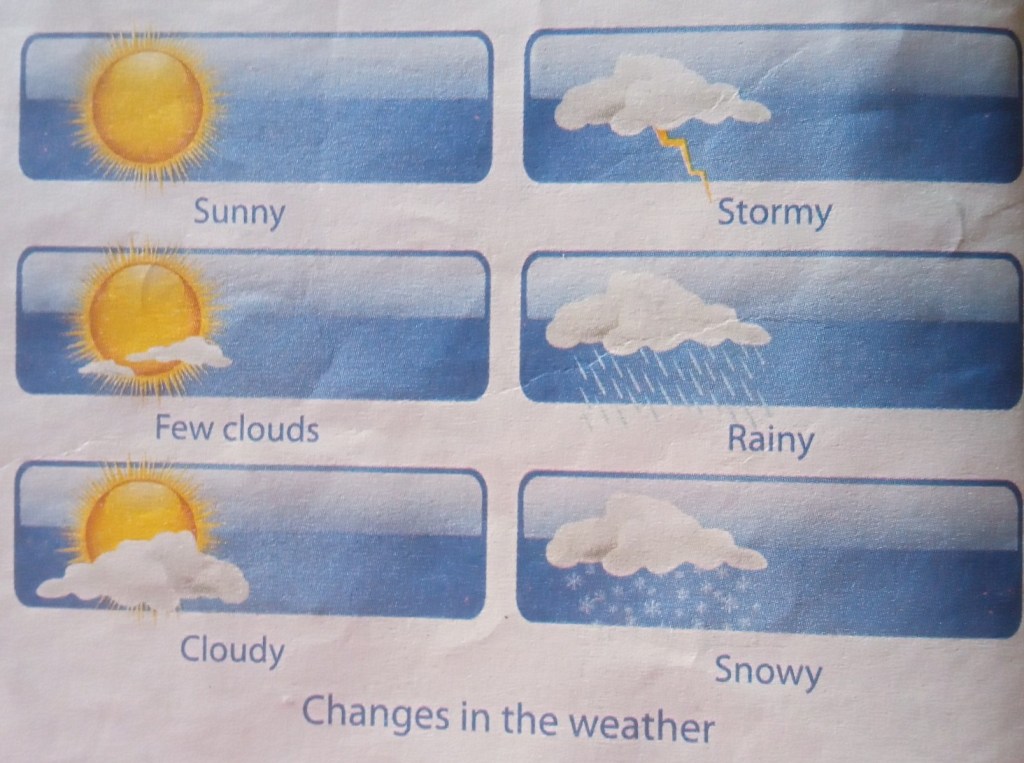
A. Tick the Correct Answer
1. Who among the following study climate?
✔️ Climatologists
2. What is the height of a place above sea level known as?
✔️ Altitude
3. Which of the following is the measurement of warmth or coldness of air around us?
✔️ Temperature
4. What is the heat zone between the Tropic of Cancer and the Tropic of Capricorn known as?
✔️ Torrid
B. Fill in the Blanks
1. The thin layer of the air surrounding the Earth is called the
→ Atmosphere
2. The amount of water vapour present in air is called
→ Humidity
3. Temperature
→ Decreases
with increase in altitude.
4. The coldest climatic zone on the Earth is
→ Frigid zone
C. Match the Columns
1. Weather – Changes from time to time
2. Degree of humidity – Distance from the sea
3. Onshore wind – Sea breeze
4. Offshore wind – Land breeze
D. Answer the following questions (Section D)
1. What is weather?
Answer — Weather refers to the condition or state of the atmosphere over a short period of time at a particular place.
2. What is climate?
Answer — Climate is the average weather condition of a place over a long period of time.
3. Describe the factors that influence the climate of a place.
Answer — Factors include latitude, altitude, distance from the sea, ocean currents, and wind patterns.
4. Write about the climatic zones of the world.
Answer — The world is divided into three heat zones: Torrid Zone (near the equator), Temperate Zone (between tropics and polar circles), and Frigid Zone (near the poles).
E. Observe and Answer (Section E – Activities)
Sunny ☀️ – ✔️
Cloudy 🌥 – ✔️
Stormy ⛈ – ✔️
Snowy 🌨 – ✔️
Rainy 🌧 – ✔️
Windy 🌬 – ✔️
Kanaklata Barua – A Brave Young Woman, solved exercise,questions and answers
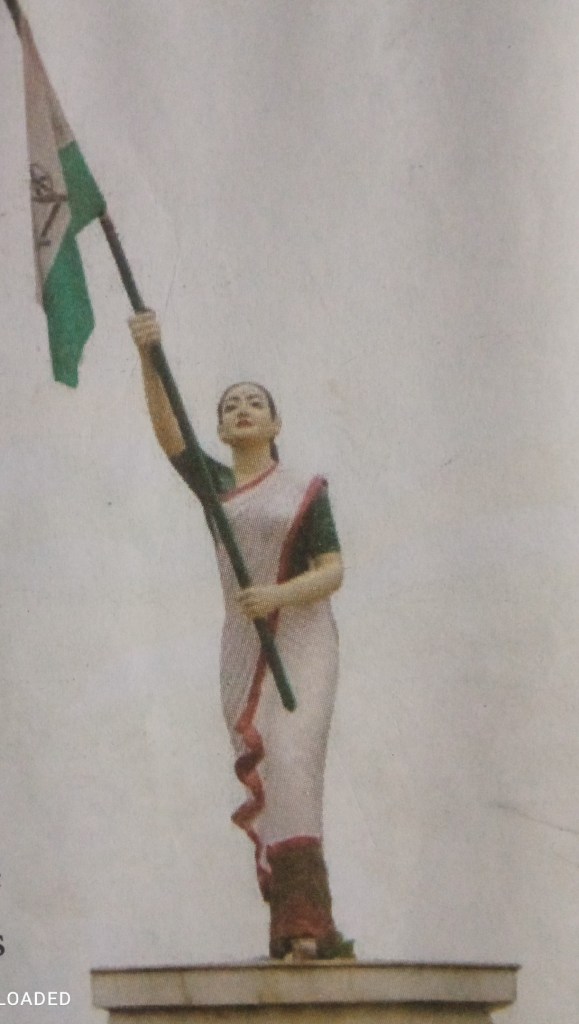
2. Let’s check how well we understood:
a) Answer the following questions:
i) Where was Kanaklata Barua born?
Ans: Kanaklata Barua was born in Gohpur in Assam.
ii) How old was Kanaklata Barua when she joined the Quit India Movement?
Ans: She was 17 years old when she joined the Quit India Movement.
iii) What was Kanaklata Barua carrying during the procession?
Ans: She was carrying the tricolour flag during the procession.
iv) Where did Kanaklata Barua want to hoist the flag?
Ans: She wanted to hoist the flag at the local police station.
v) She was a brave young woman. Who is ‘she’ referred to here?
Ans: ‘She’ refers to Kanaklata Barua.
vi) She wanted to free it from the British rule. Who is ‘it’ referred to here?
Ans: ‘It’ refers to her motherland, India.
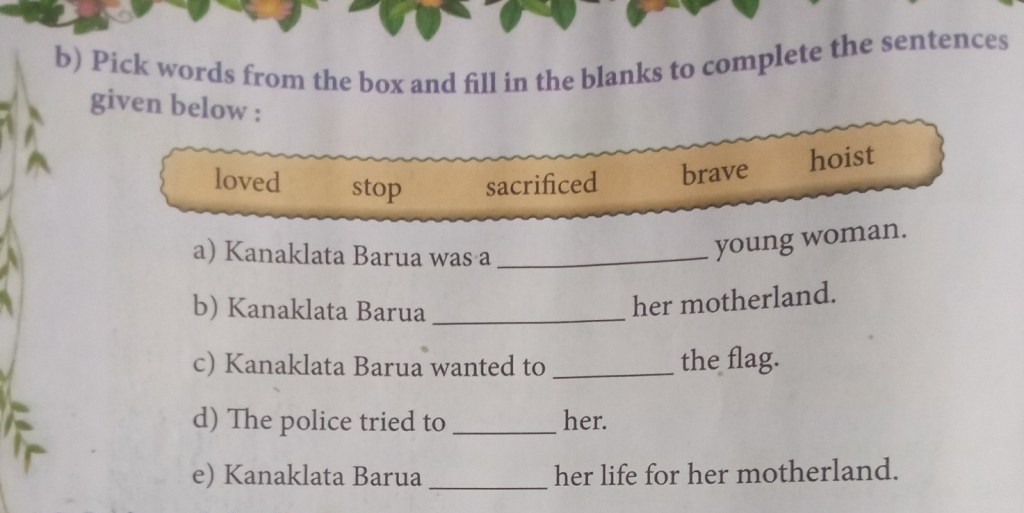
Let’s complete the sentences using the correct words from the box:
Sentences:
a) Kanaklata Barua was a brave young woman.
b) Kanaklata Barua loved her motherland.
c) Kanaklata Barua wanted to hoist the flag.
d) The police tried to stop her.
e) Kanaklata Barua sacrificed her life for her motherland.
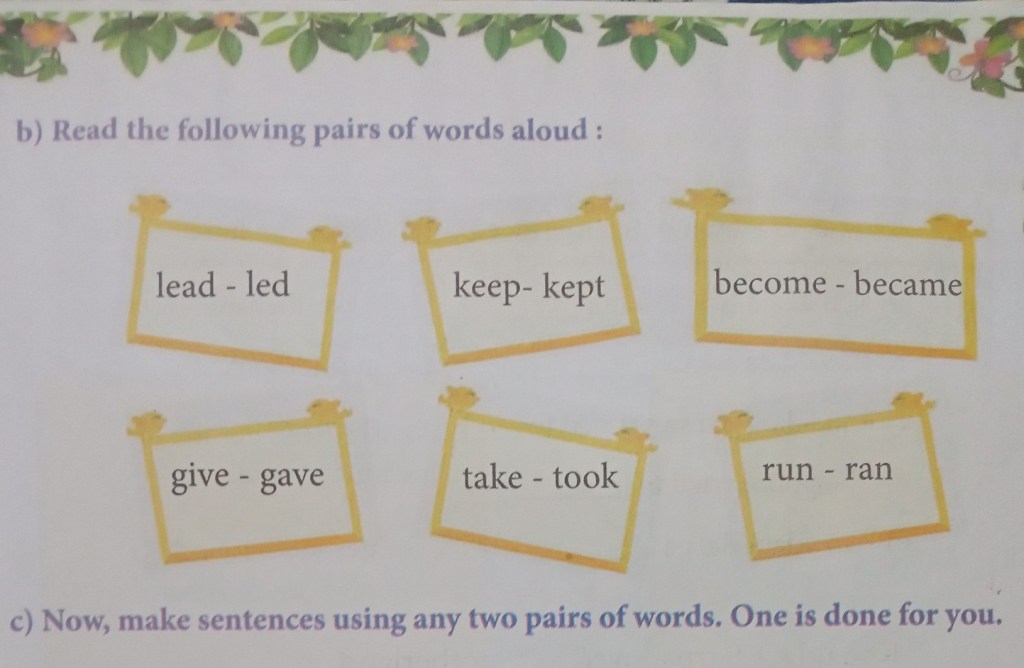
1. lead – led
lead: Good teachers lead their students by example.
led: Mahatma Gandhi led India to independence.
—
2. keep – kept
keep: I keep my toys in a big box.
kept: She kept her promise to help me.
—
3. become – became
become: I want to become a doctor when I grow up.
became: He became very tired after playing football.
—
4. give – gave
give: I always give food to the stray dog.
gave: My father gave me a book on my birthday.
—
5. take – took
take: We always take our water bottles to school.
took: She took the wrong bus yesterday.
—
6. run – ran
run: I run in the playground every morning.
ran: Yesterday, Rohan ran quickly to catch the bus.
Land, Soil, Water, Natural Vegetation and Wildlife Resources.Chapter – 2,solved questions and answers.
1. Answer the following questions:
(i) Which are the two main climatic factors responsible for soil formation?
Answer– Temperature and rainfall.
(ii) Write any two reasons for land degradation today.
Answer– (i)Deforestation
(ii) Overgrazing
(iii) Why is land considered an important resource?
Answer– Because land provides us with food, shelter, and other resources. It is essential for agriculture, forestry, industries, and infrastructure development.
(iv) Name any two steps that the government has taken to conserve plants and animals.
Answer– (i) Establishment of national parks and wildlife sanctuaries
(ii) Implementation of laws to protect endangered species
(v) Suggest three ways to conserve water.
Answer- (a) Rainwater harvesting
(b) Avoiding water wastage
(c) Reusing wastewater after treatment
2. Tick the correct answer:
(i) Which one of the following is NOT a factor of soil formation?
✔️ (b) Soil texture
(ii) Which one of the following methods is most appropriate to check soil erosion on steep slopes?
✔️ (c) Terrace cultivation ✅ (Correct)
_₱
(iii) Which one of the following is NOT in favour of the conservation of nature?
✔️ (c) Dispose polybags after shopping
3. Match the followings:
(i) Land use (c) Productive use of land
(ii) Humus (d) Organic matter deposited on top soil
(iii) Rock dams (a) Prevent soil erosion
(iv) Biosphere (b) Narrow zone of contact between the lithosphere, hydrosphere and atmosphere
4. State whether the given statement is true or false. If true, write the reasons:
(i) Ganga–Brahmaputra plain of India is an overpopulated region.
✔️ True – Due to fertile land and abundant water supply, it supports high population density.
(ii) Water availability per person in India is declining.
✔️ True – Due to increasing population and water pollution.
(iii) Rows of trees planted in the coastal areas to check the wind movement is called intercropping.
❌ False – It is called shelter belts, not intercropping.
(iv) Human interference and changes of climate can maintain the ecosystem.
❌ False – They disturb the e
 Site 𝓝𝓲𝓻𝓾'𝓼𝓫𝓵𝓸𝓰