ryot peasant mahal village nij cultivation on planter’s own land ryoti cultivation on ryot’s lands
2. Fill in the blanks:
(a) Growers of woad in Europe saw indigo as a crop which would provide competition to their earnings.
(b) The demand for indigo increased in late eighteenth-century Britain because of expansion of cotton production.
(c) The international demand for indigo was affected by the discovery of synthetic dyes.
(d) The Champaran movement was against indigo planters.
Let’s Discuss
3. Describe the main features of the Permanent Settlement.
Answer– The main features of the Permanent Settlement were as follows:
I) Introduced by: Lord Cornwallis in 1793 in Bengal.
ii) Landowners: Zamindars were recognized as owners of the land.
iii) Revenue Collection: Zamindars had to pay a fixed revenue to the British.
iv) Permanency: The revenue amount was fixed permanently.
V) Impact: Led to absentee landlordism and exploitation of peasants.
4.Differences between Mahalwari and Permanent Settlement.
Answer— The difference between Mahalwari and permanent Settlement were as follows:
1. Revenue Collection & Ownership:
Mahalwari System: Revenue was collected from a group of villages (mahal) through the village headman. Land was collectively owned by the villagers.
Permanent Settlement: Revenue was collected from zamindars, who were made landowners by the British.
2. Revenue Revision & Area:
Mahalwari System: Revenue was revised periodically based on land productivity. Implemented in North-Western Provinces.
Permanent Settlement: Revenue was fixed permanently and never changed. Implemented in Bengal, Bihar, and Orissa.
5. Give two problems which arose with the new Munro system of fixing revenue.
Answer– The Munro system refers to the Ryotwari system introduced by Thomas Munro in southern India. Two major problems with this system were:
1. High Revenue Demand: The revenue demand was very high and fixed by the British without considering the actual productivity of the land. This burdened the peasants.
2. Direct Settlement with Peasants (Ryots): Since the government dealt directly with individual peasants, there was no middleman to support the ryots. If crops failed, peasants had no resources left and often fell into debt.
6. Why were ryots reluctant to grow indigo?
Answer– Ryots were reluctant to grow indigo due to several reasons:
a) Unfair Contracts: Planters forced ryots to sign contracts (satta) for growing indigo on a fixed portion of their land.
b) Soil Exhaustion: Indigo exhausted the fertility of the soil, making it difficult to grow food crops afterward.
c) Low Payment: Ryots were paid very little for the indigo, not even enough to cover the cost of production.
d) Coercion and Violence: Planters used pressure, coercion, and sometimes violence to enforce cultivation.
7. What were the circumstances which led to the eventual collapse of indigo production in Bengal?
Answer– The collapse of indigo production in Bengal was due to:
Widespread Ryot Resistance: Peasants started refusing to grow indigo. This led to what became known as the Indigo Revolt (1859–60).
Support from Intelligentsia: The ryots got support from local intellectuals, press, and even some British officials.
Government Inquiry: A commission was appointed which supported the ryots and criticized the planters.
Availability of Synthetic Dyes: By the end of the 19th century, synthetic dyes became popular in Europe, drastically reducing the demand for natural indigo.
A hungry dog stole a piece of meat from a shop. As he was crossing a bridge over a river, he looked into the water and saw his reflection, which he mistook for another dog with a bigger piece of meat. Wanting the other piece, he barked, dropping his own meat into the water. He ended up losing his meat because of his greed.
EXERCISES:
A. Tick (✓) the correct answer:
1. The dog ran with a piece of (✓ meat / loaf) in his mouth.
2. The dog had to cross a (✓ river / tunnel).
3. The dog saw (✓ his reflection / another dog) in the river.
4. The piece of meat looked (✓ bigger / smaller) in the reflection.
5. The dog (✓ barked / jumped) at the other dog.
B. Answer these questions:
1. Why did the shopkeeper run after the dog? Ans→ Because the dog stole a piece of meat from the shop.
2. What did the dog see in the water? Ans→ He saw his own reflection in the water.
3. What happened to the dog in the end? Ans→ He lost his piece of meat when he barked at the reflection .
4. Describe the dog in the story. Ans→ The dog was hungry and greedy.
1. What was the great Buddha doing when the monk came to talk to him? Answer- The great Buddha was going for a walk when the monk came to talk to him.
2. What happened to the pillow cover? Answer- The pillow cover had a hole in it, so the monk used it as a doormat.
3. The Buddha smiled and gave the monk a new shawl. Why? Answer- The Buddha smiled because the monk reused things wisely. He gave the monk a new shawl as a reward for his thoughtful behavior.
4. Why do you think we should reuse and recycle? Answer- We should reuse and recycle to reduce waste, and save nature.
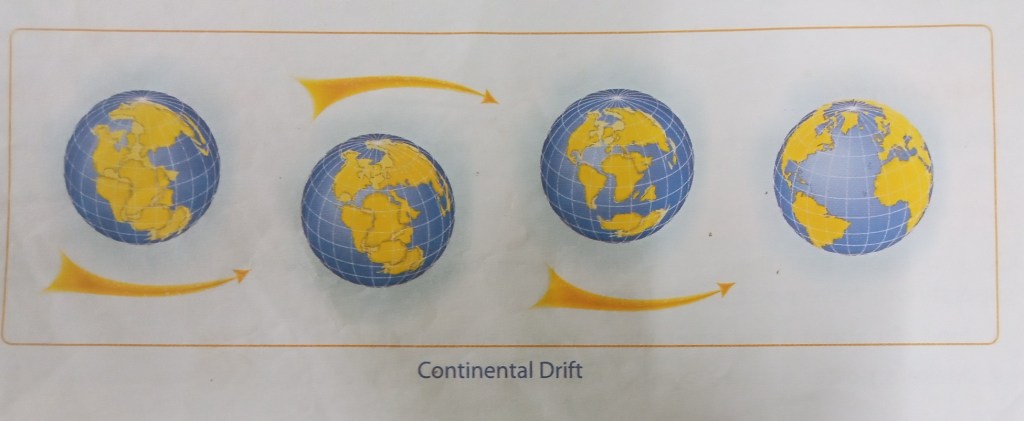
1. Alfred Wegener – Gave the Continental Drift Theory ✅
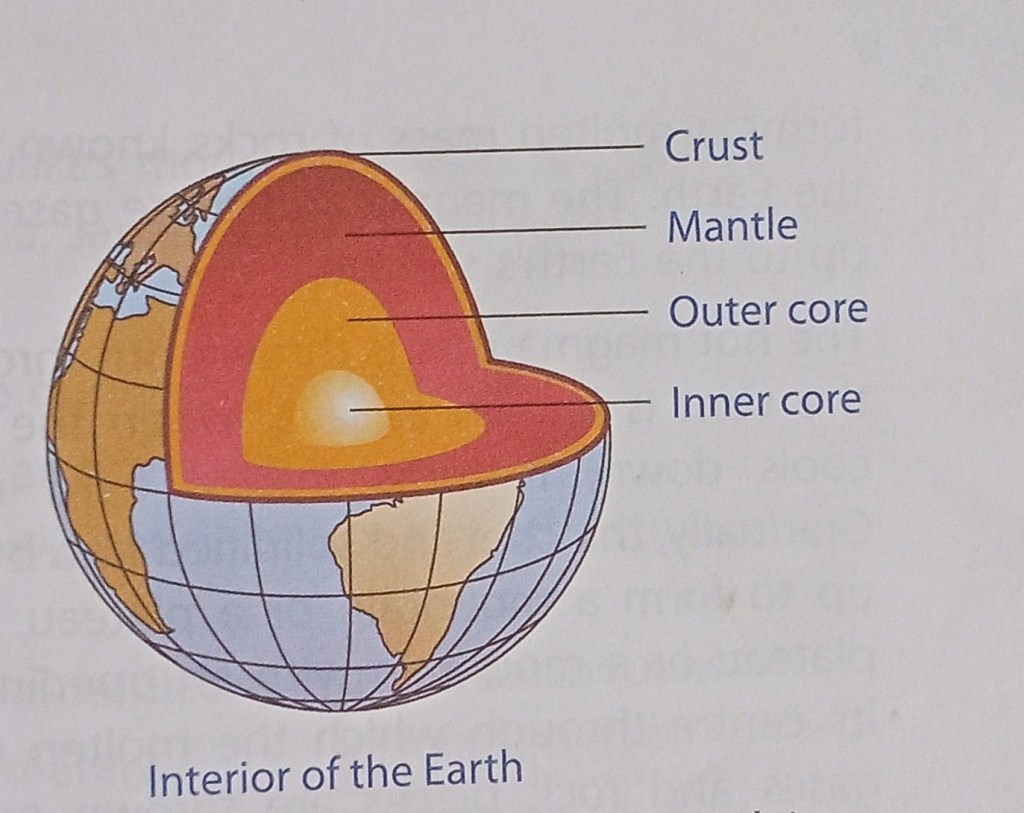
2. Crust – Top layer of the Earth ✅
3. Lava – Hot magma that comes out of the volcano ✅
4. Focus – The place where the effect of an earthquake is maximum ✅
Section B: Fill in the blanks
1. The surface of the Earth is made of 29% land and 71% water. ✅
2. Nearly 200 million years ago, all the landmasses formed a supercontinent known as Pangaea. ✅
3. The metals nickel and iron make up the core of the Earth. ✅
4. A tsunami is a series of underwater waves. ✅
Section C: Answer the following questions
1. What is Continental Drift Theory? Continental Drift Theory was given by Alfred Wegener. It states that all the continents were once joined together as a single landmass called Pangaea, and they slowly drifted apart over millions of years.
2. Write a note on the exterior of the Earth. The exterior of the Earth is called the crust. It is the outermost and thinnest layer of the Earth. It includes land (continents) and ocean floors and is made up of solid rocks and minerals.
3. Compare slow changes and rapid changes. Give their examples.
Slow changes happen over a long period of time. Example: Mountain formation, weathering.
4. What is a volcano? A volcano is an opening in the Earth’s surface through which hot magma, gases, and ash come out. When the magma reaches the surface, it is called lava.
5. How does an earthquake occur? An earthquake occurs when there is a sudden movement or shaking of the Earth’s crust. This happens due to the release of energy from the Earth’s interior, usually along faults or cracks in the crust.
Section D: Give reasons
1. The core of the Earth is known as NiFe. The core is made up mainly of two metals – Nickel (Ni) and Iron (Fe). That is why it is called NiFe.
2. Famine is a major consequence of droughts. During droughts, there is very little or no rainfall for a long time. This causes crops to fail, which leads to a shortage of food. This condition is called famine.
3. Floods are quite common in India. Floods are common in India because many parts of the country receive heavy rainfall during the monsoon. Rivers overflow, and water spreads over large areas, causing floods.
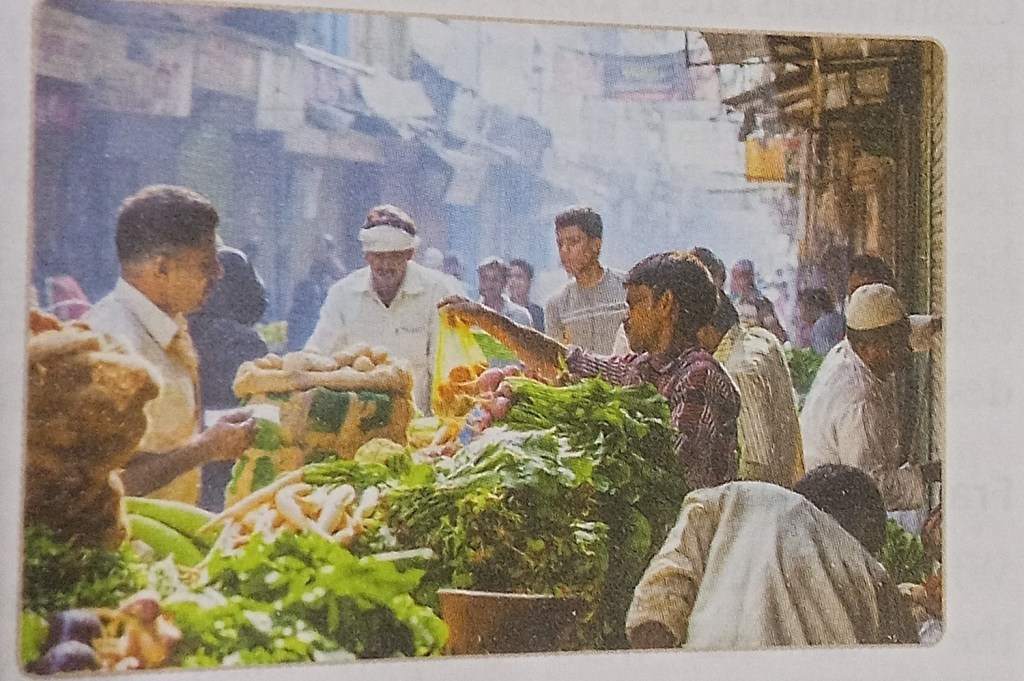
1. What is a market? Answer: A market is a place where goods and services are exchange between buyers and sellers.
2. Who are the people involved in a market? Answer: The people involved in a market include buyers, sellers, traders, vendors, and consumers.
3. What is a wholesale market? Answer: A wholesale market is a place where goods are sold in large quantities, usually to retailers or businesses at lower prices.
4. What is a retail market? Answer: A retail market is where goods are sold directly to consumers in small quantities for personal use.
5. Who are vendors? Answer: Vendors are people who sell goods, often on streets, in markets, or door-to-door, buses, and traffic signals.
F. Short Answer Type Questions (50–60 words)
1. Describe departmental stores. Answer: Departmental stores are large retail establishments that offer a wide range of products under one roof. They are divided into various sections or departments, each selling a specific type of product, such as clothing, electronics, groceries, etc., for consumer convenience.
2. What do you understand by speciality markets? Answer: Speciality markets are markets that focus on a specific type of product, such as electronics, books, jewellery, or handicrafts. These markets cater to a particular need or interest of customers, offering variety and expertise in that category.
3. Explain franchise outlets. Answer: Franchise outlets are stores operated by individuals or groups under the brand name of a larger company. The franchisee sells products or services following the company’s established rules, ensuring uniform quality and branding.
4. Discuss who benefits from online shopping. Answer: Consumers benefit from online shopping as it offers convenience, a wide range of choices, home delivery, and competitive prices. Sellers also benefit by reaching more customers and reducing overhead costs.
5. Examine the importance of advertisement. Answer: Advertisement is important as it informs consumers about products and services, persuades them to buy, and creates brand awareness. It helps companies reach a wide audience and influences purchasing decisions.
G. Long Answer Type Questions (80–100 words)
1. Elaborate on the factors that influence the functioning of wholesale markets. Answer: Wholesale markets are influenced by factors such as demand and supply, transportation facilities, storage and warehousing, government policies, and pricing mechanisms. Efficient logistics and communication systems also play a vital role. Wholesale markets function effectively when there is a strong network of buyers and sellers, availability of quality goods, and competitive pricing.
2. Write about different types of retailers. Answer: Retailers can be classified into different types: departmental stores, chain stores, supermarkets, specialty stores, convenience stores, online retailers, and street vendors. Each type has a unique way of operating, catering to different customer needs, and varying in size, product range, and pricing.
3. What are the factors that help us to choose a market? Answer: Factors include product availability, pricing, location, quality, variety, reputation, customer service, and convenience. People may also consider cleanliness, safety, and parking availability when choosing a market.
4. Markets play an important role in our lives. Explain. Answer: Markets are essential for economic activity. They provide goods and services, create employment, support business growth, and ensure the circulation of money. Markets help producers sell their products and allow consumers to get what they need. They also support trade and influence lifestyle and consumption patterns.
H. Higher-Order Thinking Skills
1. Has online shopping affected small traders? Think and answer. Yes, online shopping has affected small traders by reducing their customer base as many people prefer the convenience and discounts of online purchases. However, some small traders have adapted by selling online.
2. How do you think all franchise outlets of a company are able to maintain the standard of the product or service? Answer: Franchise outlets follow strict guidelines set by the parent company regarding quality, service, pricing, and branding. Regular training, audits, and standardized supply chains help maintain uniformity across outlets.
(a) Diwani (iii) Right to collect land revenue (b) “Tiger of Mysore” (i) Tipu Sultan
(c) faujdari adalat. . (iv) criminal court (d) Rani Channamma (v) Led an anti-British
movement in Kitoor
(e) sipahi. (iii) Sepoy
—
2. Fill in the blanks:
(a) The British conquest of Bengal began with the battle of Plassey.
(b) Haidar Ali and Tipu Sultan were the rulers of Mysore.
(c) Dalhousie implemented the Doctrine of Lapse.
(d) Maratha kingdoms were located mainly in the western part of India.
—
3. State whether true or false:
(a) The Mughal Empire became stronger in the eighteenth century. – False
(b) The English East India Company was the only European company that traded with India. – False
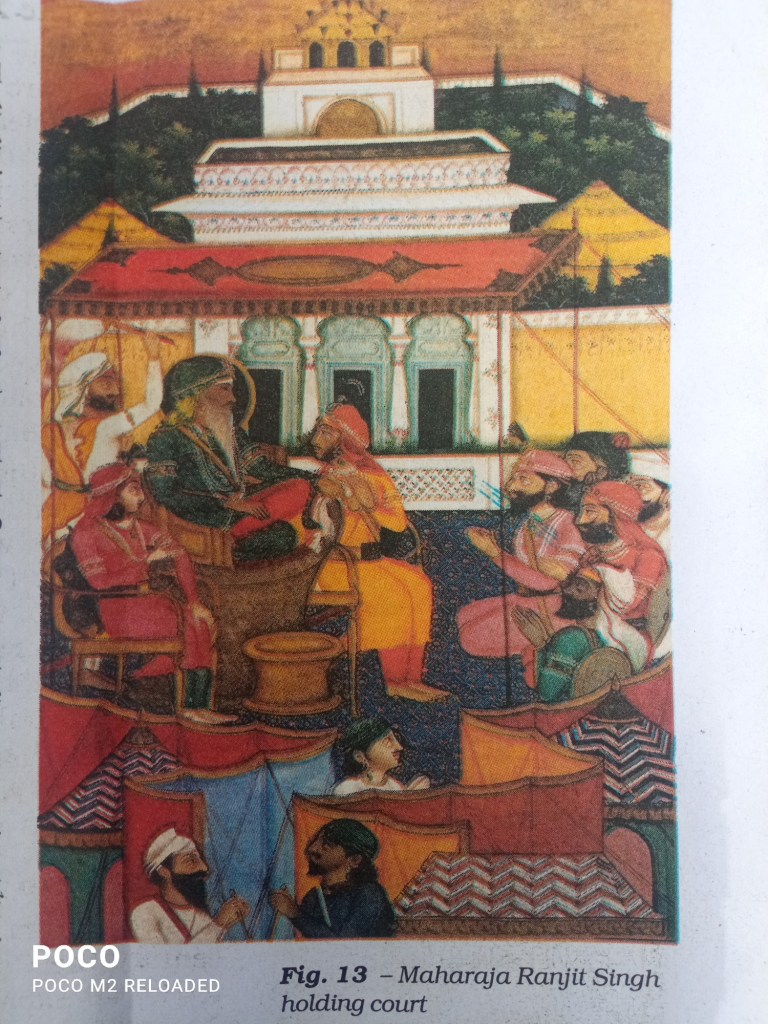
(c) Maharaja Ranjit Singh was the ruler of Punjab. – True
(d) The British did not introduce any administrative changes in the territories they conquered. – False
—
Let’s Discuss
4. What attracted European trading companies to India? Answer — India was rich in spices, cotton, silk, indigo, and other goods that were in great demand in Europe. These products could be bought at low prices in India and sold at high prices in Europe, offering great profits.
5. What were the areas of conflict between the Bengal nawabs and the East India Company?
Answer — The areas of conflict between the bangle nawab and the East India company where as follows (i)The nawabs opposed the Company’s efforts to expand trade privileges and refuse to pay taxes.
(ii) The Company demanded large concessions and refused to pay duties.
(iii) The nawabs accused the Company of dishonesty in trade.
(iv)The Company wanted political control, which threatened the nawabs’ authority.
6. How did the assumption of Diwani benefit the East India Company? Answer — The Diwani (right to collect revenue) gave the Company control over Bengal’s financial resources. It allowed them to use Indian revenues to finance trade and maintain their army and administration.
7. Explain the system of “subsidiary alliance”. Answer — The system meant Indian rulers had to:
(a)Keep British forces in their territory.
(b) Pay for their maintenance.
(c) Not enter alliances or declare war without British permission. In return, they received British “protection.” If they failed to comply, they had to cede territory.
8. In what way was the administration of the Company different from that of Indian rulers?
Answer — The Company ruled to serve its own economic and political interests.
Indian rulers ruled as sovereigns with some traditional legitimacy.
The Company implemented new systems of land revenue, justice, and policing that were more bureaucratic and extractive.
9. Describe the changes that occurred in the composition of the Company’s army.
Answer — The Mughal-style cavalry was replaced with European-style infantry.
Indian soldiers were trained in British drill and discipline.
1. Why are resources distributed unequally over the earth? Answer -Resources are not the same everywhere because different places have different landforms, climates, and people. That is why some places have more resources than others.
2. What is resource conservation? Answer – Resource conservation means using resources carefully and not wasting them, so they last for a long time.
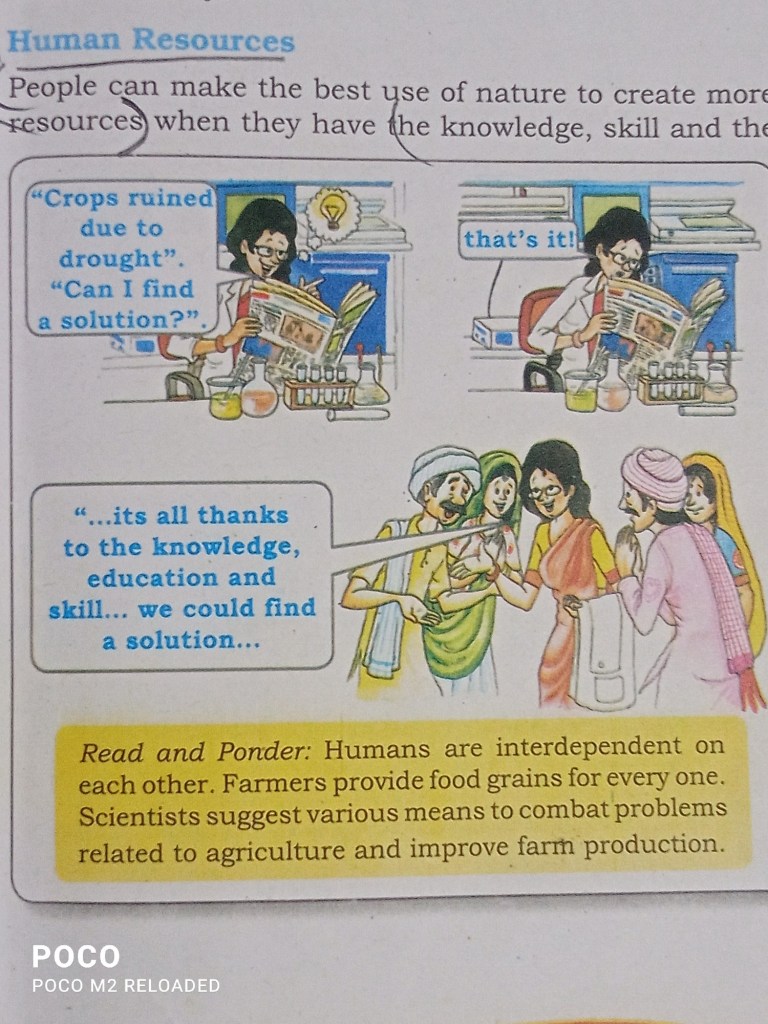
3. Why are human resources important? Answer – Human resources are important because people have knowledge and skills. They can use other resources wisely to make new things.
4. What is sustainable development? Answer – Sustainable development means using resources in such a way that we meet our needs now, without harming the needs of future generations.
Extra Questions and Answers:
1. What is a resource? Answer – A resource is anything that is useful to us and helps to satisfy our needs.
2. What are human-made resources? Answer – Resources that are made by humans using natural resources are called human-made resources. Examples: Roads, buildings, machines.
3.What is a renewable resource? Answer – A renewable resource is one that can be used again and again because it can be replaced naturally. Examples: Sunlight, wind.
4. What is a non-renewable resource? Answer – A non-renewable resource is one that cannot be replaced easily. Once it is used, it is gone forever. Examples: Coal, oil.
5.What are human resources? Answer – People who use their skills, knowledge, and ideas to create and use resources are called human resources.
6. What is the meaning of utility? Answer – Utility means usefulness. If something is useful, it has utility.
7.. Why should we conserve resources? Answer – We should save resources so that they don’t finish and future generations can also use them.
8. What does the word ‘value’ mean in terms of resources? Answer- Value means the worth or importance of a resource. It can be in terms of money or how useful it is.
(a) James Mill divided Indian history into three periods – Hindu, Muslim, Christian. False (James Mill divided it into Hindu, Muslim, and British periods.)
(b) Official documents help us understand what the people of the country think. False (They only reflect what the officials thought was important.)
(c) The British thought surveys were important for effective administration. True
2. What is the problem with the periodisation of Indian history that James Mill offers? Answer: James Mill’s periodisation—Hindu, Muslim, British—is problematic because it is based on religion and ignores the diversity and richness of Indian society. It reflects a Eurocentric view that portrays earlier periods as backward and suggests that only the British brought progress.
3. Why did the British preserve official documents? Answer: The British believed that writing and maintaining official records was essential for proper and effective administration. They documented every instruction, plan, decision, and policy to ensure control and accountability in governance.
4. How will the information historians get from old newspapers be different from that found in police reports? Answer: Old newspapers may reflect public opinion, social issues, and everyday events from different perspectives. Police reports, on the other hand, mainly document law-and-order situations, crimes, and administrative concerns. Newspapers provide a broader view, while police reports are limited in scope.
Extra Questions and Answers:
Q1. Who was Warren Hastings and what was his significance in British India? A: Warren Hastings was the first Governor-General of India, appointed in 1773. He played a crucial role in establishing British control and administration in India.
Q3. What was James Mill’s view of Indian society before British rule? A: James Mill believed that Indian society under Hindu and Muslim rulers was backward, full of religious intolerance, caste-based discrimination, and superstitions. He thought that British rule would civilize India.
—
Q4. Why do historians divide history into periods? A: Historians divide history into periods to better understand and explain the characteristics of different eras. It helps in organizing historical events in a meaningful way.
Q5. What is meant by the term ‘colonial’? A: The term ‘colonial’ refers to the period when one country controls another and establishes political, economic, and cultural domination. In Indian history, it refers to the British rule over India and how they restructured every aspect of Indian life.
Q6. Why are official records not enough to understand history? A: Official records reflect only the viewpoint of British officials and what they thought was important. They ignore the voices of ordinary people, their experiences, and opinions, which are also vital to understanding the past.

 Site 𝓝𝓲𝓻𝓾'𝓼𝓫𝓵𝓸𝓰